1.6 - Rusting
Corrosion of Metals
- Corrosion is a redox process in which a metal is oxidised spontaneously when its atoms release electrons to form metal ions: .
- Rusting is the corrosion of iron. Both water and oxygen are required; salts and acids increase the rate by improving electrical conduction.
- Aluminium, zinc, lead, nickel and chromium form compact oxide layers that protect the underlying metal. Rust is porous and flakes off, continually exposing fresh iron.
Experiment 1D — corrosion of copper and iron
- Aim: Study corrosion of copper and iron.
- Problem statement: Do copper and iron undergo corrosion?
- Hypothesis: Copper corrosion produces a blue precipitate; iron corrosion produces a brown precipitate.
- Variables: type of metal; presence and colour of precipitate; salt solution kept constant.
- Materials: copper wire, iron wire and the salt/alkali solutions below.
- Apparatus: Test tubes, test-tube rack, sandpaper, beaker, tripod, wire gauze and Bunsen burner.
- Procedure:
- Clean the wires with sandpaper, coil them and place in separate test tubes.
- Mix of sodium chloride, of potassium chloride and of sodium hydroxide; heat the mixture.
- Cover both wires with the mixture and leave for three days.
- Results: Copper produces a blue precipitate; iron produces a brown precipitate. Both metals undergo corrosion.
- Metal atoms are oxidised and dissolved oxygen is reduced to . Copper ions form blue copper(II) hydroxide; iron corrosion ultimately gives brown hydrated iron(III) oxide.
Rusting as a Redox Reaction
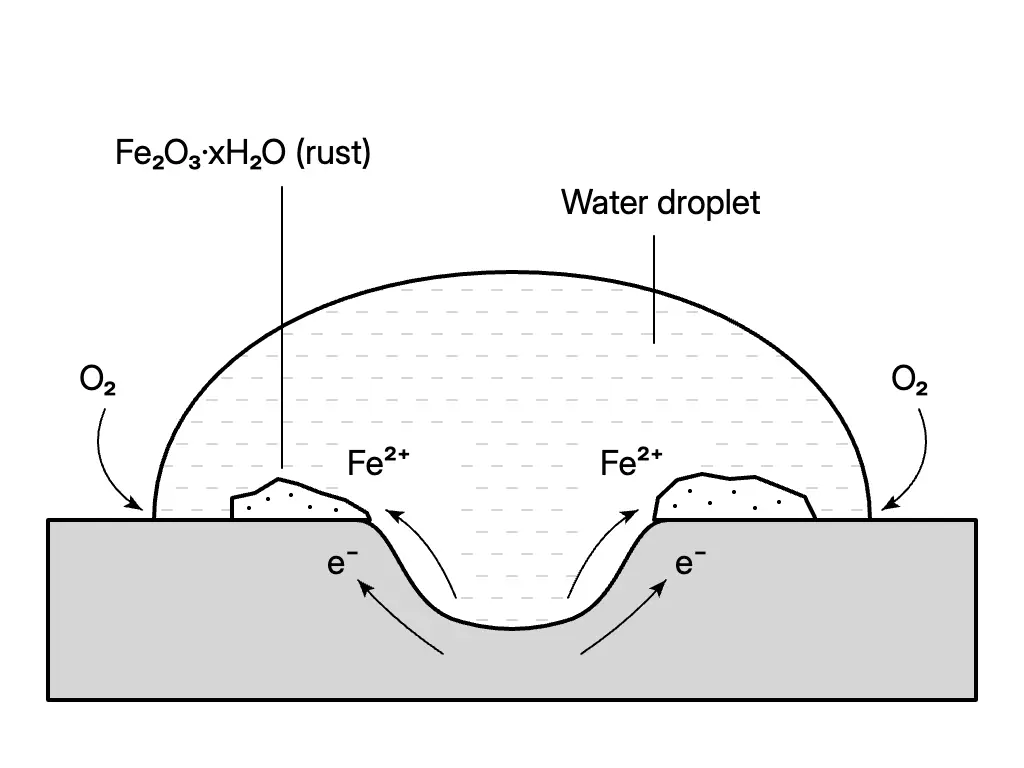
Different regions on wet iron act as tiny electrodes: the centre of a water droplet has less oxygen and forms the anode; the edge has more oxygen and forms the cathode.
At the anodic region, iron is oxidised:
Electrons move through the iron to a cathodic region, where oxygen is reduced:
and form iron(II) hydroxide, which is further oxidised to hydrated iron(III) oxide, , or rust.
Formation of iron(II) hydroxide: . In rust, has variable integer values.
Iron is the reducing agent; oxygen is the oxidising agent.
Effect of Contact with Other Metals
- When iron contacts a more electropositive metal such as Mg, Al or Zn, that metal releases electrons and is oxidised in preference to iron. Rusting of iron slows or stops.
- When iron contacts a less electropositive metal such as Sn, Pb or Cu, iron becomes the anodic metal, loses electrons more readily and rusts faster.
Experiment 1E — effects of other metals
- Problem: How do different metals in contact with iron affect rusting?
- Hypothesis: A more electropositive metal protects iron; a less electropositive metal accelerates rusting.
- Aim: Study the effects of other metals on rusting.
- Variables: Manipulated = metal coiled around iron; responding = rusting of iron; fixed = iron nail.
- Materials: Agar, phenolphthalein, potassium hexacyanoferrate(III), iron nails, magnesium ribbon, tin, zinc and copper strips.
- Apparatus: Test tubes, rack and sandpaper.
- Procedure:
- Clean five iron nails and the four metals with sandpaper. Coil one nail with each metal; leave the fifth nail uncoiled as the control.
- Place the nails in separate test tubes and completely immerse them in hot agar containing potassium hexacyanoferrate(III) and phenolphthalein.
- Leave for one day and examine the colours.
- Precaution: Potassium hexacyanoferrate(III) solution is poisonous.
- Blue colour indicates formation; pink indicates formation. Colour locations identify oxidation and reduction regions.
Preventing Rusting
Barrier protection isolates iron from water and oxygen: paint, oil or grease, and plastic coating. Damage to the coating exposes iron.
Coating with another metal:
- galvanising with zinc protects by a barrier and by sacrificial action even if scratched;
- tin plating is a barrier, but scratched tin exposes iron beside a less electropositive metal and can accelerate rusting.
Chrome plating protects items such as car bumpers, bicycles and decorative objects.
Sacrificial protection: connect iron or steel structures to a more electropositive metal such as magnesium or zinc. The sacrificial metal corrodes instead and must be replaced periodically.
Sacrificial protection is used on bridge pillars, ship hulls and underground pipes; magnesium protects iron pipes and zinc blocks protect ship hulls.
Alloying: stainless steel contains iron alloyed with carbon, chromium and nickel. Its protective oxide layer resists corrosion; it is used for cutlery and surgical instruments.
Answer practice questions to test your knowledge
Practice