1.5 - Extraction of Metal from Its Ore
Choosing an Extraction Method
Very unreactive metals may occur naturally as elements.
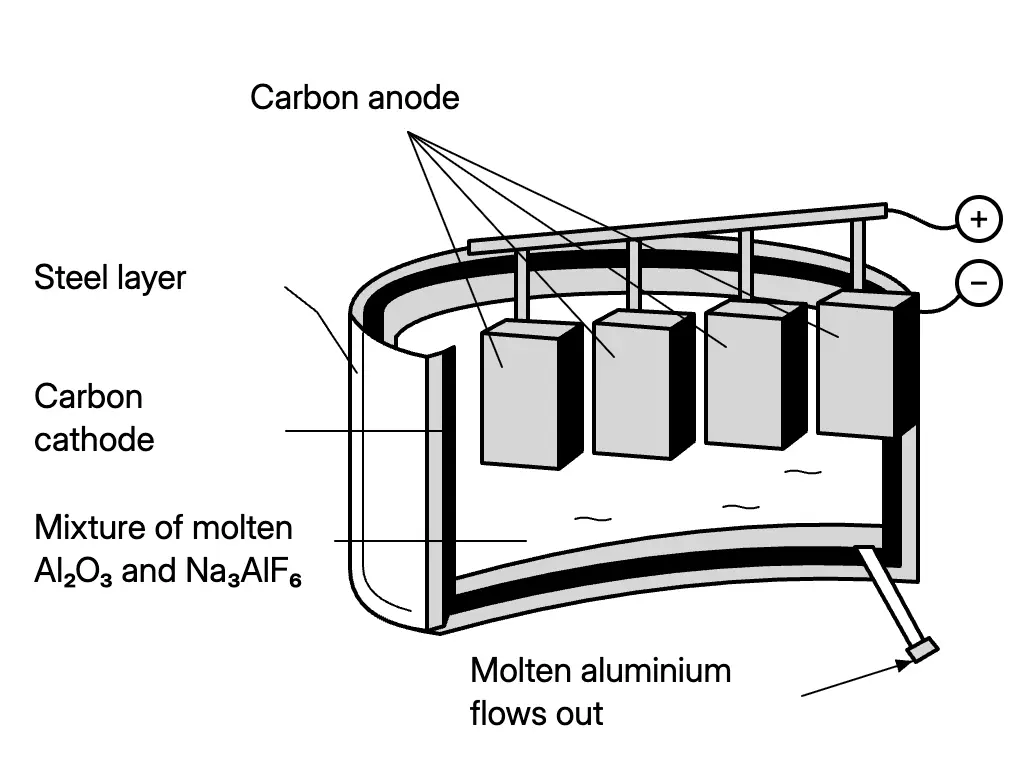
Metals more reactive than carbon, such as aluminium, are extracted by electrolysis of molten compounds.
Metals less reactive than carbon, such as iron, can be extracted by reduction with carbon or carbon monoxide.
Ores are metal-containing compounds found with rocks and soil, commonly oxides, sulphides or carbonates. Gold and silver can occur as elements.
The reactivity series guides extraction: K, Na, Mg and Al by electrolysis; Zn, Fe, Sn and Pb by carbon reduction; less reactive Cu and Hg by direct heating in air; Ag and Au occur as elements.
Aluminium by Electrolysis
- Bauxite is purified to aluminium oxide, (alumina).
- Alumina melts near , so molten cryolite, , is added to lower the operating temperature and energy demand.
- Cathode: ; molten aluminium sinks and is tapped off.
- Anode: ; oxygen reacts with carbon anodes to form carbon dioxide, so the anodes wear away.
- The process consumes much electricity, produces and bauxite purification produces toxic red mud. Recycling aluminium is 95% more efficient than extraction from bauxite and reduces these impacts.
Iron in a Blast Furnace
Hematite, , is heated with coke, , and limestone, .
Other iron ores include magnetite, ; iron pyrite, ; and siderite, .
Zone 1: Coke combustion is exothermic and raises the furnace temperature to about .
Zone 2: Carbon dioxide reacts with coke to form carbon monoxide; this endothermic reaction lowers the temperature.
Zone 3: Coke and carbon monoxide reduce iron(III) oxide to molten iron. Direct carbon reduction is .
Coke burns and generates the reducing agent carbon monoxide:
Carbon monoxide reduces iron(III) oxide:
Limestone decomposes: .
Basic calcium oxide removes acidic silicon(IV) oxide impurity as molten slag:
Denser molten iron collects below the slag and both layers are tapped separately.
Other Extraction Routes
- Less reactive metals can be extracted by heating their ores directly in air, while unreactive metals such as gold occur as elements.
- A metal oxide can also be reduced by a metal higher in the reactivity series. In the thermite reaction, aluminium reduces iron(III) oxide and produces enough heat to form molten iron for welding railway tracks:
- Chromium and titanium can similarly be extracted from their oxides using a more reactive metal.
Answer practice questions to test your knowledge
Practice