1.3 - Voltaic Cell
Structure and Energy Conversion
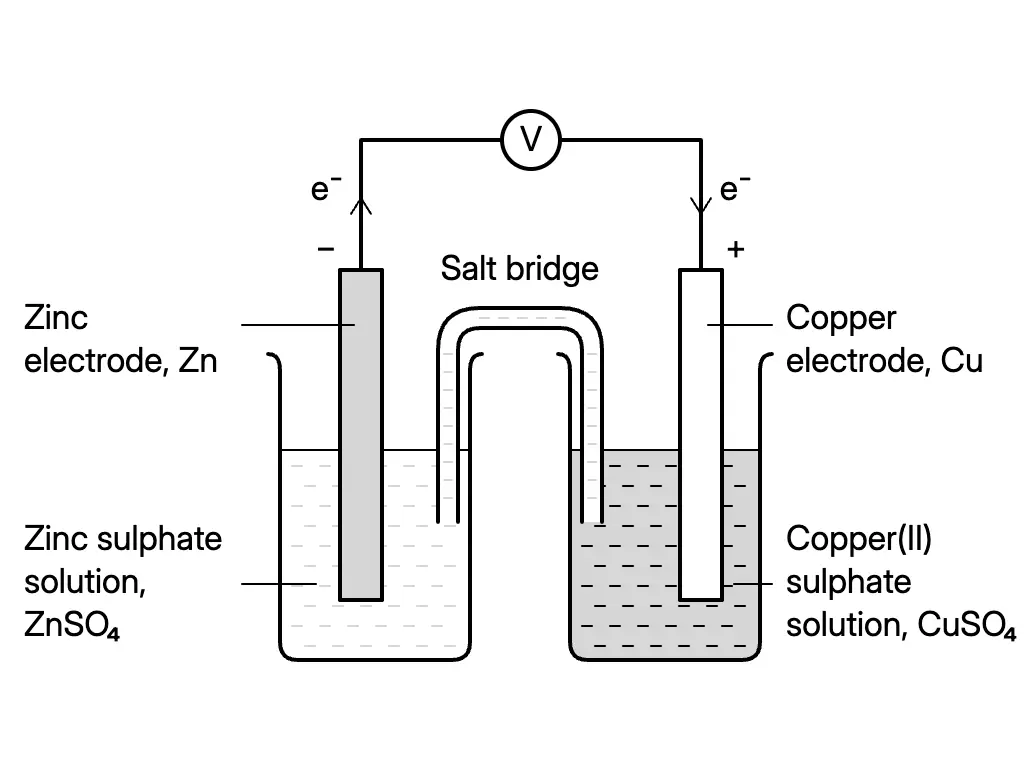
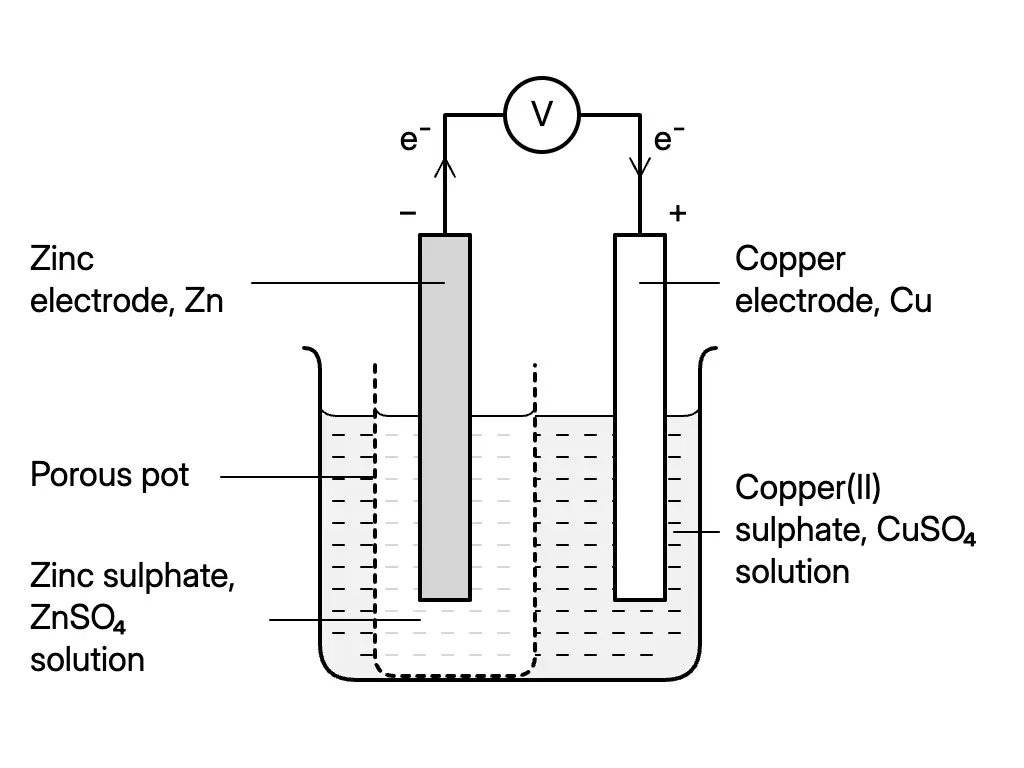
A voltaic cell or galvanic cell has two different electrodes connected through an external circuit and electrolytes that permit ion movement.
A spontaneous redox reaction converts chemical energy to electrical energy.
Oxidation occurs at the anode (negative terminal); reduction occurs at the cathode (positive terminal). Electrons flow through the wire from anode to cathode.
Two half-cells are joined by a salt bridge or separated by a porous pot so ions can move and electrical neutrality is maintained.
In the simple Mg/Cu cell with copper(II) chloride solution, magnesium is the anode: ; copper is the cathode: .
Conventional current flows through the external circuit from the positive terminal to the negative terminal, opposite to electron flow.
Daniell Cell and Cell Notation
- In a Daniell cell:
- anode: ;
- cathode: ;
- overall: .
- Cell notation places the anode on the left and cathode on the right. A single line separates phases; a double line represents the salt bridge or porous partition:
- With and :
- Use platinum as an inert electrode when a half-cell contains only ions or gases.
Experiment 1A — Voltage of a Voltaic Cell
Aim: Determine the voltage of a voltaic cell using different pairs of metals.
Problem statement: How do different metal pairs dipped in electrolytes affect cell voltage?
Hypothesis: The greater the difference between the metals’ values, the greater the voltage.
Variables:
- manipulated: pair of metals;
- responding: voltage reading;
- fixed: volume and concentration of electrolytes.
Operational definition of a chemical cell: The voltmeter gives a reading when two different metals are dipped into electrolytes.
Materials: Different metal plates and suitable metal-salt solutions of .
Apparatus: Sandpaper, voltmeter and connecting wires with crocodile clips, with apparatus suitable for a simple cell or two half-cells.
Measurements: Cell voltage, negative terminal (anode) and positive terminal (cathode) for each metal pair in a simple cell or two connected half-cells.
Relationship: The larger the difference in electrode potentials, the larger the cell voltage; .
Answer practice questions to test your knowledge
Practice