1.2 - Standard Electrode Potential
Half-cells and Standard Conditions
A half-cell consists of an electrode in contact with an electrolyte containing its ions. Electrode potential is the potential difference established at equilibrium between a metal and a solution containing its ions. A single electrode potential cannot be measured directly; it is measured against a reference half-cell.
Standard electrode potential, , is measured relative to the standard hydrogen electrode under:
- ion concentration ;
- gas pressure or ;
- temperature or ;
- an inert platinum electrode when the half-cell has no conducting solid electrode.
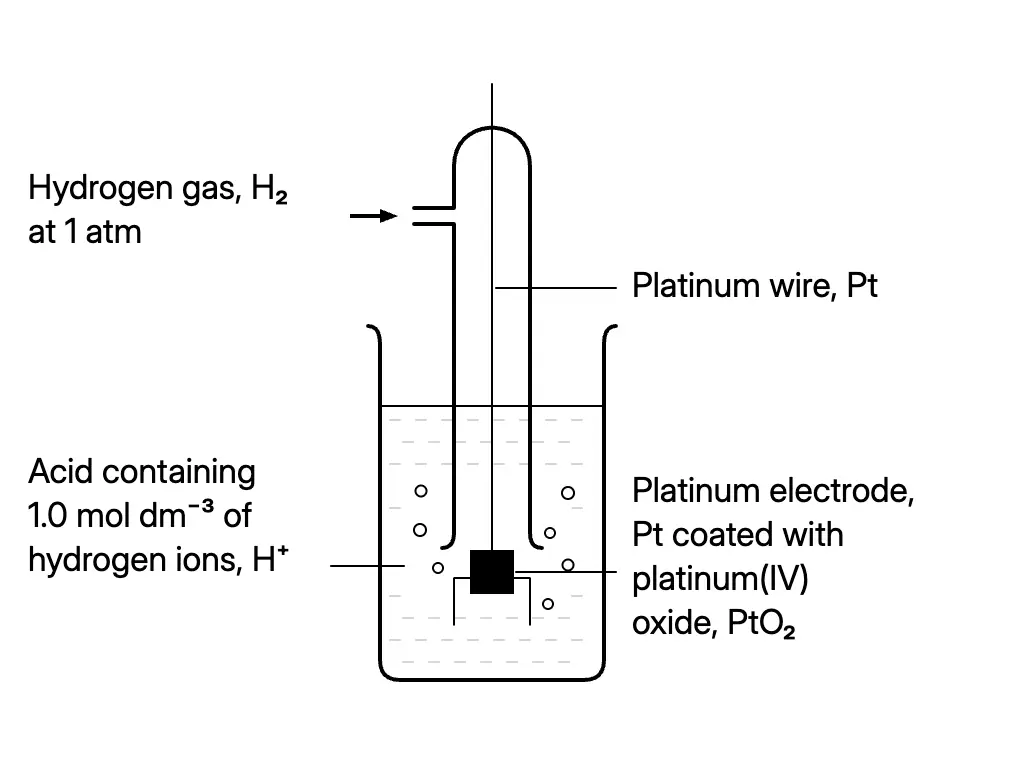
The standard hydrogen electrode uses platinum, hydrogen gas at and solution. Its value is defined as:
A salt bridge completes the circuit and maintains electrical neutrality through ion movement.
The hydrogen electrode’s platinum(IV) oxide coating increases its surface area for adsorption of hydrogen and contact with hydrogen ions.
For zinc, connect a zinc electrode in zinc-ion solution to the hydrogen electrode through a salt bridge containing saturated potassium nitrate. The voltmeter reads ; electrons flow from zinc to platinum.
Standard Electrode Potential Series
- Every half-equation in the series is written as a reduction.
- measures a species’ tendency to accept or release electrons:
- more positive greater tendency to accept electrons, undergo reduction and act as a stronger oxidising agent;
- more negative greater tendency of the reduced form to release electrons, undergo oxidation and act as a stronger reducing agent.
- Example: has . Against the standard hydrogen electrode, zinc is the negative terminal and is oxidised.
- To predict a spontaneous redox reaction, select the half-cell with the more positive for reduction and reverse the other half-equation for oxidation. Balance electrons before adding the equations.
Standard Reduction Potentials
| Reduction half-equation | / V (298 K) |
|---|---|
- Copper reacts with silver nitrate: , because is more positive than . Silver ions are the oxidising agent; copper is the reducing agent.
- Copper does not displace magnesium from magnesium nitrate: , so magnesium ions are a weaker oxidising agent than copper(II) ions.
Answer practice questions to test your knowledge
Practice