6.7 - Neutralisation
Meaning and Ionic Equation
- Neutralisation is a reaction between an acid and an alkali or base to produce salt and water only.
- and are spectator ions. The net ionic equation is:
Applications
- Medicine: milk of magnesia, , neutralises excess stomach acid.
- Hair care: weak alkali in shampoo neutralises acid on hair.
- Dental care: a base in toothpaste neutralises lactic acid formed by mouth bacteria.
- Agriculture: slaked lime, , treats acidic soil.
- Neutralisation is used to manufacture fertilisers such as ammonium nitrate and potassium sulphate; urea is produced from ammonia and carbon dioxide.
Acid–Base Titration
- Titration quantitatively determines the volume of acid required to neutralise a measured volume of alkali, or vice versa.
- The end point is when the acid–base indicator changes colour.
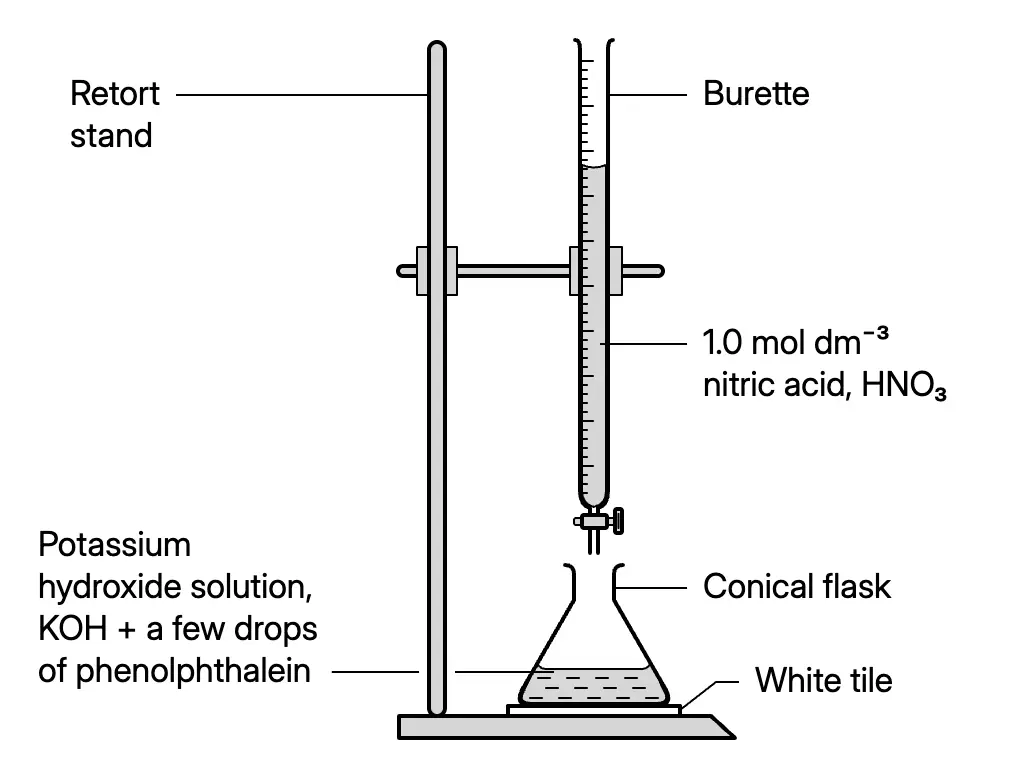
Determine unknown concentration:
- Rinse a pipette with , then transfer exactly to a conical flask.
- Add a few drops of phenolphthalein and place the flask on a white tile.
- Rinse and fill a burette with ; record the initial reading at eye level.
- Add acid while swirling until the solution changes from pink to colourless; record a rough titre.
- Repeat, adding acid rapidly to within of the rough end point, then dropwise. Obtain concordant titres and calculate the average, excluding the rough result.
- Distilled water may wash flask walls because it changes concentration but not reacting moles.
| Indicator | Colours |
|---|---|
| Phenolphthalein | Acidic: colourless; neutral: colourless; alkaline: pink |
| Methyl orange | Acidic: red; neutral: orange; alkaline: yellow |
Neutralisation Calculations
For mol acid reacting with mol alkali :
Always balance the equation first and use its mole ratio.
If a reactant is given by mass, convert it to moles before applying the stoichiometric ratio.
and are acid and alkali molarities; and are their volumes in the same unit.
Example: of needs of , using the ratio.
Mass example: is . The equation requires acid. In , its molarity is .
Answer practice questions to test your knowledge
Practice6.1 - The Role of Water in Showing Acidic and Alkaline Properties6.2 - pH Value6.3 - Strength of Acids and Alkalis6.4 - Chemical Properties of Acids and Alkalis6.5 - Concentration of Aqueous Solution6.6 - Standard Solution6.7 - Neutralisation6.8 - Salts, Crystals and Their Uses in Daily Life6.9 - Preparation of Salts6.10 - Effect of Heat on Salts6.11 - Qualitative Analysis