6.11 - Qualitative Analysis
Purpose and Physical Observations
- Qualitative analysis identifies the cation and anion in a salt from its physical and chemical properties.
- Use evidence in sequence: colour and solubility → effect of heat and gas tests → anion and cation tests → confirmatory tests.
- Solubility narrows possibilities but does not itself confirm an ion.
- White soluble salts form colourless solutions. Transition-metal ions often give coloured salts or solutions:
| Ion | Typical solid/solution colour |
|---|---|
| Green solid; green or pale-green solution | |
| Brown solid; brown or yellowish-brown solution | |
| Blue nitrate/sulphate solution; green copper(II) chloride solid forming blue solution; green insoluble carbonate |
Evidence from Heating
A black residue suggests ; brown suggests ; yellow hot/white cold suggests ; brown hot/yellow cold suggests .
Cloudy limewater after heating suggests carbonate; brown acidic gas plus oxygen suggests nitrate; pungent alkaline gas suggests ammonium.
These are preliminary inferences and should be confirmed chemically.
A gas that rekindles a glowing splinter may indicate a nitrate or ; oxygen alone does not confirm nitrate.
Anion Tests
Experiment 6.9 — identifying anions:
- Aim: identify anions in aqueous salt solutions.
- Hypothesis: anions can be identified from chemical-test observations.
- Variables: anion type (manipulated), observations (responding), salt-solution volume (fixed).
- Materials: sodium carbonate, sodium chloride, sodium sulphate and sodium nitrate; distilled water, limewater and the test reagents listed below.
- Apparatus: test tubes, holder and rack, glass rod, dropper, stopper with delivery tube, spatula, beaker and measuring cylinder.
- Procedure:
- Dissolve each salt separately to make solution.
- Put portions in four separate test tubes for the four tests below.
- For carbonate, add of and pass any gas into limewater.
- For chloride, add excess , then of .
- For sulphate, add excess , then of .
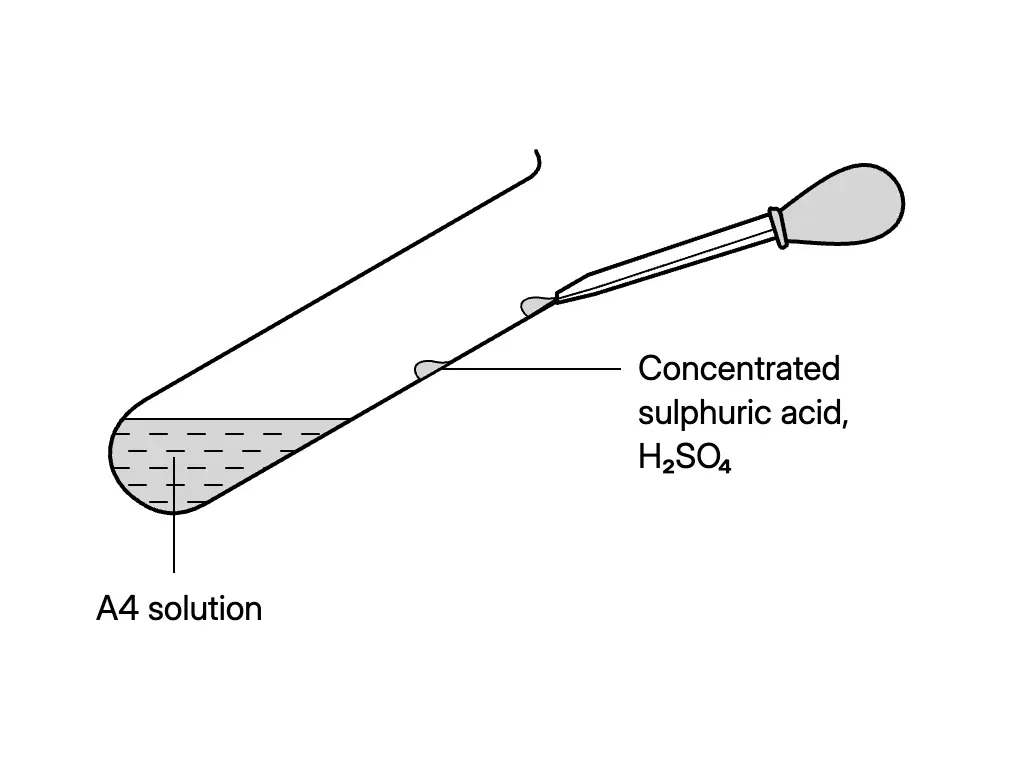
- For nitrate, add each of and ; shake. Tilt the tube, slowly add a few drops of concentrated along its wall and gently return it upright.
- Precautions: add concentrated acid carefully; silver nitrate stains skin brown.
- Conclusion: the characteristic observations identify the anions, as summarised below.
| Anion | Test / Positive observation / equation |
|---|---|
| Add dilute acid; pass gas into limewater; Effervescence; limewater turns cloudy. | |
| Acidify with excess dilute , then add ; White precipitate. | |
| Acidify with excess dilute , then add ; White precipitate. | |
| Add dilute and ; carefully add concentrated ; Brown ring of nitrosyliron(II) sulphate at the boundary |
- Acidification removes interfering carbonate ions before chloride or sulphate precipitation tests.
Cation Tests with Sodium Hydroxide and Ammonia
Experiment 6.10 — identifying cations:
- Aim: identify cations in aqueous solutions.
- Hypothesis: cations can be identified from chemical-test observations.
- Variables: cation type (manipulated), observations (responding), salt-solution volume (fixed).
- Materials: sodium hydroxide and ammonia; solutions of calcium, magnesium, aluminium, zinc and lead(II) nitrates, iron(II) sulphate, iron(III) chloride, copper(II) sulphate and ammonium nitrate.
- Apparatus: test tubes, holder and rack, dropper, beaker, red litmus paper, Bunsen burner and measuring cylinder.
- Use salt-solution portions. For the sodium-hydroxide test with no precipitate, heat and test the gas with moist red litmus; use a fresh portion for ammonia.
- Conclusion: compare precipitate colours and solubility in excess reagent to identify possible cations; use confirmatory tests where observations overlap.
Add a few drops of reagent, note precipitate colour, then add reagent in excess and note solubility.
| Cation | With / With |
|---|---|
| NaOH: White precipitate, insoluble in excess; NH₃: No precipitate | |
| NaOH: White precipitate, insoluble in excess; NH₃: White precipitate, insoluble in excess | |
| NaOH: White precipitate, soluble in excess; NH₃: White precipitate, insoluble in excess | |
| NaOH: White precipitate, soluble in excess; NH₃: White precipitate, soluble in excess to colourless solution | |
| NaOH: White precipitate, soluble in excess; NH₃: White precipitate, insoluble in excess | |
| NaOH: Green precipitate, insoluble in excess; NH₃: Green precipitate, insoluble in excess | |
| NaOH: Brown precipitate, insoluble in excess; NH₃: Brown precipitate, insoluble in excess | |
| NaOH: Blue precipitate, insoluble in excess; NH₃: Blue precipitate, soluble in excess to dark-blue solution | |
| NaOH: No precipitate; on warming, released turns moist red litmus blue. NH₃: No precipitate |
- Metal ions form hydroxide precipitates, for example:
Confirmatory Tests for Cations
Experiment 6.11 — confirming cations: the aim is to confirm , , and in aqueous solutions.
- To ammonium chloride solution, add a few drops of Nessler reagent.
- To iron(II) sulphate solution, add a few drops of potassium hexacyanoferrate(III), .
- To separate iron(III) chloride portions, add potassium hexacyanoferrate(II), , or potassium thiocyanate, .
- Mix lead(II) nitrate solution with potassium iodide solution. Add distilled water, heat, then cool.
- Conclusion: the characteristic observations below confirm the corresponding ions.
| Ion | Confirmatory reagent / Observation |
|---|---|
| Nessler reagent; Brown precipitate | |
| ; Dark-blue precipitate | |
| ; Dark-blue precipitate | |
| ; Blood-red solution | |
| ; Yellow precipitate; dissolves in hot water and recrystallises on cooling |
distinguishes from : lead gives the yellow precipitate, aluminium gives none.
with gives a light-blue precipitate; with gives a greenish-brown colour. These differ from the dark-blue positive tests above.
Systematic Analysis of an Unknown Salt
- Observe the solid’s colour.
- Heat a small portion and test any gas; observe residue colours while hot and cold.
- Add distilled water to another portion and test solubility and solution colour.
- If soluble, divide the solution into fresh portions for cation and anion tests.
- If insoluble in water, add dilute nitric acid to obtain an aqueous solution for ion tests.
- Use preliminary results to select confirmatory tests; never identify the salt from one ambiguous observation.
Answer practice questions to test your knowledge
Practice