6.10 - Effect of Heat on Salts
Gas Tests
| Gas | Confirmatory observation |
|---|---|
| Rekindles a glowing wooden splinter | |
| Burns with a pop near a lighted splinter | |
| Turns limewater cloudy | |
| Turns moist red litmus blue; forms white fumes with concentrated | |
| Bleaches moist blue litmus after first turning it red | |
| Forms white fumes of with concentrated ammonia | |
| Decolourises acidified ; changes acidified from orange to green | |
| Brown acidic gas; turns moist blue litmus red |
- Precaution: carry out gas-generation tests in a fume chamber.
- Litmus must be moist so a gas can dissolve and produce the ions responsible for acidic or alkaline properties.
Heating Carbonate Salts
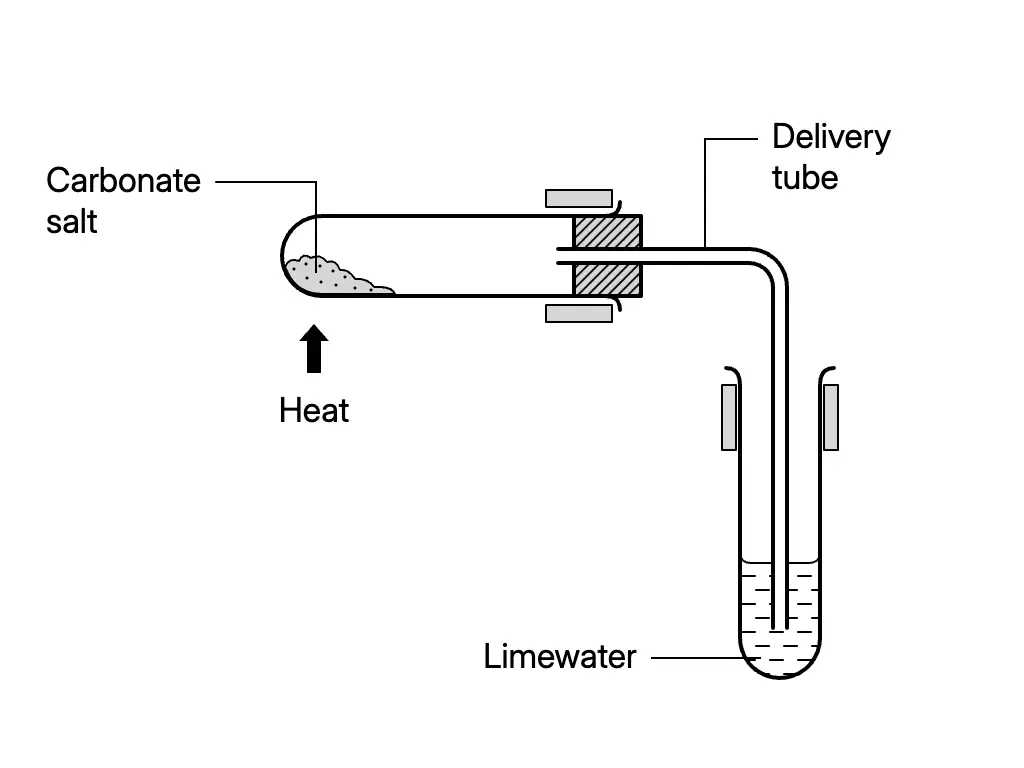
Experiment 6.7 — aim: investigate the effect of heat on carbonate salts.
Hypothesis tested: all carbonate salts decompose on heating to release carbon dioxide.
Variables: carbonate type (manipulated), decomposition products (responding), two spatulas of salt (fixed).
Apparatus: test tubes, boiling tube, holder, Bunsen burner and stopper with delivery tube.
Procedure:
- Put two spatulas of salt in a dry boiling tube and note its colour.
- Connect the delivery tube with its other end in limewater.
- Heat strongly and observe limewater and residue colours while hot and after cooling.
- Repeat for each carbonate salt.
Materials: two spatulas each of , , , and , and limewater.
Most metal carbonates decompose to a metal oxide and :
- Conclusion: sodium and potassium carbonates do not decompose under these conditions, so the hypothesis that all carbonates decompose is rejected.
Heating Nitrate and Other Salts
Experiment 6.8: Heat sodium, magnesium, zinc, lead(II) and copper(II) nitrates; test gases using moist blue litmus and a glowing splinter.
- Aim and apparatus: investigate nitrate heating using a boiling tube, test tube holder, Bunsen burner and spatula.
- Compare salt colour before heating, residue colour hot and cold, gas colour, and the gas’s effect on moist blue litmus and a glowing wooden splinter.
- Most nitrates form metal oxide, brown and :
- Only some sulphates and chlorides decompose on heating; examples include , and .
| Observation after heating | Inference |
|---|---|
| released | Carbonate ion may be present |
| and released | Nitrate ion may be present |
| released | Ammonium ion may be present |
| Residue yellow hot, white cold | ; may be present |
| Residue brown hot, yellow cold | ; may be present |
| Residue black hot and cold | ; may be present |
Answer practice questions to test your knowledge
Practice6.1 - The Role of Water in Showing Acidic and Alkaline Properties6.2 - pH Value6.3 - Strength of Acids and Alkalis6.4 - Chemical Properties of Acids and Alkalis6.5 - Concentration of Aqueous Solution6.6 - Standard Solution6.7 - Neutralisation6.8 - Salts, Crystals and Their Uses in Daily Life6.9 - Preparation of Salts6.10 - Effect of Heat on Salts6.11 - Qualitative Analysis