5.5 — Palm Oil
Structure of Oil Palm Fruit and Oil Quantity
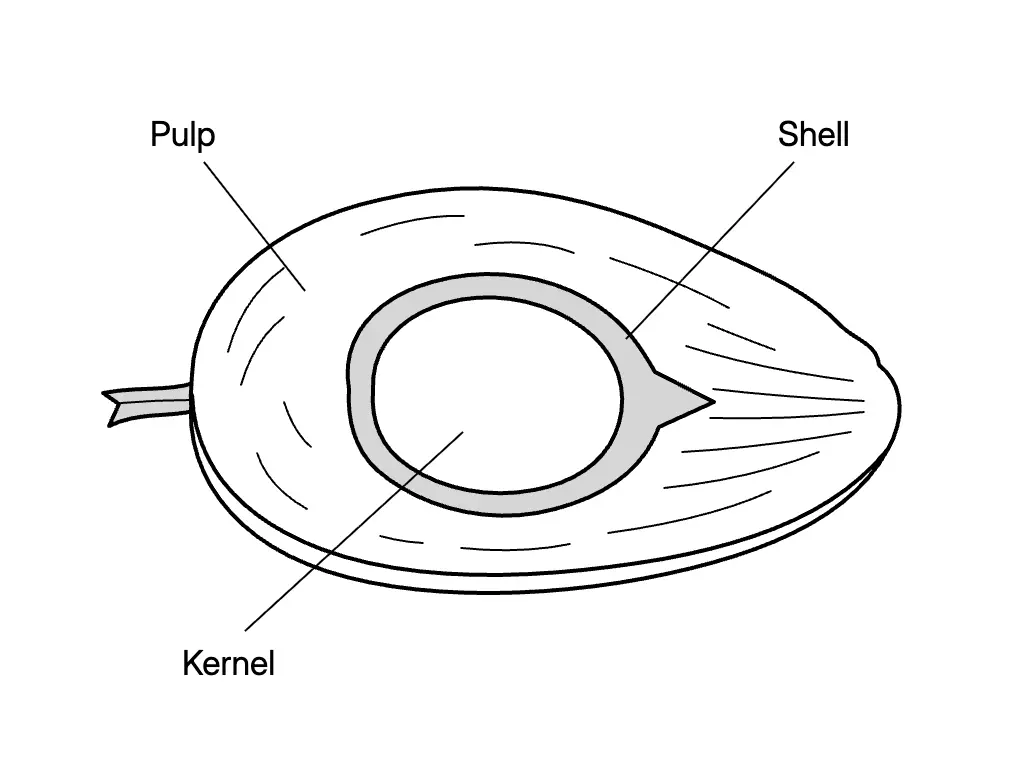
- An oil palm fruit has three parts:
- Pulp (mesocarp): contains the most palm oil.
- Kernel: contains the best-quality palm kernel oil.
- Shell (endocarp): contains no oil.
Activity 5.9 — Extracting oil from pulp and kernel
- Materials: 10 oil palm fruits.
- Apparatus: forceps, knife, magnifying glass, press, Bunsen burner, tripod stand, wire gauze and white tile.
- Cut one fruit cross-sectionally; sketch and label the pulp, shell and kernel.
- Wash all fruits and boil them in water for 20 minutes.
- Separate the pulp from the shell; squeeze the pulp with a press and collect the palm oil.
- Cut open the shell, remove the kernel and press it to obtain palm kernel oil.
- Compare the quantity and colour of oil extracted from the pulp and kernel.
Industrial Extraction of Palm Oil
- Sterilisation
- Sterilise whole bunches with steam at high pressure and high temperature.
- Heat kills bacteria and fungi that can spoil the fruits.
- Steam softens the pulp and makes fruits easier to remove from the bunch.
- Threshing
- Detach fruits from the bunches in a threshing machine.
- Digestion
- Reheat fruits at high temperature and pound them with rotating beater arms.
- Separate pulp from shell; process the pulp and the shell containing the kernel separately.
- Palm oil (PO) extraction from pulp
- Squeeze pulp with a hydraulic or spindle press.
- Filter out pulp fibres.
- Palm kernel oil (PKO) extraction from kernel
- Steam the shell containing the kernel at high pressure; separate and dry the kernel.
- Extract PKO with a hydraulic or spindle press; filter out the kernel.
- PO purification
- Pass steam through PO to remove odour and eliminate acids that make it sour.
- Pass PO through activated carbon to decolourise it.
- Final products: pure PO and pure PKO.
Components and Composition
- Palm oil consists of glycerol and various fatty acids.
- Saturated fatty acids: palmitic acid and stearic acid.
- Unsaturated fatty acids: oleic acid and linoleic acid.
- Palm oil has a 1.0 ratio of unsaturated fat to saturated fat.
Comparison with other vegetable oils
| Oil | Unsaturated / saturated fat ratio | Main fatty-acid percentages |
|---|---|---|
| Coconut | 0.1 | Lauric 47%; myristic 18%; palmitic 9% |
| Corn | 6.7 | Linoleic 58%; oleic 28%; palmitic 11% |
| Olive | 4.6 | Oleic 71%; palmitic 13%; linoleic 10% |
| Palm | 1.0 | Palmitic 45%; oleic 40%; linoleic 10%; stearic 4% |
| Palm kernel | 0.2 | Lauric 48%; myristic 16%; oleic 15% |
| Peanut | 4.0 | Oleic 48%; linoleic 32%; palmitic 11% |
| Sesame | 6.6 | Linoleic 45%; oleic 41%; palmitic 9% |
| Soya bean | 5.7 | Linoleic 54%; oleic 24%; palmitic 11% |
Chemical Properties and Emulsification
- Oxidation: palm-oil molecules combine with oxygen in air or from other reactants; harmful free radicals and compounds are produced.
- Hydrolysis: palm oil reacts with water to produce glycerol and fatty acids.
- Esterification: fatty acids in palm oil react with alcohol to produce an ester—methyl ester, or palm-oil biodiesel.
- Emulsification: bile juice breaks palm oil into smaller droplets, increasing its total surface area and its rate of digestion.
Nutritional Content and Uses
- Fats: balanced amounts of saturated and unsaturated fats.
- Vitamins: rich in vitamins E and A.
- Antioxidants: carotene and vitamin E slow down or stop oxidation.
- Substances making up less than 1%—sterol, phosphatides, triterpene and aliphatic alcohols—add nutritional value and stability and facilitate oil filtration.
- Food products: cooking oil, vegetable oil, margarine and chocolate.
- Palm-oil-based products are also used in medicine, plastic surgery, cosmetics and prosthetics; their uses and health effects must be justified.
Soap Production by Saponification
- Soap is a fatty-acid salt produced by reacting palm oil with concentrated alkali: concentrated sodium hydroxide or potassium hydroxide.
Experiment 5.1 — Producing soap
- Aim: Produce soap through saponification.
- Problem statement: How is soap produced?
- Materials: palm oil, 5 mol dm⁻³ concentrated sodium hydroxide solution, distilled water, sodium chloride, filter paper, and red and blue litmus papers.
- Apparatus: beaker, measuring cylinder, glass rod, Bunsen burner, tripod stand, wire gauze, filter funnel, retort stand, spatula, test tube and conical flask.
- Mix 10 cm³ palm oil with 50 cm³ of 5 mol dm⁻³ concentrated sodium hydroxide solution.
- Stir and boil for 5 minutes.
- Stop heating; add 50 cm³ distilled water and three spatulafuls of sodium chloride.
- Stir and boil again for 5 minutes.
- Filter the mixture; rinse the residue with distilled water and dry it.
- Shake the dry residue with a little water; observe the changes and how it feels.
- Test the residue-water mixture with red and blue litmus papers.
- Conclusion: palm oil reacts with concentrated alkali through saponification to produce soap and glycerol.
Soap Molecule and Cleansing Action
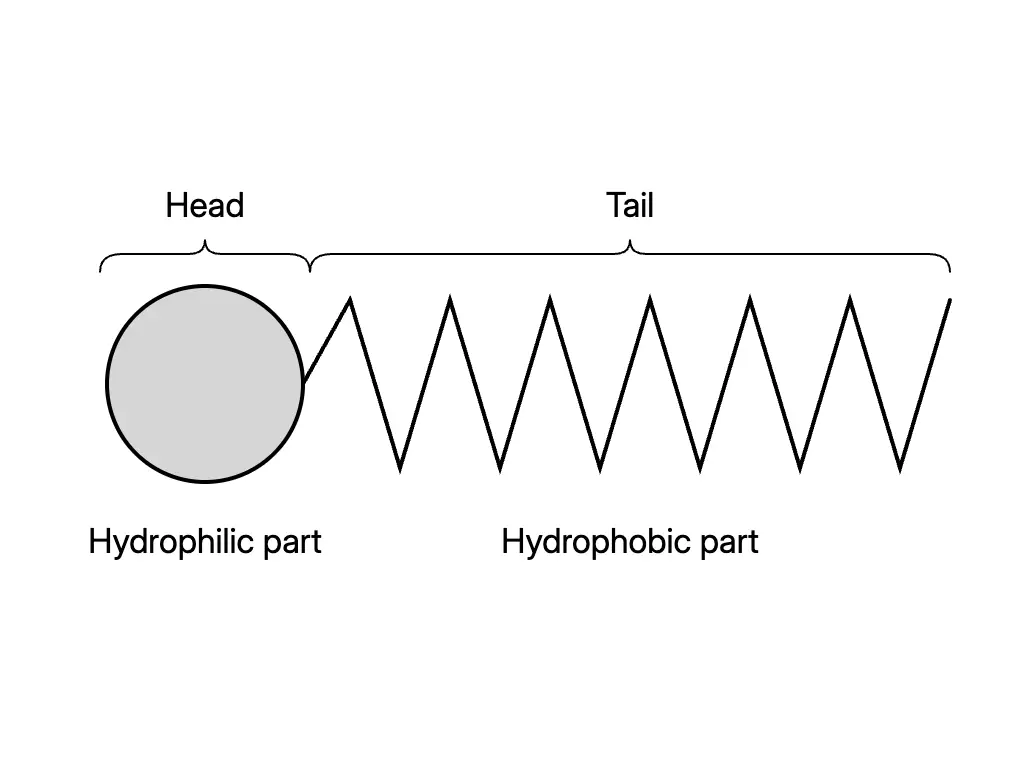
Molecular components
- Hydrophilic head: an ionic group that dissolves in water.
- Hydrophobic tail: a hydrocarbon chain that does not dissolve in water but dissolves in oil or grease.
Cleansing sequence
- Soap dissolves in water and reduces water’s surface tension, allowing soapy water to wet the cloth completely.
- Hydrophobic tails dissolve in and attach to greasy dirt; hydrophilic heads remain dissolved in water.
- Scrubbing or brushing dislodges the grease as droplets surrounded by soap molecules and suspended in soapy water.
- Soap bubbles trap the grease droplets.
- Rinsing removes the soapy water, bubbles and greasy dirt.
Sustainable Management of the Palm Oil Industry
- Land use: replanting optimises land use.
- Wastewater: palm oil mill effluent (POME) from sterilisation is converted into organic fertiliser and biogas energy substances.
- Air quality: oil palm trees absorb carbon dioxide and release oxygen during photosynthesis.
- Oil palm waste: the zero waste concept converts waste into useful products:
- Fronds → fertiliser.
- Tree trunks → wood replacement.
- Empty fruit bunches → compost.
- Shells → fuel for boiling water.
- Pulp fibre → carpets and textiles.
- POME → biogas and fertiliser.
- Efficient management addresses land use, wastewater, air quality and oil palm waste, including concerns that forest burning for plantations contributes to worldwide deforestation.
Answer practice questions to test your knowledge
Practice