5.2 — Hydrocarbons
Hydrocarbons from Natural Sources
- A hydrocarbon is an organic carbon compound made up of carbon and hydrogen only.
Formation of petroleum and natural gas
- Remains of dead marine life are buried on the seabed.
- Over millions of years, the remains become buried deeper under thick layers of rock and mud.
- The combined effects of pressure, heat from the surroundings and decomposition by bacteria change the remains into petroleum and natural gas.
- Natural gas occurs above petroleum beneath the seabed.
Formation of coal
- Remains of dead plants are naturally buried underground.
- Over millions of years, they become buried deeper under thick layers of rock.
- The combined effects of pressure, heat from the surroundings and decomposition by bacteria change the plant fossils into coal.
Fractional Distillation of Petroleum
- Petroleum is a mixture of hydrocarbons.
- Petroleum fractions are separated by fractional distillation before use.
- The method works because petroleum fractions have different boiling points.
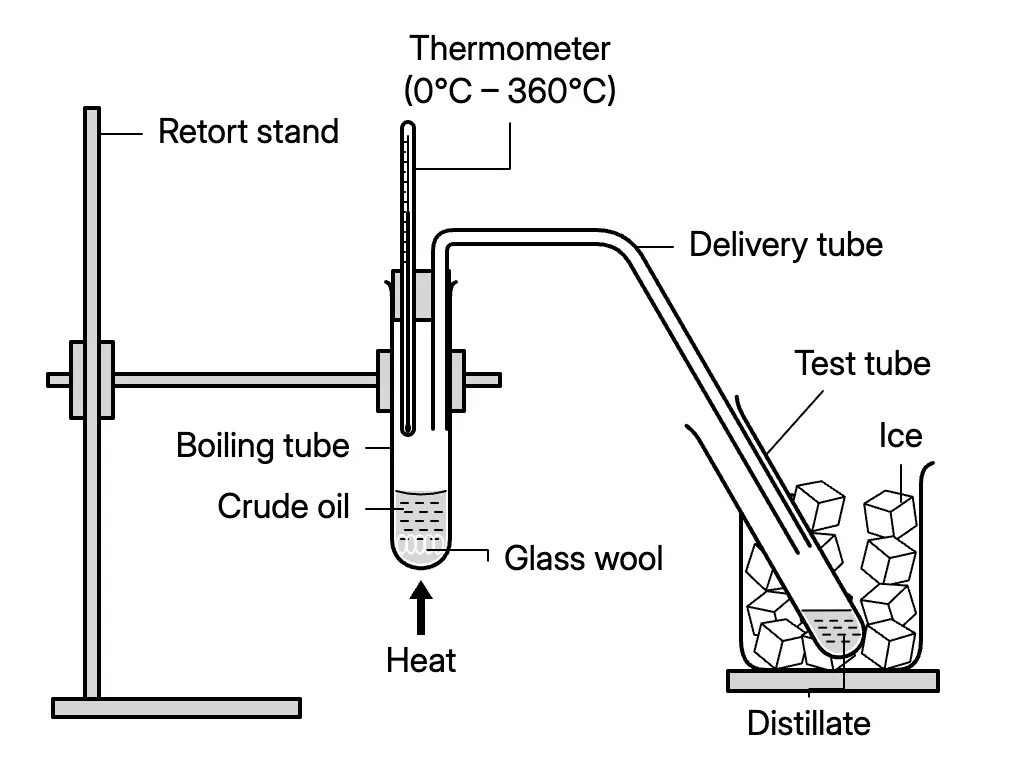
Activity 5.2 — Separating crude oil into four fractions
- Materials: crude oil, wooden splinter, ice, water and glass wool.
- Apparatus: measuring cylinder, boiling tube, retort stand, test tubes and rack, beaker, rubber stopper with delivery tube, thermometer (0°C–360°C), Bunsen burner and evaporating dishes.
- Place 10 cm³ of crude oil and glass wool in a boiling tube; assemble the delivery tube and an ice-cooled receiving test tube.
- Heat gently from room temperature to 80°C; collect about 1 cm³ as Fraction 1.
- Continue with new test tubes to collect:
- Fraction 2: 80°C–150°C
- Fraction 3: 150°C–230°C
- Fraction 4: 230°C–250°C
- Compare each fraction’s colour, viscosity and flammability.
- Fractional distillation separates the mixture according to the fractions’ different boiling points.
Safety: Crude oil and its vapour are highly flammable. Use crude oil only, heat gently, and wash skin exposed to crude oil with soap and water.
Saturated and Unsaturated Hydrocarbons
| Type | Carbon–carbon bonding |
|---|---|
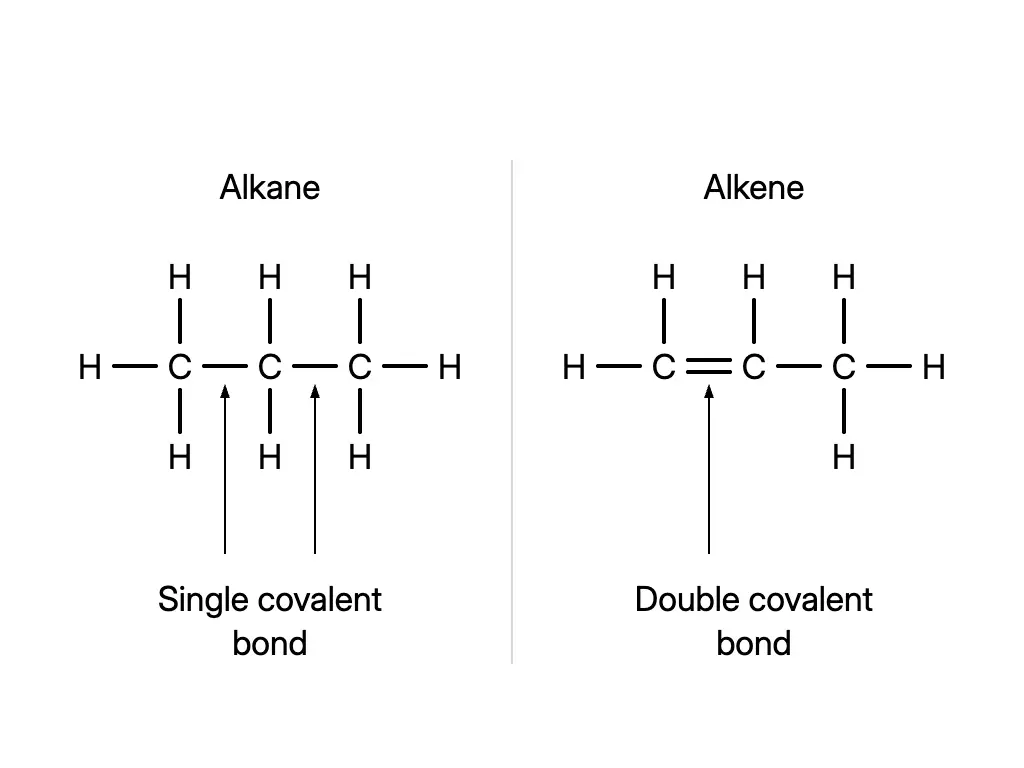
| Saturated hydrocarbon | Has only single covalent bonds, C–C; example: alkane |
| Unsaturated hydrocarbon | Has at least one double covalent bond, C=C, or triple covalent bond, C≡C; example: alkene |
Homologous Series: Alkanes and Alkenes
- A homologous series is a specific group of organic compounds with similar chemical properties.
Alkanes
- Saturated hydrocarbons; every carbon atom forms single covalent bonds with other carbon atoms.
- General formula: , where
Alkenes
- Unsaturated hydrocarbons; every molecule has at least one double covalent bond between two carbon atoms.
- General formula: , where
| Number of carbon atoms, | Alkane / alkene |
|---|---|
| 1 | Methane / — |
| 2 | Ethane / ethene |
| 3 | Propane / propene |
| 4 | Butane / butene |
| 5 | Pentane / pentene |
| 6 | Hexane / hexene |
Alternative and Renewable Energy Sources
- Petroleum, coal and natural gas are non-renewable fossil fuels that are fast depleting.
- Alternative energy sources do not deplete easily; they include nuclear energy and renewable energy sources.
- Renewable sources: solar, geothermal, wind, tidal, hydroelectric, wave and biomass energy.
- The advantages and disadvantages of nuclear power stations must be evaluated before construction.
- Decay of organic waste in disposal sites releases carbon dioxide and methane; methane can be collected to generate electrical energy.
- Methane is highly flammable and must be collected carefully.
Answer practice questions to test your knowledge
Practice