4.3 - Applications of the Concept of Rate of Reaction
Application in Daily Life
- Factors affecting the rate of reaction can be adjusted to increase or decrease the rate of a reaction.
- A refrigerator lowers the temperature of food and drinks.
- The lower temperature slows down the rate of food spoilage.
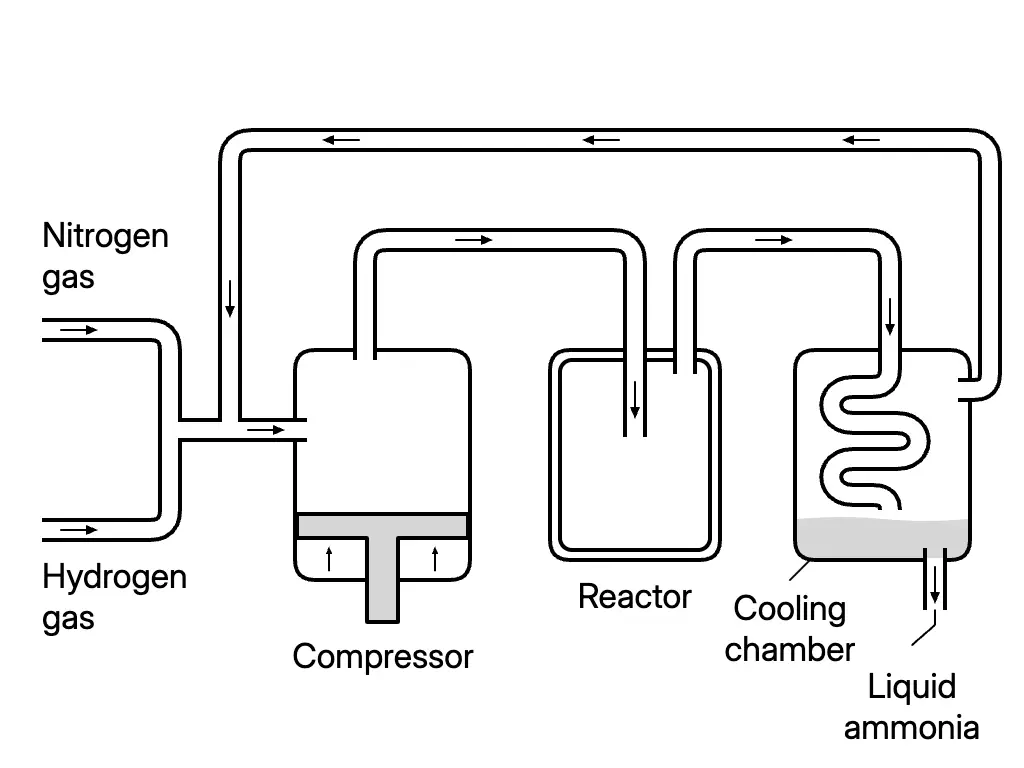
Haber Process
The Haber Process produces ammonia, .
Conditions
- Reactants: nitrogen gas, , and hydrogen gas, .
- Ratio of nitrogen to hydrogen: 1 : 3.
- Temperature: –.
- Pressure: .
- Catalyst: iron filings, .
Reaction
Process flow
- Nitrogen gas and hydrogen gas are mixed in a 1 : 3 ratio.
- The gas mixture is compressed to .
- The compressed gases pass through a reactor containing iron filings at –.
- Ammonia gas produced is cooled to form liquid ammonia.
- Unreacted nitrogen and hydrogen gases are channelled back into the process.
Contact Process
The Contact Process produces sulphuric acid, .
Stage 1: production of sulphur dioxide
- Sulphur is burnt in excess air.
Stage 2: production of sulphur trioxide
- Sulphur dioxide is mixed with excess air.
- The gas mixture passes over vanadium(V) oxide catalyst at and .
Stage 3: production of oleum
- Sulphur trioxide is dissolved in concentrated sulphuric acid to produce oleum, .
Stage 4: production of concentrated sulphuric acid
- Oleum is diluted with water.
Industrial Conditions at a Glance
| Haber Process | Contact Process |
|---|---|
| Product: ammonia | Product: sulphuric acid |
| Temperature: – | Temperature: |
| Pressure: | Pressure: |
| Catalyst: iron filings | Catalyst: vanadium(V) oxide |
The controlled factors that increase the rate of reaction in these industrial processes are temperature, pressure and presence of catalyst.
Answer practice questions to test your knowledge
Practice