4.1 - Introduction to Rate of Reaction
Fast Reactions and Slow Reactions in Daily Life
- A chemical reaction is a process in which one or more reactants are converted into one or more products.
- Example:
- Colourless lead(II) nitrate solution and colourless potassium iodide solution are the reactants.
- Yellow lead(II) iodide precipitate and colourless potassium nitrate solution are the products.
- As a reaction proceeds:
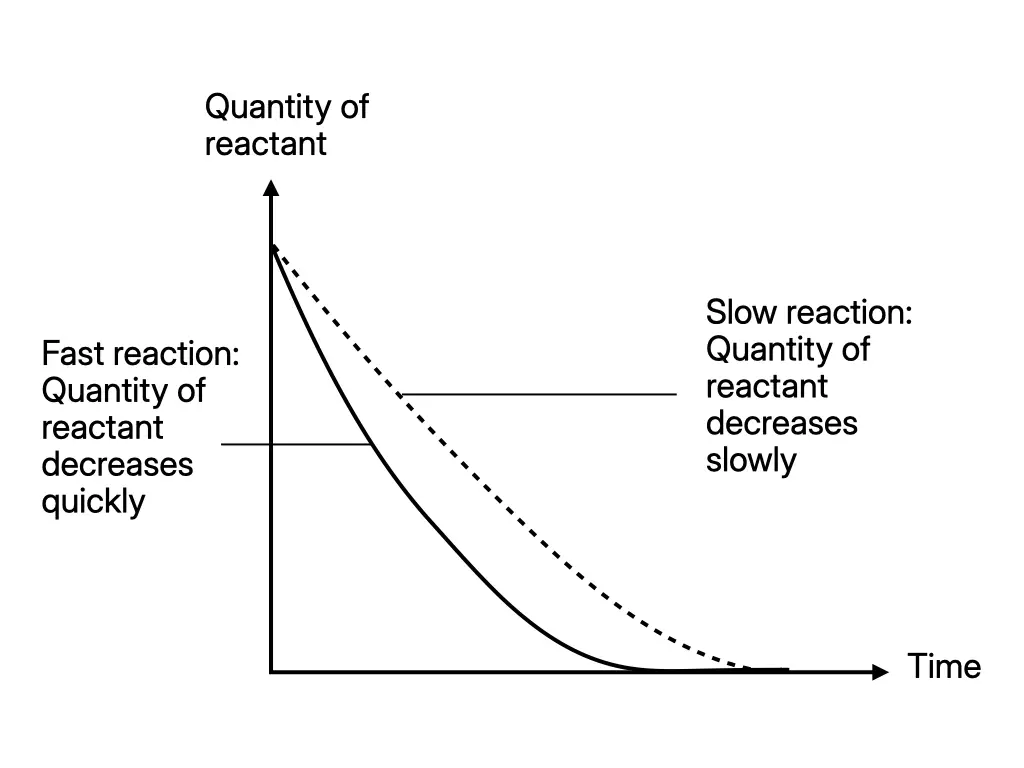
- the quantity of reactant decreases with time;
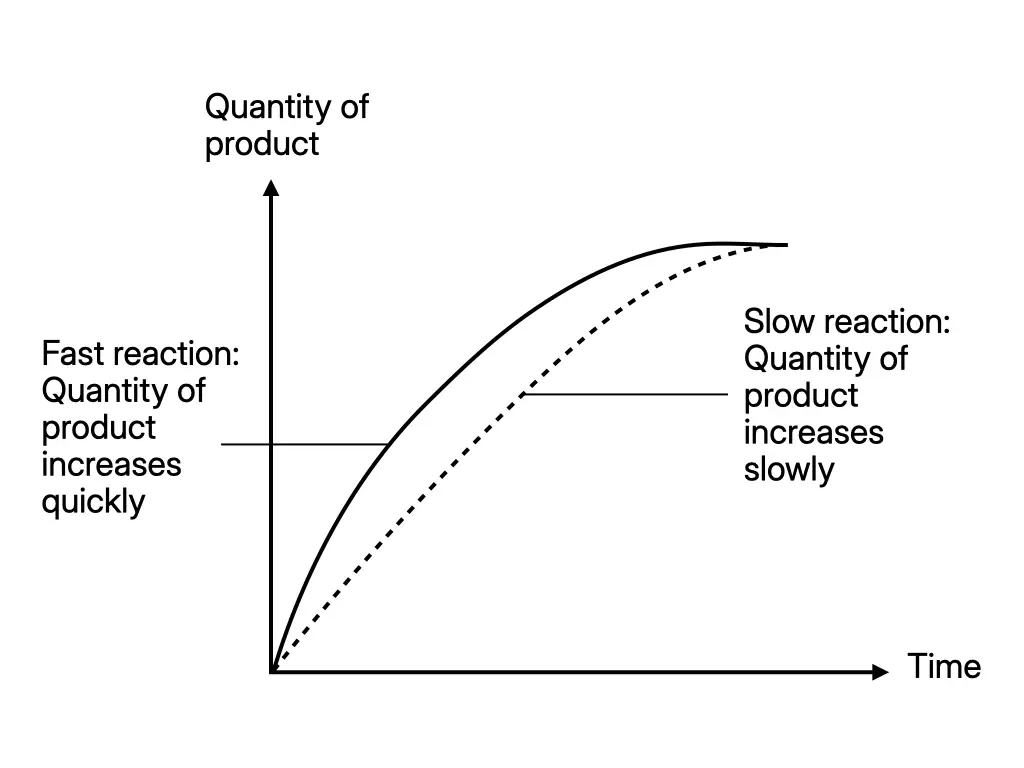
- the quantity of product increases with time.
| Fast reaction | Slow reaction |
|---|---|
| High rate of reaction | Low rate of reaction |
| Happens quickly | Happens slowly |
| Takes a shorter time to complete | Takes a longer time to complete |
| Reactant decreases quickly; product increases quickly | Reactant decreases slowly; product increases slowly |
| Example: burning of butane gas | Example: rusting of iron |
Graph interpretation
- A graph of quantity of reactant against time slopes downwards.
- A graph of quantity of product against time slopes upwards.
- A fast reaction has a steeper curve and reaches its final quantity in a shorter time.
- A slow reaction has a less steep curve and reaches its final quantity in a longer time.
Rate of Reaction
Rate of reaction is the change in the quantity of reactant or product per unit time.
Changes that can be observed or measured over a specific period of time include:
- decrease in the mass, volume or concentration of a reactant;
- increase in the mass, volume or concentration of a product;
- decrease or increase in the pressure, temperature, pH value, electrical conductivity, heat conductivity or intensity of colour of the reacting mixture;
- increase in the volume or pressure of gas released;
- increase in the height of precipitate formed.
The unit of rate follows the quantity measured and the unit of time, for example:
- mass per unit time: ;
- gas volume per unit time: .
Determining the Average Rate of Reaction
The average rate of reaction is the average value for the rate of reaction that occurs in a specific time interval.
Example 1: decrease in the mass of a reactant
When of magnesium tape reacts completely with excess dilute hydrochloric acid in :
Example 2: volume of hydrogen gas against time
Given the graph readings at , at and at , after which the graph is horizontal:
| Time interval | Average rate of reaction |
|---|---|
| First minute, – | |
| First 2 minutes, – | |
| Second minute, – | |
| Third minute, – | |
| Whole reaction, – |
- Use the change within the stated interval, not the total quantity from time zero, when the interval does not begin at zero.
- The reaction ends when the graph first becomes horizontal. In this example, use , not the final time shown on the horizontal axis.
Rate of Reaction at a Particular Point of Time
The rate of reaction at a particular point of time, or instantaneous rate of reaction, is the rate at a specific instant.
Method
- Mark the required point on the curve.
- Draw a tangent that touches the curve at that point.
- Choose two well-separated points on the tangent.
- Form a large right-angled triangle.
- Calculate the gradient:
Worked tangent examples
- At the 20th second:
- At the 60th second:
- At the 120th second:
Answer practice questions to test your knowledge
Practice