2.1 Balanced Diet and Calorific Value
Balanced Diet and Pinggan Sihat Malaysia
- A balanced diet includes all classes of food in the right quantity according to an individual’s body requirement.
- A lack or an excess of any class of food causes malnutrition. Examples include goitre, scurvy, marasmus, kwashiorkor and rickets.
- Pinggan Sihat Malaysia divides one plate into:
- Half: fruits and vegetables.
- One quarter: rice or other carbohydrate sources.
- One quarter: fish or other protein sources.
- Daily applications:
- Eat three healthy main meals a day.
- Eat one or two healthy snacks between meals if needed.
- Eat more cereal foods.
- Eat less fried food or food containing coconut milk.
- Eat home-cooked food more frequently.
Calorific Value of Food
- Calorific value, or energy value, is the amount of energy released from the complete oxidation or combustion of 1 g of food.
- Energy is measured in calorie (cal), kilocalorie (kcal), joule (J) or kilojoule (kJ).
- The S.I. unit for calorific value is joule per kilogram, .
- A bomb calorimeter measures the calorific value of food accurately.
- The calorific value of food depends on its quantities of carbohydrate, protein and fat.
| Class of food | Calorific value () |
|---|---|
| Carbohydrate | 16.7 |
| Fat | 37.6 |
| Protein | 16.7 |
Examples of estimated calorific values:
| Food | Calorific value () |
|---|---|
| Rice | 15.04 |
| White bread | 10.60 |
| Coarse sugar | 16.50 |
| Palm oil | 38.00 |
| Butter | 31.20 |
| Chicken | 8.27 |
| Beef | 13.11 |
| Cabbage | 0.34 |
| Cucumber | 0.55 |
Experiment 2.1: Estimating Calorific Value
Aim: Estimate the calorific value of groundnuts, anchovies and bread using a calorimeter.
Problem statement: Which food sample has the highest calorific value?
Hypothesis: The calorific value of groundnuts is higher than that of bread and anchovies.
Variables:
- Manipulated: type of food sample.
- Responding: change in temperature / calorific value of food.
- Constant: mass of water.
Materials: 1 g each of groundnuts, bread and anchovies, cotton wool and distilled water.
Apparatus: Retort stand, boiling tube, thermometer, shield, plasticine and needle.
Apparatus arrangement: A food sample fixed on a needle is burnt below a boiling tube containing distilled water. A thermometer measures the water temperature; a shield reduces heat loss.
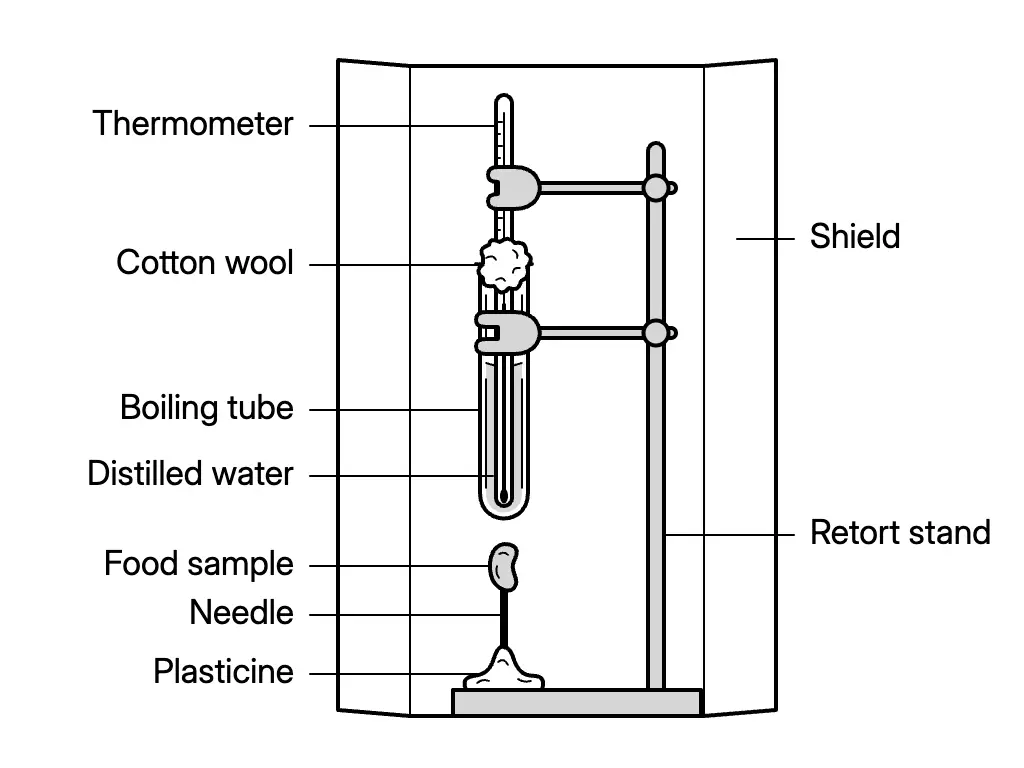
Procedure:
- Set up the apparatus.
- Record the type and mass of food, mass of water and initial temperature, .
- Set the food sample alight.
- Record the final temperature, , after the sample burns completely.
- Repeat with the other food samples using the same mass of water.
- The experimental value is smaller than the actual value because some heat energy is lost to the surroundings.
- Suitable samples: rice or bread for carbohydrate, groundnut or palm oil for fat, and anchovy or egg white for protein.
- Water has no calorific value because it cannot be completely oxidised or burnt.
Effects of Calorie Intake That Does Not Meet Individual Requirements
- Total calories from meals must meet individual requirements.
- Insufficient intake may cause underweight and malnutrition.
- Excessive intake may cause obesity.
- Inappropriate mealtimes and unhealthy eating patterns may cause malnutrition, obesity, anorexia nervosa, arteriosclerosis, diabetes mellitus, high blood pressure, thrombosis, stroke, heart attack and heart disease.
| Health problem | Cause and effect |
|---|---|
| Obesity | Excessive intake of high-calorific food over a long period increases the risk of diabetes mellitus, arteriosclerosis and high blood pressure. |
| Anorexia nervosa | Refusal to eat due to fear of gaining weight causes malnutrition that can be fatal. |
| Atherosclerosis | Cholesterol deposits on artery walls narrow the artery lumen, causing high blood pressure and increasing the risk of heart disease and stroke. |
| Diabetes mellitus | Long-term intake of food and drinks high in sugar affects vision, kidneys and the nervous system, and slows wound healing. |
| High blood pressure | Long-term intake of food high in salt increases the risk of heart disease and stroke. |
Eating Patterns and Health
- Health depends on both the total calorie intake and eating patterns, including mealtimes and types of food.
- Fast food and junk food may contain:
- Excess sugar: obesity, tooth decay and increased risk of early diabetes mellitus.
- No beneficial nutrients: malnutrition.
- Caffeine in carbonated drinks: insomnia, anxiety and addiction.
- Artificial colouring and sweeteners: cancer, infertility, diabetes mellitus, and liver and kidney damage.
- Excess salt: high blood pressure, heart disease and kidney damage.
- Twenty-four-hour restaurants, fast-food restaurants and junk-food advertising can encourage unsuitable mealtimes and excessive intake of unhealthy food.
Answer practice questions to test your knowledge
Practice