5.2 - Semiconductor Diode
Structure and Function
- A semiconductor diode allows electric current to flow in one direction only. It joins a p-type semiconductor to an n-type semiconductor, forming a p–n junction.
- The diode has an anode and cathode.
- Doping adds impurity atoms to the crystal lattice of a pure semiconductor:
- p-type: majority charge carriers are holes, which act as positive charge carriers.
- n-type: majority charge carriers are electrons.
- Many electrical devices require direct current (d.c.), although the mains supply is alternating current (a.c.). Diodes enable this conversion; for example, a smartphone requires d.c. for charging.
Forward Bias and Reverse Bias
| Forward bias | Reverse bias |
|---|---|
| Connect the supply’s positive terminal to the anode and negative terminal to the cathode. | Connect the supply’s positive terminal to the cathode and negative terminal to the anode. |
| Holes move towards the n-type side; electrons move towards the p-type side. | Holes and electrons move away from the depletion layer. |
| The depletion layer narrows. | The depletion layer widens. |
| Junction voltage decreases; diode resistance becomes very small. | Junction voltage increases to the battery potential difference; diode resistance becomes very large. |
| Current flows and the series bulb lights. | Current does not flow and the series bulb remains off. |
Rectification
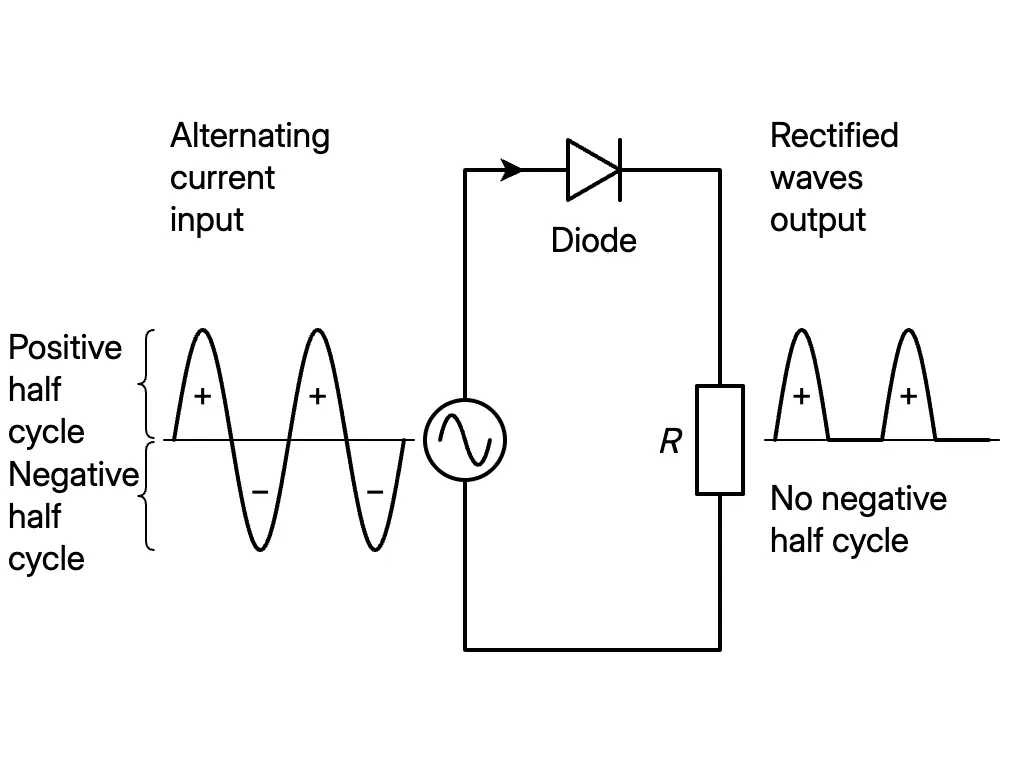
- Rectification converts a.c. into d.c.
- An a.c. cycle has positive and negative half cycles. Its current reverses direction; rectified d.c. flows in one direction but can still vary in magnitude.
| Type | Operation and output |
|---|---|
| Half-wave rectification | One diode conducts during the positive half cycle because it is forward biased. It blocks the negative half cycle because it is reverse biased. Output contains only the positive half cycles. |
| Full-wave rectification | Four diodes form a bridge rectifier. Both half cycles produce current in the same direction through load . The output has a pulse for each half cycle. |
- In each half cycle, two diodes are forward biased and conduct, while the other two are reverse biased and block current. The conducting pair changes in the next half cycle; current through keeps the same direction.
- The cathode ray oscilloscope (C.R.O.) shows the input sinusoidal waveform, positive half-wave pulses or full-wave pulses according to the circuit used.
Capacitor as a Current Smoother
- Half-wave and full-wave rectification give uneven d.c. output. A smooth d.c. supply helps an electronic circuit operate properly.
- Connect capacitor in parallel with load resistor .
- When potential difference rises, the capacitor charges and stores energy.
- When potential difference falls, the capacitor discharges.
- Its stored energy maintains the potential difference across , preventing the output current from falling to zero in the illustrated output.
The resulting output is smoother, with smaller fluctuations; the capacitor smooths the rectified output in both half-wave and full-wave circuits.
The capacitance value and capacitor type influence the current-smoothing effect.
Answer practice questions to test your knowledge
Practice