5.1 - Electron
Thermionic Emission and Cathode Rays
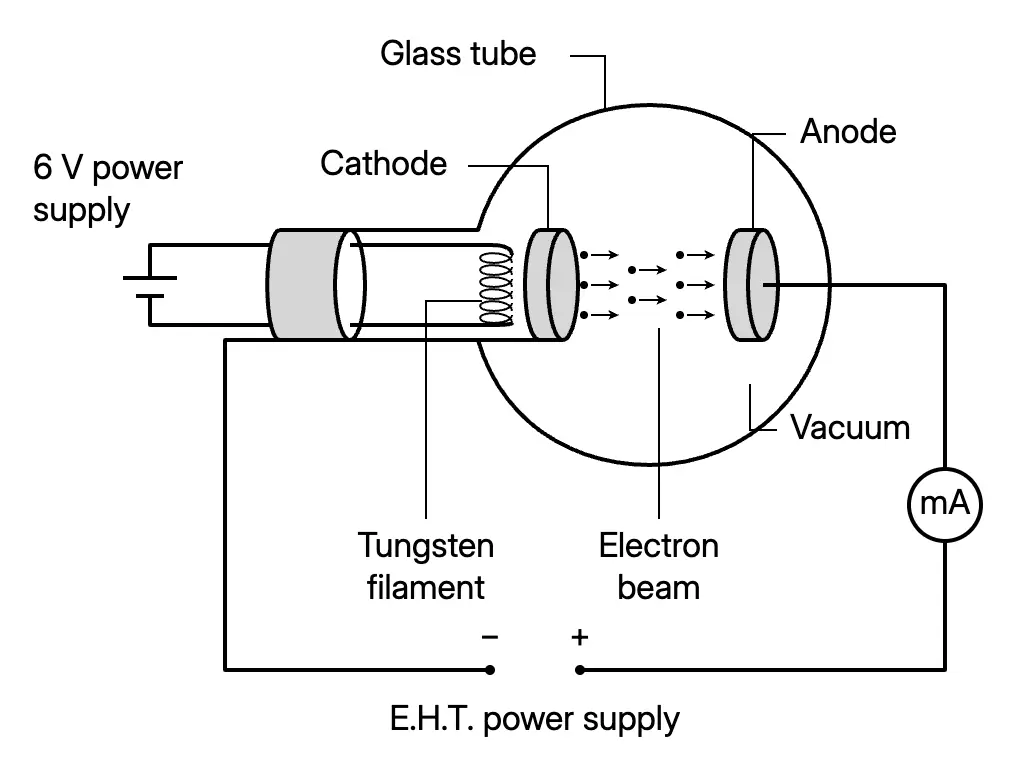
- Thermionic emission releases free electrons from a heated metal surface. Heating a tungsten filament gives its free electrons enough kinetic energy to escape.
- Cathode rays are beams of electrons travelling at high speed through a vacuum.
| Component | Function |
|---|---|
| 6 V d.c. supply and tungsten filament | Heat the cathode to release electrons. |
| Extra high tension (E.H.T.) supply | Establish a potential difference between the cathode and anode. The positive anode attracts and accelerates emitted electrons. |
| Evacuated glass tube | Allows electrons to accelerate without collisions with air molecules and the resulting energy loss. |
| Milliammeter | Detects current when the electron beam completes the E.H.T. circuit. |
- Reversing the E.H.T. connections gives no milliammeter reading.
- Coating the cathode with barium oxide or strontium oxide lowers the temperature needed to release electrons.
- A thermionic diode is a non-ohmic component; its current–voltage graph is not a straight line through the origin.
Electric Field and the Deflection Tube
- The deflection tube contains a cathode, anode, deflection plates and fluorescent grid. Switch controls the 6 V heater supply, controls the accelerating E.H.T. supply, and controls the E.H.T. supply across the plates.
| Condition | Observation and interpretation |
|---|---|
| and on | Cathode rays travel in a straight line. |
| , and on | The beam follows a parabolic path towards the positive plate, showing that cathode rays carry negative charge. |
| Deflection-plate polarity reversed | The beam deflects towards the newly positive plate. |
- Precautions: Do not touch metal parts while the E.H.T. supply is on. Switch off the E.H.T. supply when observations are not being made.
Magnetic Field and the Maltese Cross Tube
- The Maltese cross tube contains an opaque cross and fluorescent screen. A 6 V supply heats the cathode; an E.H.T. supply accelerates the electrons. A bar magnet near the tube produces the magnetic field.
| Condition | Observation and interpretation |
|---|---|
| Heater only | The cross blocks light from the hot filament and casts a shadow: light travels in a straight line. |
| Heater and E.H.T. supply on | The cross blocks cathode rays and casts a shadow; fluorescence appears around it. Cathode rays travel straight and possess momentum and kinetic energy. |
| Magnet brought near the operating tube | Two shadows appear: one from filament light and another from the magnetically deflected cathode rays. |
- Use Fleming’s left-hand rule to determine the cathode-ray deflection direction.
- Precautions: Earth the Maltese cross tube properly. Do not touch metal parts while using E.H.T.; switch off the E.H.T. supply between observations.
Electron Energy and Maximum Velocity
- An electron accelerated towards a positive anode through potential difference gains electrical energy .
- In the vacuum tube, electrons accelerate without collisions and reach their maximum velocity at the anode.
- By conservation of energy, electrical potential energy becomes maximum kinetic energy:
- is the magnitude of an electron’s charge; is its mass.
- is the cathode–anode potential difference in volts; is in joules and in .
- For a fixed electron mass and charge, .
Worked Example: Acceleration Through 550 V
- An electron beam accelerates through 550 V in a vacuum.
- Electrical energy gained:
- Maximum kinetic energy is also .
- Maximum velocity:
Answer practice questions to test your knowledge
Practice