4.2 - Electromagnetic Induction
Magnetic Flux and Induction
- Magnetic flux refers to magnetic field lines passing through a surface. A moving conductor that cuts field lines cuts magnetic flux.
- Electromagnetic induction produces an induced electromotive force (e.m.f.) in a conductor through relative motion between the conductor and magnetic field, or through a changing magnetic field.
- An induced e.m.f. produces induced current when the conductor forms a complete circuit. A connected galvanometer then deflects.
- A wire can cut flux when it moves past stationary magnets or when the magnets move past the stationary wire.
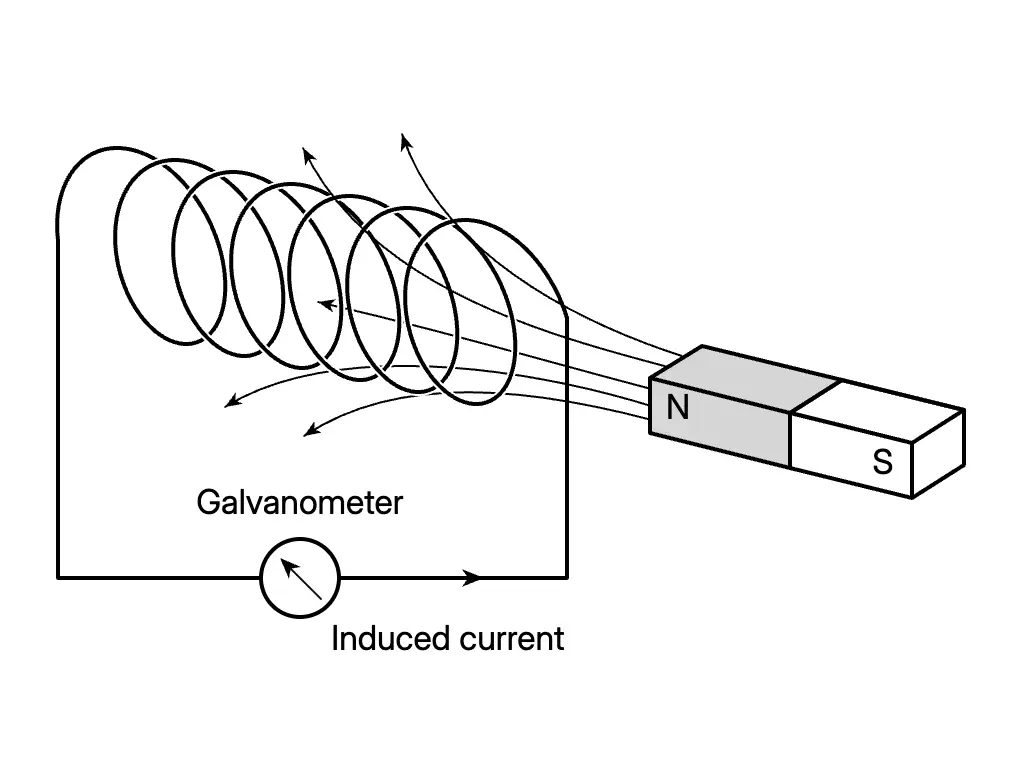
- Moving a bar magnet towards or away from a solenoid causes the turns to cut magnetic field lines, inducing an e.m.f. across the solenoid.
- An electric bass guitar pickup contains permanent magnets and copper coils and produces an electrical signal through induction.
Relative Motion and Galvanometer Observations
- Relative motion occurs when one object moves towards or away from a stationary object, or when both move with different velocities.
- There is no relative motion when both objects are stationary or travel at the same speed in the same direction.
- A straight-wire investigation uses a copper rod, Magnadur magnets, connecting wires and a sensitive centre-zero galvanometer or digital multimeter. Compare a stationary rod with motion in different directions, and with motion of the magnets instead.
- A solenoid investigation uses a bar magnet, a solenoid with at least 400 turns, connecting wires and the same measuring instrument. Compare pushing the magnet in, holding it still, pulling it out, and moving the solenoid towards or away from a stationary magnet.
- Induction requires cutting magnetic flux. Keeping the magnet and solenoid stationary does not produce the changing flux needed for induced current.
Faraday’s Law and Induced e.m.f. Magnitude
- Faraday’s law: induced e.m.f. magnitude is directly proportional to the rate of cutting magnetic flux.
- Cutting more magnetic field lines in a given time produces a larger e.m.f.
- For a straight wire, increase the speed of relative motion or the magnetic field strength.
- For a solenoid, increase the speed of relative motion, magnetic field strength or number of turns.
- The comparisons use one magnet moving slowly and quickly into a 400-turn solenoid, one magnet moving slowly into an 800-turn solenoid, then two magnets with like poles tied side by side moving slowly into the 800-turn solenoid. Maximum galvanometer readings are recorded for two attempts and averaged.
- An induction lamp uses insulated copper wire around a PVC pipe containing a neodymium magnet, connected to an LED. Different shaking speeds produce different brightnesses.
- Michael Faraday discovered electromagnetic induction in 1831 and constructed an electric dynamo for generating electrical power.
Fleming’s Right-hand Rule
- The induced current direction changes when relative motion reverses.
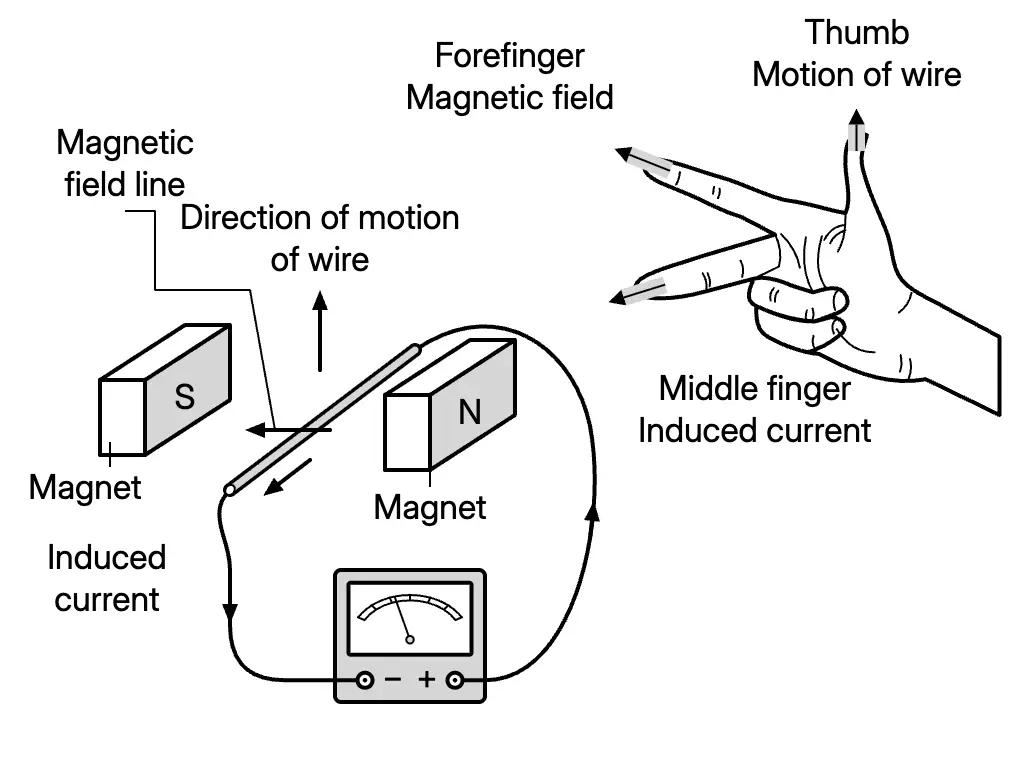
- For a straight wire, use Fleming’s right-hand rule:
- Thumb: direction of motion of the wire.
- Index finger: magnetic field direction.
- Middle finger: induced current direction.
- Moving the magnets downwards past a stationary wire is equivalent to moving the wire upwards past stationary magnets.
- Galvanometer deflection can be related to current direction using a dry cell of known polarity before replacing it with the copper wire.
Lenz’s Law and Solenoid Polarity
- Lenz’s law: induced current flows in a direction that opposes the change of magnetic flux producing it.
- The end of the solenoid facing an approaching magnet becomes a like pole to repel it; for a receding magnet, it becomes an unlike pole to attract it.
| Motion of magnet pole | Induced pole at the facing solenoid end |
|---|---|
| North approaches | North: repels the magnet. |
| North recedes | South: attracts the magnet. |
| South approaches | South: repels the magnet. |
| South recedes | North: attracts the magnet. |
Direct and Alternating Current Generators
- Both apply electromagnetic induction: an external force rotates a coil in a magnetic field; the coil cuts flux and an e.m.f. is induced.
- Both have a coil, magnets and carbon brushes. Wind turbines use electrical generators.
| Direct current generator | Alternating current generator |
|---|---|
| Coil ends connect to a split ring commutator. | Coil ends connect to two slip rings. |
| Commutator halves exchange contact with the brushes every half rotation. | Each slip ring remains connected to the same brush. |
| Output is direct current. | Output is alternating current. |
- An electric motor can be modified to function as a dynamo, producing electricity when its coil is rotated by an external force.
Answer practice questions to test your knowledge
Practice