3.3 - Electromotive Force (e.m.f.) and Internal Resistance
Electromotive Force
Electromotive force (e.m.f.), ε, is the energy supplied or work done by an electrical source for each coulomb of charge moved around a complete circuit:
ε=QE
E is energy in joules and Q is charge in coulombs. The SI unit is volt, V, equivalent to JC−1.
A 1.5 V dry cell supplies 1.5 J per coulomb.
Sources include generators, dynamos, dry cells, lead-acid accumulators and lithium-ion batteries.
A voltmeter has high resistance, so its current is negligible. Across an unloaded cell, its reading gives the cell’s e.m.f.
E.m.f. and Potential Difference
Quantity
Meaning and measurement
E.m.f., ε
Work done by the source per coulomb around the complete circuit. Measure across the cell with the switch open, when no current flows through the external circuit.
Potential difference, V
Work done per coulomb between two points. With the switch closed, the voltmeter gives the potential difference across the bulb.
Both quantities have the same unit. In the cell-and-bulb circuit, the closed-circuit reading is smaller than the open-circuit e.m.f.
Internal Resistance and Voltage Drop
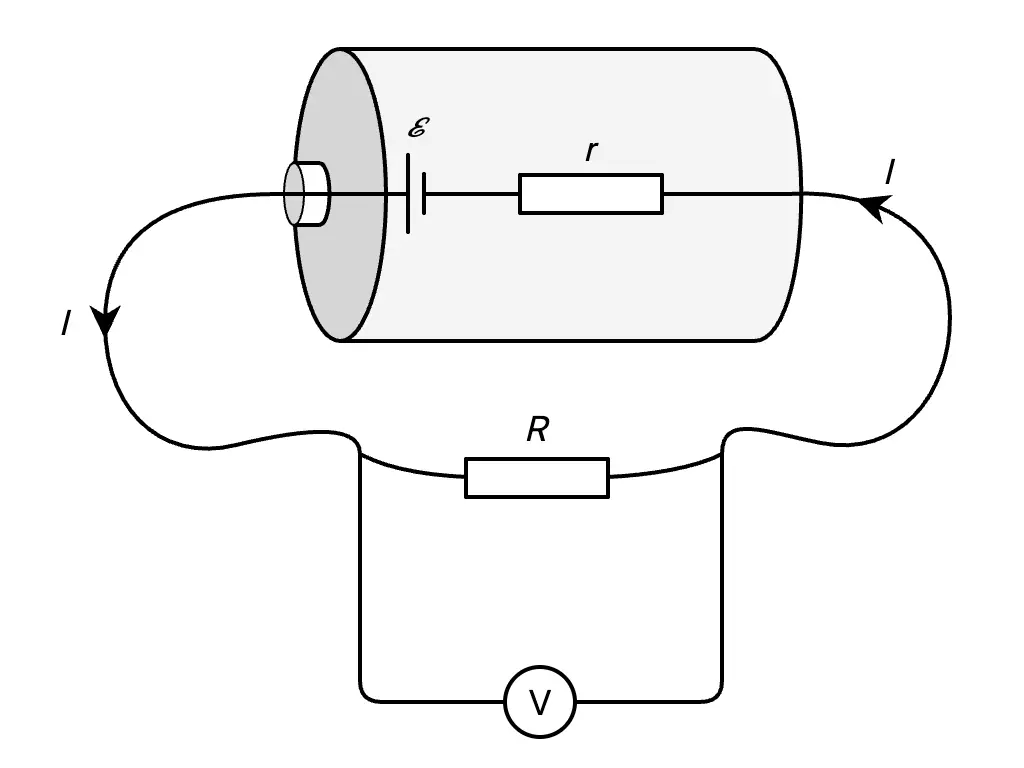
Internal resistance, r, is the resistance caused by the electrolyte inside a dry cell. Its SI unit is ohm, Ω.
Current flowing against this resistance transfers energy to heat inside the cell, reducing its terminal potential difference.
Comparing the open-circuit and closed-circuit voltmeter readings gives the voltage drop:
Ir=ε−V
Alkaline batteries use potassium hydroxide as the electrolyte and are twice as durable as zinc-carbon batteries in this comparison. Different electrolytes give different internal resistances. Cell arrangement also affects effective internal resistance.
For external resistance R, V=IR. Hence:
ε=V+Ir=IR+Ir=I(R+r)
I=R+rε,V=ε−Ir
With current flowing, V<ε; increasing current increases the voltage drop and decreases V.
Internal resistance of a dry cell
Experiment 3.5: Determining E.m.f. and Internal Resistance
Aim: Determine the e.m.f. and internal resistance of a dry cell.
Apparatus: 1.5 V dry cell, cell holder, switch, connecting wires, ammeter, voltmeter and rheostat.
Connect the cell, switch, ammeter and rheostat in series; connect the voltmeter across the cell.
Obtain paired readings of current I and potential difference V for a set of currents.
Avoid parallax errors in meter readings and reduce energy loss from the cell during data collection.
Plot V against I, determine the gradient and vertical intercept, and compare with the linear equation:
V=−rI+ε
Result: A straight line with a negative gradient; V falls as I rises.
Gradient:m=−r, so r=−m.
Vertical intercept: At I=0, V=ε; the intercept gives the e.m.f.
Cells in Series and Parallel
For four identical dry cells, each with e.m.f. ε and internal resistance r:
Arrangement
Effective e.m.f. and internal resistance
Series
E.m.f. adds to 4ε; re=r+r+r+r=4r.
Parallel
E.m.f. remains ε; 1/re=1/r+1/r+1/r+1/r, so re=r/4.
Compare current using both the effective e.m.f. and total resistance: I=εeffective/(R+re).
Worked Cell-arrangement Example
Each cell has ε=1.5V and r=0.5Ω; external resistance is 10Ω.
Two cells in series:
εeffective=3V,re=1.0Ω,I=10+1.03≈0.27A
Two cells in parallel:
εeffective=1.5V,re=0.25Ω,I=10+0.251.5=0.1463A
Series gives greater current in this example because its effective e.m.f. is higher.
Three cells in parallel:
re=30.5≈0.167Ω,I=10+0.1671.5≈0.1475A
Adding a parallel cell increases current because effective internal resistance decreases.
Electric Vehicles and Solar Cells
Electric vehicles use 100% electrical power, with rechargeable batteries supplying energy to electric motors; battery types include Li-Ion and Ni-MH. Hybrid cars combine rechargeable batteries with fossil fuels such as petrol.
The vehicle comparison uses 300–800 V batteries for electric vehicles and 100–200 V for hybrids, with batteries providing 25–40% of the hybrid’s power.
Batteries can receive energy from domestic supplies, charging stations and solar-cell charging stations.
Solar cells convert sunlight into electrical energy. Connecting solar cells in series forms a solar panel; panel arrangement provides the required voltage and current.
Electric and hybrid vehicles can reduce fossil-fuel consumption, improve energy efficiency and reduce air pollution.