3.1 - Current and Potential Difference
Electric Fields
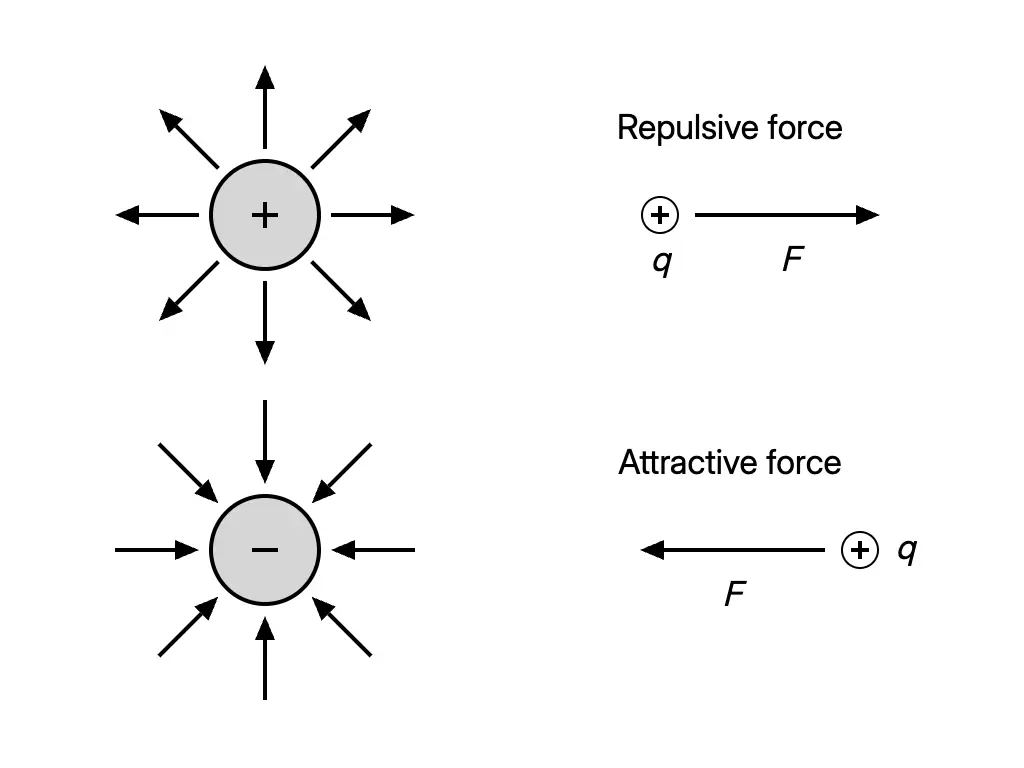
- An electric field is a region around a charged particle in which another electric charge experiences an electric force.
- Examples include water bending towards a charged comb, hair attracted to a charged balloon, paper attracted to a charged plastic comb, and a charged straw moving towards a nearby finger.
- Like charges repel; unlike charges attract.
- Electric field lines point outwards from a positive charge and inwards towards a negative charge. They begin on positive charges, end on negative charges and never cross.
- Between unlike point charges, lines connect the positive charge to the negative charge. Between like charges, the lines bend away from one another.
- Between a positive point charge and a negatively charged plane plate, field lines spread from the point charge and meet the plate at right angles.
- Oppositely charged electrodes at different potentials produce a field. Semolina powder in olive oil experiences electric forces and forms a pattern showing the field.
Electric Field Strength
- Electric field strength, , at a point is the electric force acting on each unit positive charge placed there:
- is electric force in ; is charge in . The SI unit of is .
- The direction of the field is the direction of the force on a positive test charge.
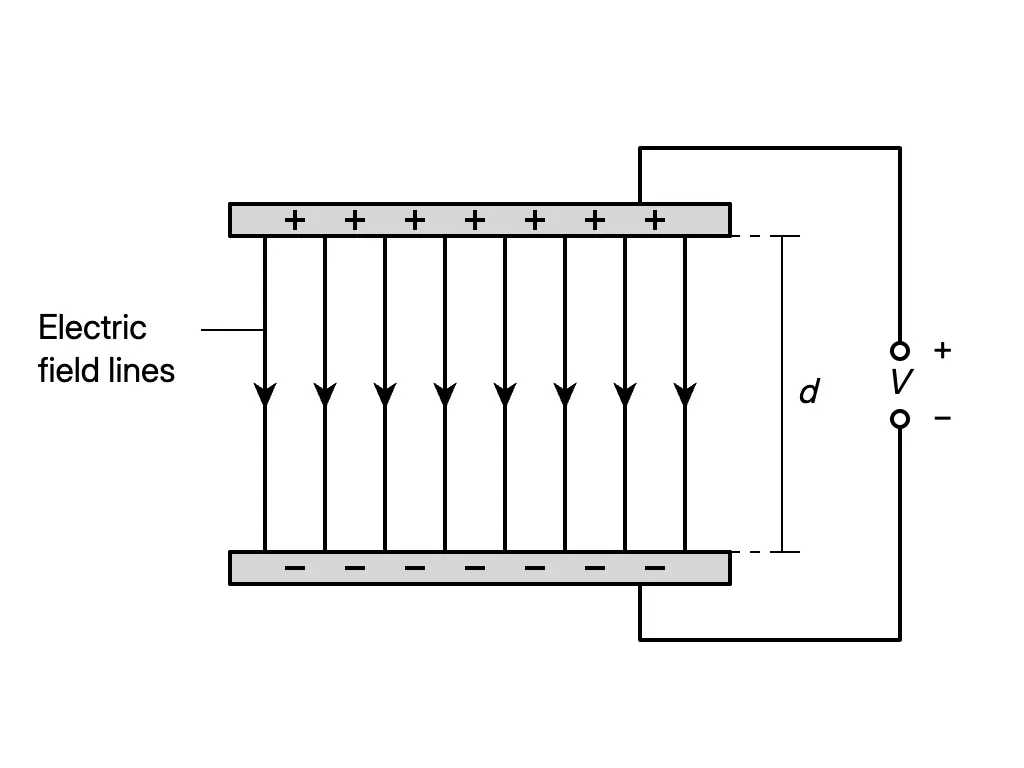
- Two oppositely charged parallel plates produce a uniform field, represented by parallel field lines directed from the positive plate to the negative plate:
- is the potential difference between the plates in volts; is their separation in metres. is equivalent to .
Charged Objects in an Electric Field
- A neutral, metal-coated polystyrene ball initially remains stationary between charged plates. After touching a plate, it swings repeatedly between the plates while the supply remains on.
- At the negative plate, the ball becomes negatively charged. It is repelled by that plate and attracted to the positive plate.
- At the positive plate, electrons move from the ball to the plate. The ball becomes positively charged, is repelled by that plate and attracted to the negative plate. Repeated charging and discharging sustain its motion.
- A candle flame spreads towards both plates, with greater spreading towards the negative plate.
- Heat ionises the air into positive and negative ions. Negative ions move towards the positive plate; positive ions move towards the negative plate. The greater mass and size of positive ions account for the greater spreading towards the negative plate.
Electric Current
- Current, , is the rate of flow of charge through a conductor. Electrical appliances require current in a complete circuit:
- is total charge in coulombs and is time in seconds. The SI unit of current is ampere, , equivalent to .
Potential Difference
- A potential difference between two points allows current to flow between them.
- Potential difference, , is the work done to move one coulomb of charge between two points:
- is work done and is energy transferred, both in joules. Here, denotes energy rather than electric field strength.
- The SI unit is volt, , equivalent to . A potential difference of 1 V means 1 J of work for each 1 C of charge.
- The magnitude of an electron’s charge is ; 1 C corresponds to electrons.
- Alessandro Volta, an Italian physicist, invented the voltaic pile, the first electric battery. The unit volt honours his contribution.
Answer practice questions to test your knowledge
Practice