2.5 - Archimedes’ Principle
Buoyant Force and Its Derivation
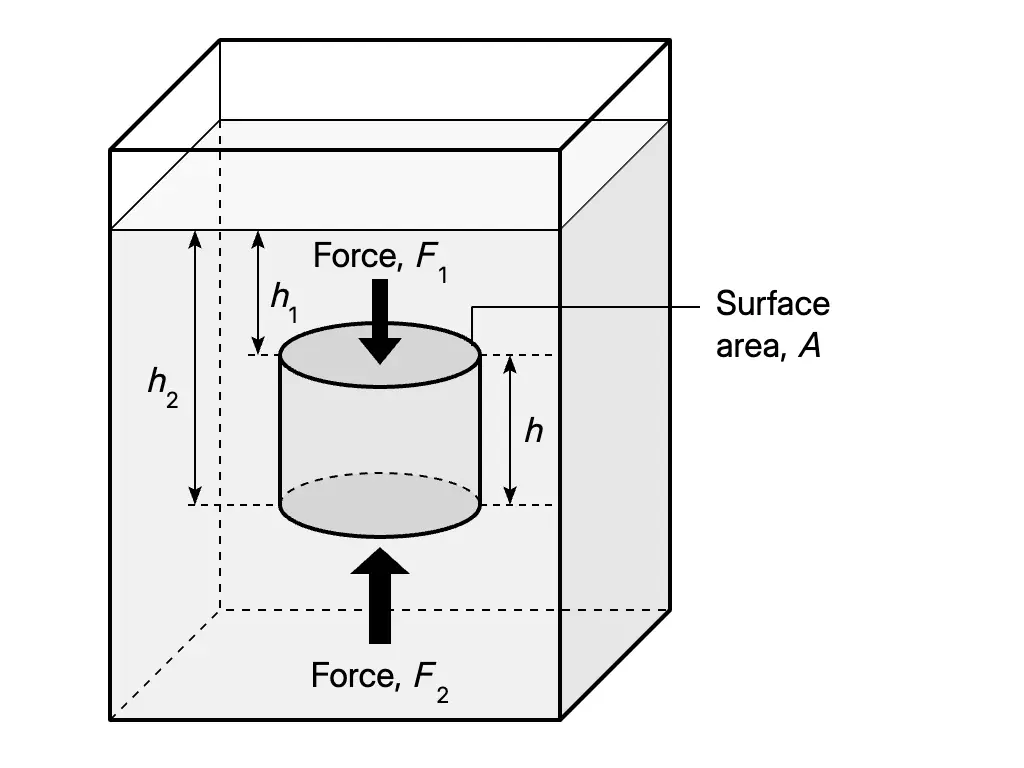
- Buoyant force acts upwards on an immersed object because liquid pressure is greater at its lower surface than at its upper surface.
- Floating-platform example: Water buoyancy supports the weight of Tengku Tengah Zaharah Mosque at Teluk Ibai, Terengganu.
- For a fully immersed cylinder with equal top and bottom areas , at depths and :
- is the volume of the cylinder and of the liquid displaced.
- The displaced liquid has mass and weight .
- Archimedes’ principle: An object partly or fully immersed in a fluid experiences an upward buoyant force equal to the weight of fluid displaced.
- is the fluid’s density and is the displaced volume, equal to the immersed part of the object.
- Fluids include liquids and gases. Buoyancy in gases matters when it is appreciable compared with the object’s weight, as in hot air balloons.
Experiment 2.3: Buoyancy and Displaced Water
- Aim: Determine the relationship between buoyant force and the weight of liquid displaced.
- Inference: Buoyant force depends on the weight of liquid displaced.
- Hypothesis: Greater weight of displaced liquid gives greater buoyant force.
- Variables: Manipulated — weight of displaced water; responding — buoyant force; constant — water density.
- Apparatus: Slotted weights, Eureka can, beaker, spring balance, electronic balance, retort stand and wooden block.
- Material: Water.
- Set up the water-filled Eureka can on the wooden block, with the beaker under its spout and on the electronic balance.
- Hang a slotted weight on the spring balance. Record its weight in air, .
- Place the beaker on the electronic balance and zero the reading.
- Fully immerse the weight in water. Record its apparent weight in water, .
- Calculate . Use the collected-water mass to calculate displaced-water weight , taking as for this experiment.
- Repeat measurements with , , and weights. Record , , and .
- Plot against and determine the gradient.
- The relationship is buoyant force = displaced-liquid weight = apparent loss in weight.
- Weight in air is the actual weight; weight in liquid is the apparent weight.
Equilibrium and Floatation
| Relative forces | State of the object |
|---|---|
| Resultant force is zero; an object floating at rest is in equilibrium | |
| Downward resultant force; object accelerates downwards | |
| Upward resultant force; object accelerates upwards |
- For an object floating at rest:
- A floating ship displaces water equal in weight to the ship. Displaced volume equals the volume of its submerged section.
- A ship can float in a wide sea or narrow canal if enough water can be displaced to support its weight.
Hydrometer
- A hydrometer measures liquid density by floating at different depths.
- At rest, its weight equals the weight of liquid displaced.
- In a less dense liquid, it sinks deeper to displace a larger volume. In a denser liquid, less of it is submerged.
- It measures specific gravity, the liquid’s density relative to water. If water density is , the reading gives the liquid density numerically in .
- A milk hydrometer tests milk dilution; its range is –.
Ships, Submarines and Hot Air Balloons
- Ship and Plimsoll line: The ship illustration carries Plimsoll load markings; the immersed section displaces the water that supports the ship.
- Submarine: Ballast tanks control its state of floatation. The illustrated system includes valves and a compressed-air tank.
- Cartesian diver model: A partly water-filled inverted test tube floats when the combined weight of the tube and its water equals buoyancy. Squeezing the surrounding bottle pushes water into the tube, increasing its weight above buoyancy so it sinks. Releasing pressure allows it to rise again.
- Hot air balloon rising: Close the parachute valve and ignite the burner to heat air; the balloon rises when its weight is less than buoyant force.
- Hot air balloon descending: Open the parachute valve to release hot air and turn off the burner; it descends when its weight exceeds buoyant force.
Worked Examples
- Maximum boat load: A boat has below line L. With water density and :
- Floating raft: For mass and sea-water density :
Answer practice questions to test your knowledge
Practice