2.4 - Pascal’s Principle
Uniform Transmission of Pressure
- Pascal’s principle: Pressure applied to an enclosed fluid is transmitted uniformly in all directions throughout the fluid.
- In Pascal’s piston, pushing the piston applies pressure to the enclosed water. Water spurts from every hole because the pressure is transmitted in all directions.
Hydraulic System as a Force Multiplier
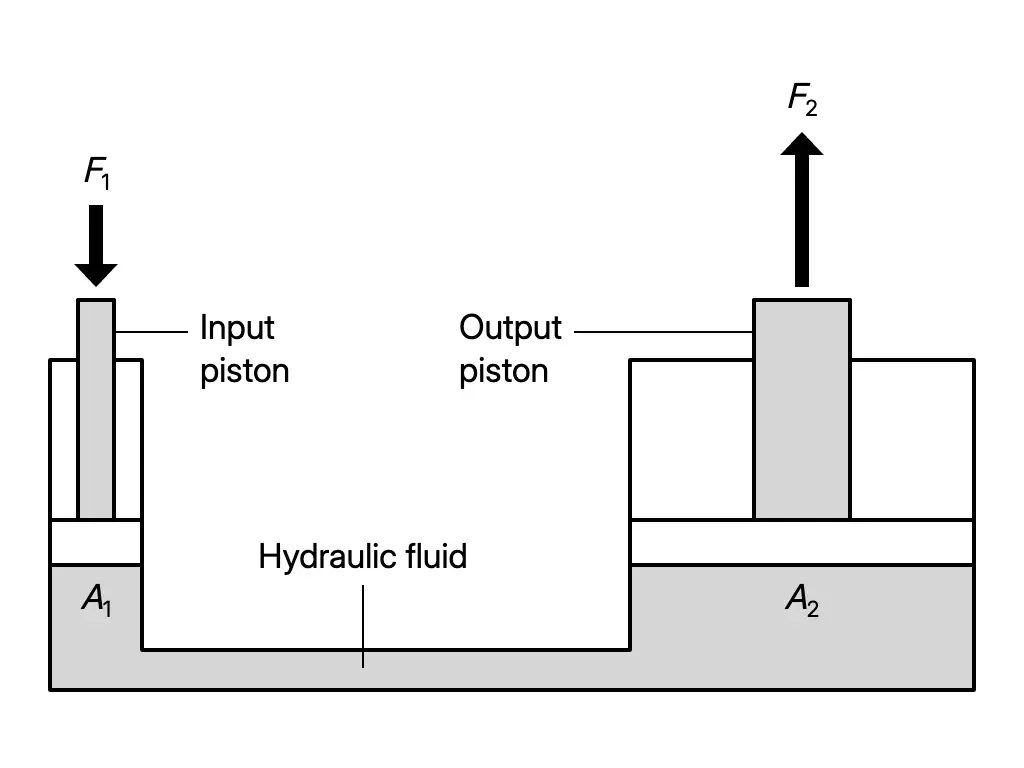
- A hydraulic system uses a liquid to transmit pressure. A small input force on a small piston can produce a larger output force on a larger piston.
- With input force , input area , output force and output area :
- Equal transmitted pressure gives:
- If , then . Force increases because the same pressure acts over a larger area.
Applications
- Coconut milk extractor: Pressure transmission in an enclosed fluid produces a large force to press grated coconut.
- Hydraulic brake: Force on the brake pedal acts through the master cylinder and brake fluid. Transmitted pressure acts at the slave cylinders to apply the brake pads or brake shoes.
- Hydraulic jack: A handle operates the small piston; pressure transmitted through hydraulic fluid acts on the large piston to lift the load. The arrangement includes a fluid reservoir, valves A and B and a release valve.
Worked Examples
- Force multiplication: With , and :
- Bicycle brake: An input force of on must produce :
Answer practice questions to test your knowledge
Practice