Variables: Manipulated — depth h; responding — pressure represented by the difference D between the two water levels in a U-tube; constant — liquid density.
Apparatus: 500 ml measuring cylinder, silicone tube, thistle funnel covered with a thin rubber sheet, U-tube, two half-metre rules and retort stand.
Materials: Water and food colouring.
Connect the covered thistle funnel to the U-tube using the silicone tube. Initially keep the funnel outside the measuring cylinder, with equal water levels in the U-tube.
Immerse the funnel mouth to h=4.0cm and measure D.
Repeat at 8.0, 12.0, 16.0 and 20.0cm.
Record h and D, then plot D against h.
Experiment 2.2: Density and Pressure
Aim: Study the relationship between liquid density and pressure.
Inference: Liquid pressure depends on density.
Hypothesis: Higher density gives higher pressure.
Variables: Manipulated — density ρ; responding — pressure represented by the U-tube water-level difference D; constant — liquid depth.
Apparatus: Half-metre rule, three 600 ml beakers, U-tube, silicone tube, thistle funnel covered with a thin rubber sheet and retort stand.
Materials: Masking tape, alcohol, water and glycerine.
Mark each beaker 2cm above its base. Use beakers A, B and C for alcohol, water and glycerine respectively.
Connect the covered funnel to the water-filled U-tube. Slowly immerse the funnel vertically in alcohol until its mouth is level with the mark.
Measure D, then remove and dry the funnel.
Repeat for water and glycerine. Record D for each liquid and relate it to density.
Liquid
Density / kgm−3
Alcohol
790
Water
1 000
Glycerine
1 300
Characteristics of Liquid Pressure
Liquid pressure does not depend independently on the liquid’s mass, volume, surface area or the shape of its container.
Pressure at a point acts in all directions. Points at the same level in the same static liquid have equal pressure.
Connected columns of different shapes and cross-sectional areas have the same liquid level. Holes at the same level in a water-filled bottle produce equal horizontal spurt distances.
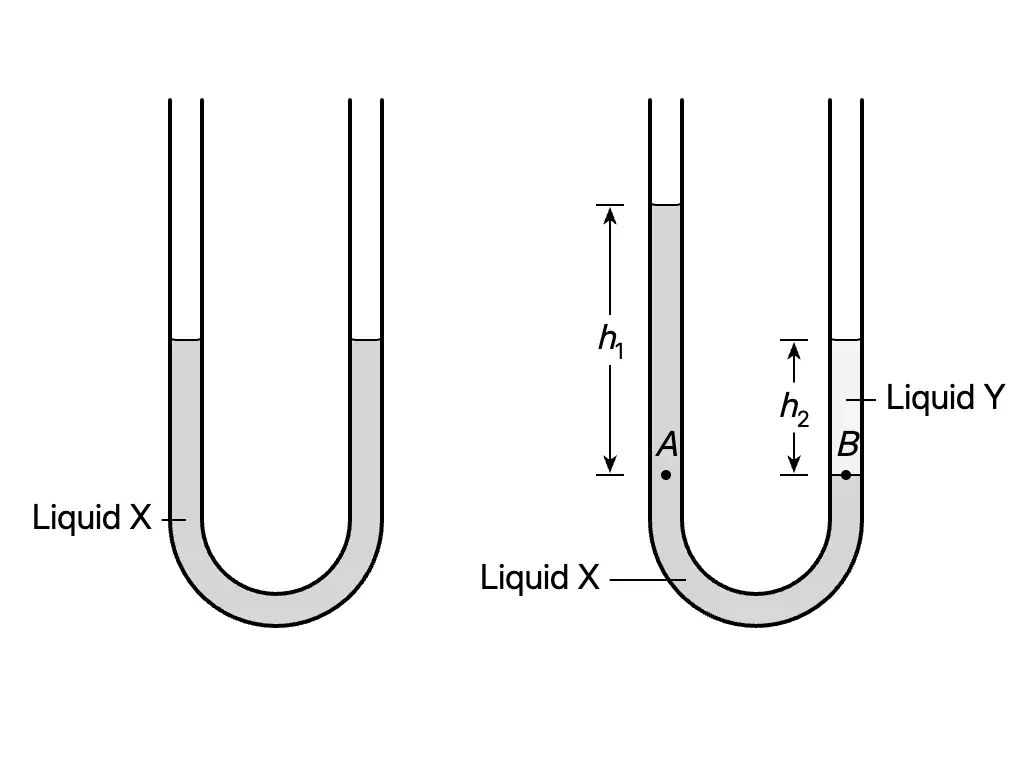
For two immiscible liquids in a U-tube, compare pressures at the same horizontal level in the connected static liquid. With both free surfaces exposed to the same atmospheric pressure:
h1ρ1g=h2ρ2g⇒h1ρ1=h2ρ2
Measure each column height from its free surface to the common reference level.
A U-tube filled with liquid X and liquid Y
Actual Pressure and Worked Examples
A liquid exposed to the atmosphere experiences pressure at its surface. Actual pressure at depth includes both contributions:
Pactual=hρg+Patm
A fish at 1.5m in aquarium water of density 1050kgm−3, with g=9.81ms−2 and Patm=100kPa:
Pwater=1.5(1050)(9.81)=15450.8Pa≈15.5kPa
Pactual=15.5+100=115.5kPa
In a U-tube, a 15.0cm water column balances a 16.5cm olive-oil column. With ρwater=1000kgm−3:
ρoil=16.515.0(1000)=909.1kgm−3
Applications
Household water tank: Placing it between the ceiling and roof gives a large height difference above the tap, producing pressure that makes water flow quickly.
Intravenous liquid: A bag above the patient’s body produces pressure that pushes liquid into the body. Bag height affects flow rate; an adjuster controls the flow.
Dam: A thicker base withstands the greater pressure at greater depth. A low penstock supplies fast-flowing water to drive turbines.
Siphon: A water-filled flexible tube transfers water from a higher reservoir to a lower outlet without electrical power. Outflow lowers pressure near the top of the tube; atmospheric pressure pushes water into its submerged inlet.
Rate of liquid transfer is volume transferred per unit time: