6.5 - Optical Instruments
Magnifying Glass and Uses of Optical Instruments
- A magnifying glass uses a convex lens with the object inside its focal length to form a virtual, upright, magnified image.
- Gemologists use magnifying glasses to identify and evaluate gemstones; ophthalmologists use them to examine eyes.
- Microbiologists use microscopes to examine microorganisms; geologists use them to identify rock and mineral specimens.
- Astronomers use telescopes to study celestial objects.
Compound Microscope
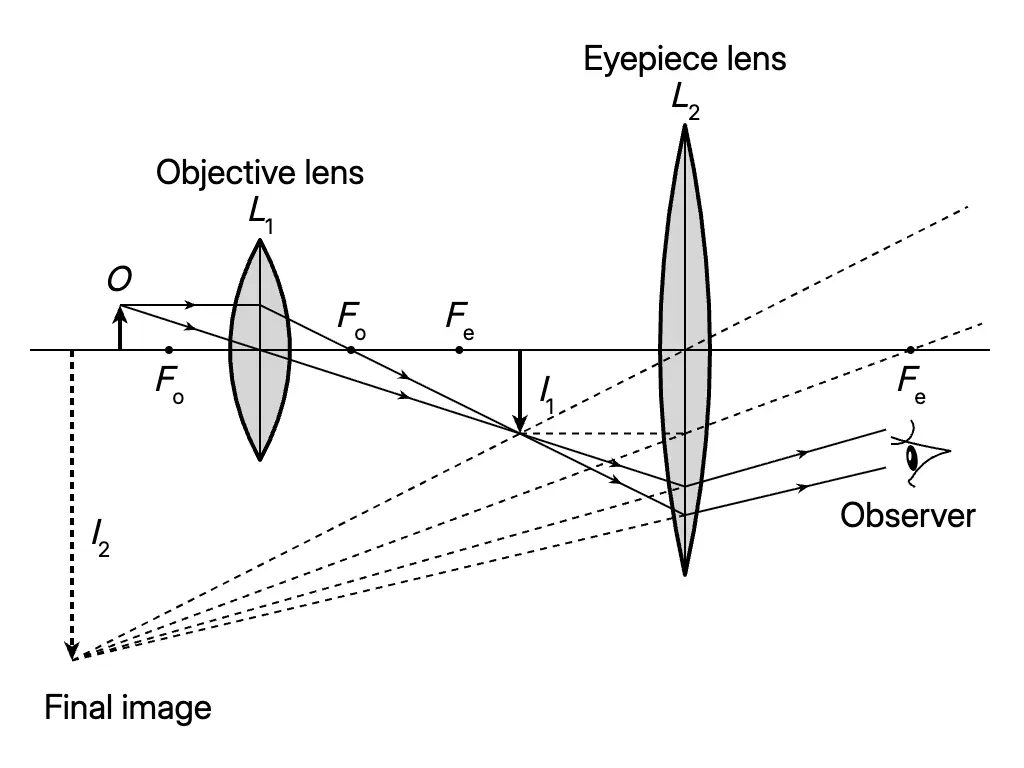
- Uses two convex lenses with short focal lengths: the objective lens has focal length and the eyepiece lens has focal length , with .
- The separation of the lenses is greater than .
- Place the object between and . The objective forms the first image, , which is real, inverted and magnified.
- lies between the eyepiece’s focal point and optical centre and acts as the object for the eyepiece.
- The eyepiece functions as a magnifying glass, producing final image , which is virtual, magnified and inverted relative to the original object.
- Adjust the eyepiece so that the final image is at the observer’s near point, approximately 25 cm, for clear vision.
Telescope
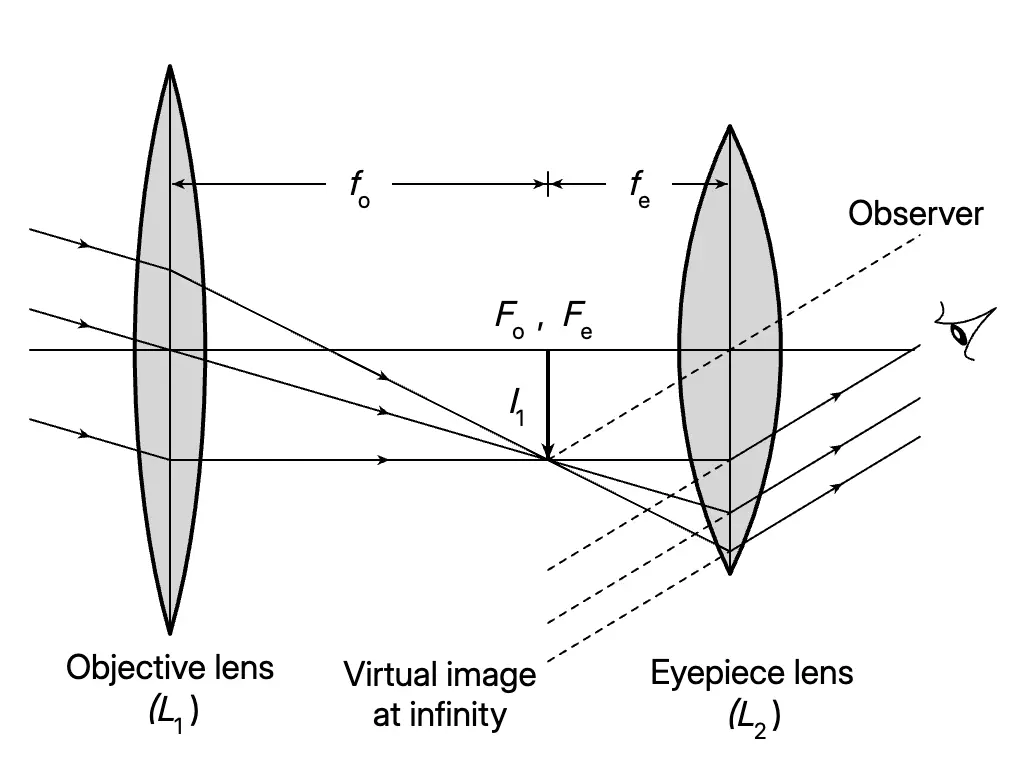
- Uses two convex lenses: an objective with a long focal length, , and an eyepiece with a short focal length, .
- Parallel rays from a distant object converge in the objective’s focal plane, forming first image : real, inverted and diminished.
- acts as the object for the eyepiece. The final image, , is virtual, magnified and inverted relative to the original object.
- At normal adjustment, the focal planes coincide, the final image is at infinity and lens separation is:
- This adjustment gives comfortable viewing. Telescope magnification is:
- A longer objective focal length relative to the eyepiece focal length gives greater magnification. A larger objective diameter produces a brighter image.
Small Lenses in Smartphone Cameras and CCTV
- Thin smartphones and small closed circuit television (CCTV) cameras use small convex lenses.
- The lens forms a real, inverted, diminished image on the sensor, enabling clear photographs and video recordings.
- The minimum distance from the lens centre to the sensor equals the camera lens’s focal length.
- Since focal length cannot be zero, it limits the overall thickness of the smartphone or CCTV camera.
Answer practice questions to test your knowledge
Practice