6.1 - Refraction of Light
Refraction and Optical Density
- Refraction occurs because light changes velocity when it travels between media of different optical densities. A pencil in water or seen through a glass block can appear bent.
- From an optically less dense to a denser medium, light slows down and bends towards the normal: .
- From an optically denser to a less dense medium, light speeds up and bends away from the normal: .
- Angle of incidence, , and angle of refraction, , are measured between the respective ray and the normal.
- Optical density differs from mass per unit volume. Oil floats on water because its mass density is lower, although its optical density is higher.
Refractive Index and Snell’s Law
- Refractive index, , is the ratio of light speed in vacuum to light speed in a medium:
- Higher optical density gives a larger . The value is at least 1 and depends on light wavelength; temperature changes can also change it.
- The incident ray, refracted ray and normal meet at one point and lie in the same plane.
- Snell’s law relates the two media:
- : refractive indices of the incident and refracting media; : respective angles to the normal.
- For light entering a medium from air, take :
| Medium | Refractive index |
|---|---|
| Vacuum and air | 1.00 |
| Water | 1.33 |
| Olive oil | 1.46 |
| Perspex | 1.50 |
| Crown glass | 1.52 |
| Flint glass | 1.66 |
| Diamond | 2.42 |
- At an incidence angle of from water, refraction angles in perspex, flint glass and diamond are , and respectively: the higher the second medium’s index, the greater the bending towards the normal.
Experiment 6.1: Refractive Index of a Glass Block
- Inference: Refraction angle depends on incidence angle.
- Hypothesis: Increasing increases .
- Aim: Determine the refractive index of a glass block.
- Variables: Manipulated — ; responding — ; constant — refractive index of the glass block.
- Apparatus: Ray box with a single slit, protractor and ruler. Materials: Glass block, white paper and pencil. Perspex may replace glass.
- Trace the block’s outline on white paper and draw a normal at incidence point .
- Draw incident-ray lines at .
- Place the block on its outline and direct the ray along the line. Mark the emergent ray .
- Remove the block, join to emergence point , and measure .
- Replace the block and repeat for the other incidence angles. Record , , and .
- Plot against and against . Use to obtain from the second graph’s gradient.
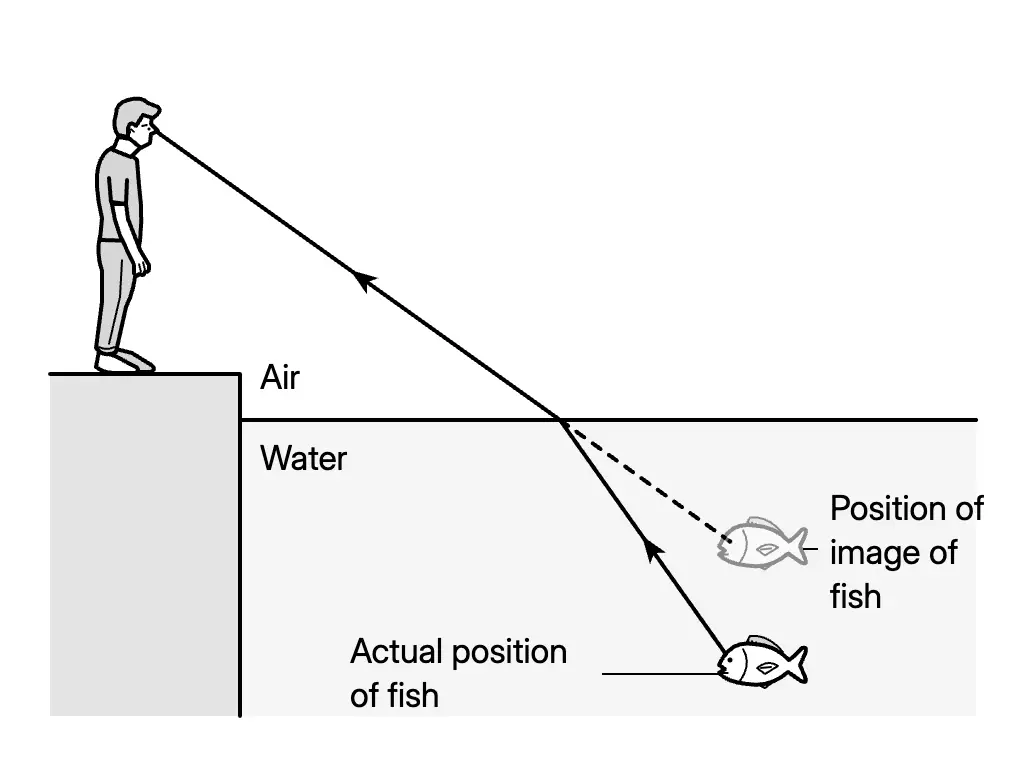
Real Depth and Apparent Depth
- Real depth, : Distance from the actual object to the medium’s surface.
- Apparent depth, : Distance from the object’s image to that surface.
- Rays from a fish bend away from the normal on leaving water. Their backward extensions locate an image closer to the surface, so the fish appears shallower.
- An instructor above a swimming pool sees a diver nearer the water surface; the diver sees the instructor farther away.
- The relationship for a transparent medium viewed from air is:
Experiment 6.2: Refractive Index of Water
- Inference: Image position depends on object position and the refractive indices of the media.
- Hypothesis: Greater real depth gives greater apparent depth.
- Aim: Determine water’s refractive index by the non-parallax method.
- Variables: Manipulated — ; responding — ; constant — water’s refractive index.
- Apparatus: 1 000 ml beaker, ruler and retort stand with two clamps. Materials: Cork, two pins, cellophane tape and water.
- Tape object pin to the base of the beaker. Arrange the ruler and adjustable comparison pin beside it using the stand and cork.
- Fill with water to and view the image of from above.
- Adjust vertically until it lines up with the image of at the same level.
- Measure , the height of above the base. Calculate .
- Repeat with . Record , and .
- Plot against ; its gradient gives .
Worked Examples
- Air to plastic: , .
- Apparent rise of a coin: The image is above the coin, so and .
Answer practice questions to test your knowledge
Practice