Total internal reflection occurs when light is completely reflected back into its original medium.
Both conditions must be satisfied: light travels from a medium of higher to lower optical density, and the angle of incidence is greater than the critical angle, i>c.
Critical angle, c, is the incidence angle in the optically denser medium when the refraction angle in the less dense medium is 90∘.
Incidence angle
Behaviour at a glass–air boundary
i<c
Ray refracts away from the normal; a weak reflected ray is present.
i=c
Refracted ray travels along the boundary; the reflected ray is brighter.
i>c
No refracted ray; total internal reflection occurs.
At the critical angle, Snell’s law gives n1sinc=n2sin90∘. For a medium surrounded by air, n2=1:
nsinc=1,n=sinc1,c=sin−1(n1)
Higher refractive index gives a smaller critical angle. For diamond, n=2.42 gives c=24.4∘.
Natural Phenomena and Light Guidance
Rainbow: Sunlight refracts and disperses into colours as it enters water droplets, undergoes internal reflection, then refracts and disperses again on leaving. The observer sees the separated colours.
Mirage: Air near a hot road is hotter and optically less dense than the air above. Light from clouds bends progressively away from the normal towards the hotter layers. When incidence exceeds the critical angle, total internal reflection occurs. The returning light bends towards the normal and reaches the observer, producing an apparent puddle on the road.
Water stream: Repeated total internal reflection guides a laser beam along the stream to its end, even along a curved path. Oil has a higher refractive index and smaller critical angle than water; the illustrated oil stream produces more internal reflections.
Decorative lamps can use total internal reflection to guide light.
Applications
Application
Principle and use
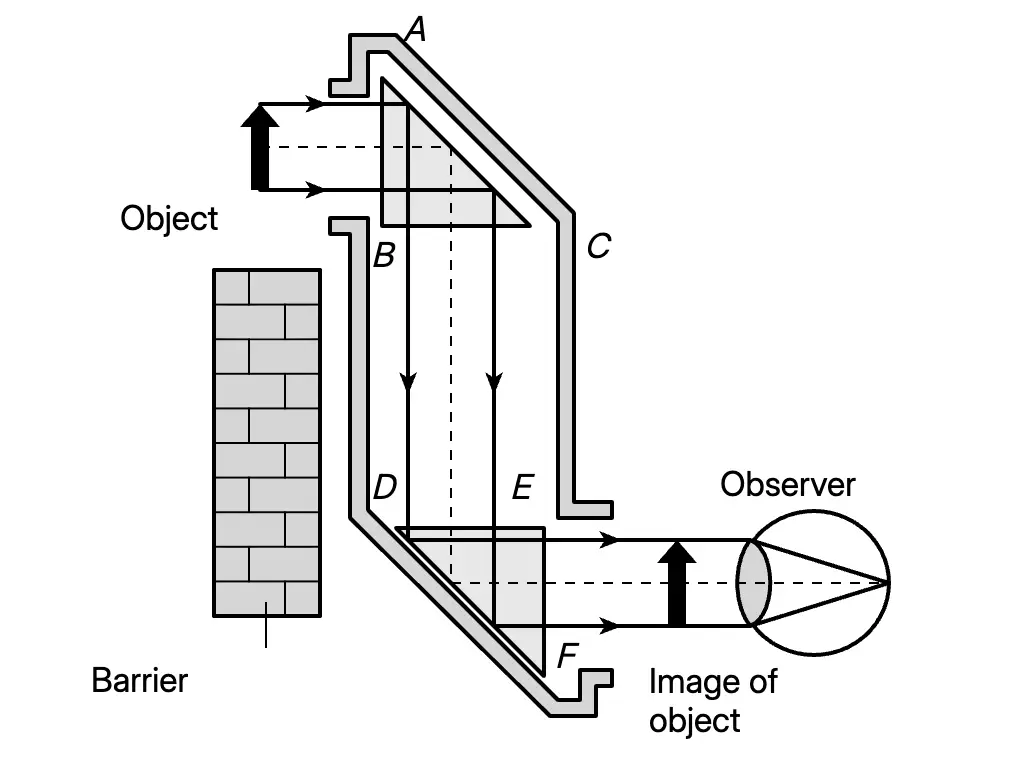
Prism periscope
Two right-angle prisms allow viewing past a barrier. Normal entry gives no bending; incidence of 45∘ exceeds the prism’s critical angle of 42∘. Two internal reflections direct light to the observer. The image is upright and the same size as the object.
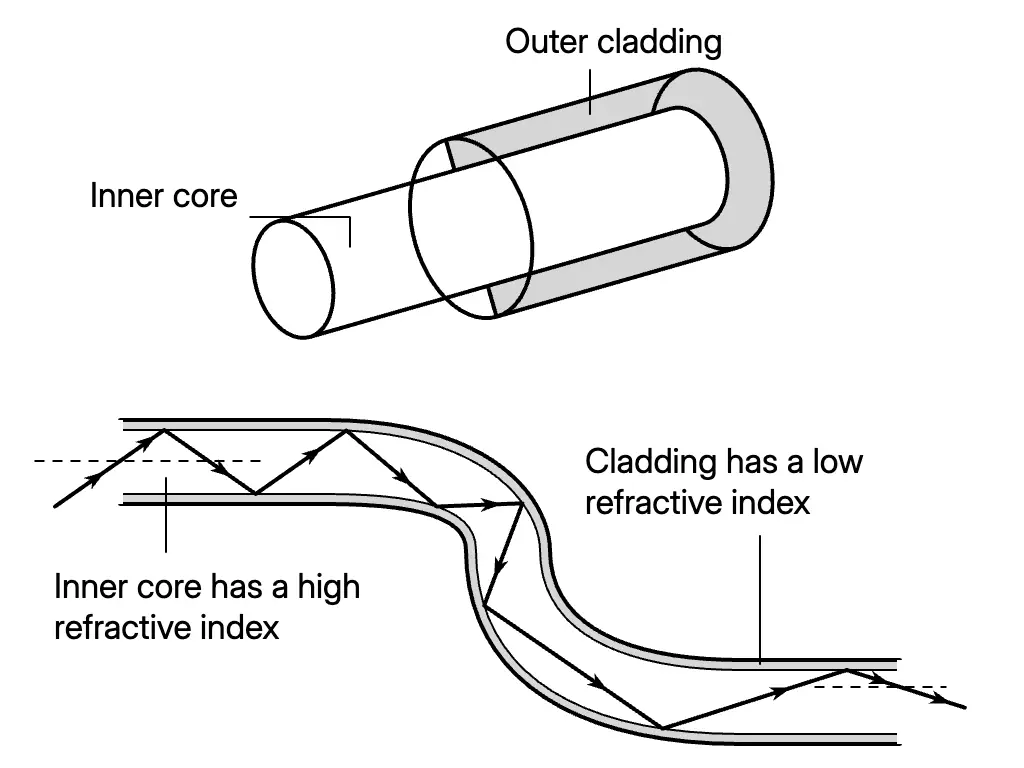
Optical fibre
Pure glass or plastic forms a high-index core surrounded by lower-index cladding. Repeated total internal reflection guides light signals through the core, enabling rapid transmission without electrical signal interference. Used in telecommunications, medical endoscopes and inspection of complex machinery.
Cat’s eye reflector
Car-headlight rays undergo total internal reflection at the back of the reflector and return towards the road user, improving visibility at night.
Prism periscopeOptical fibre
Worked Examples
Prism with n=1.49:c=sin−1(1/1.49)=42.2∘. At each illustrated 45∘ incidence, i>c, so the ray reflects internally; it leaves the final surface along its normal.
Optical fibre with n=1.51: A ray entering from air at 45∘ bends towards the normal:
sinx=1.51sin45∘=0.468,x=27.9∘
The ray undergoes repeated total internal reflection inside the fibre and bends away from the normal on emerging into air. High optical purity keeps the critical angle consistent along the fibre.