4.4 - Gas Laws
Pressure, Temperature and Volume
- Gas molecules move randomly and freely throughout their container.
- Pressure, : molecules collide with the container walls and rebound, exerting a force; force per unit area gives gas pressure. S.I. unit: pascal, Pa; another pressure unit is cm Hg.
- Temperature: higher temperature means greater average molecular kinetic energy. Absolute temperature, , is measured in kelvin, K; other temperature units include and .
- Volume, : gas fills the available space, so its volume equals the container’s volume. S.I. unit: ; other units include , and ml.
Experiment 4.4 - Pressure and Volume
- Inference: volume influences gas pressure.
- Aim: determine the pressure–volume relationship for a fixed mass of gas at constant temperature.
- Hypothesis: smaller volume gives higher pressure.
- Variables: manipulated — volume ; responding — pressure ; constant — temperature and mass of air.
- Apparatus: 100 ml syringe, rubber tube, pressure gauge and retort stand.
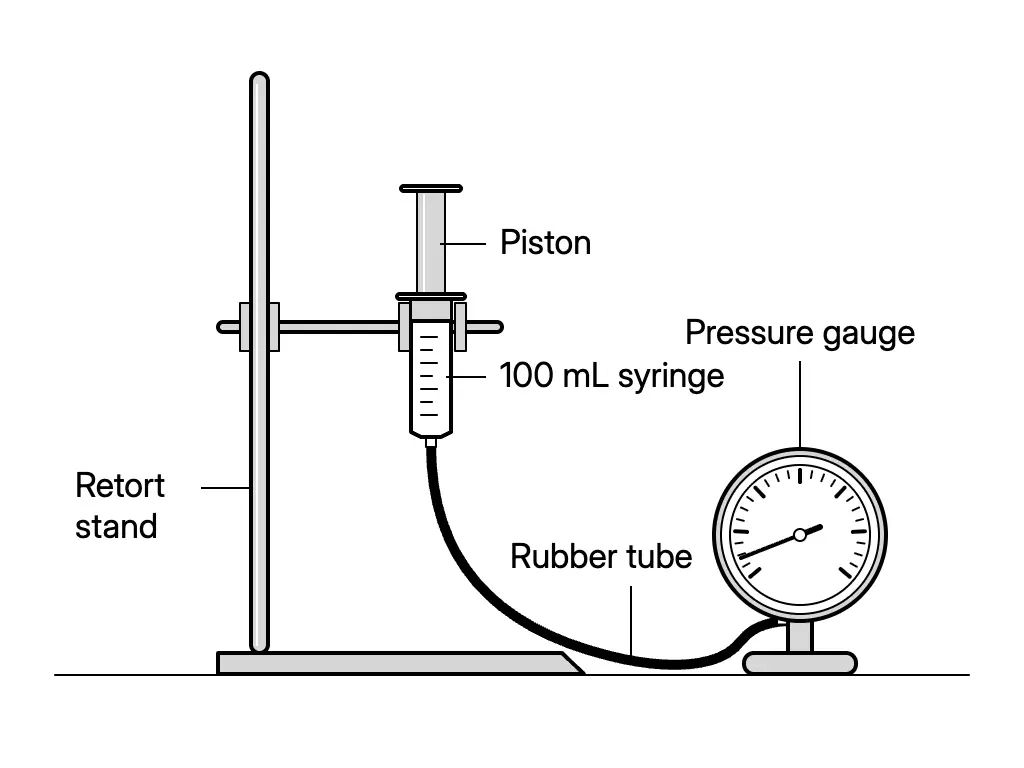
- Set the syringe to 100 ml, then connect its outlet to the pressure gauge using the rubber tube.
- Record initial volume and pressure.
- Push the piston slowly to 90 ml and record pressure; repeat for 80, 70 and 60 ml.
- Tabulate (ml), (kPa) and (); plot against and against .
- Result and conclusion: pressure rises as volume decreases; the straight – graph through the origin establishes .
Boyle’s Law
- For a fixed mass of gas at constant temperature, pressure is inversely proportional to volume:
- Graphs: against is a decreasing curve; against is a straight line through the origin.
- Molecular explanation: reducing volume puts the same number of molecules into a smaller space. Molecules per unit volume increase, wall collisions occur more frequently, and force per unit area increases.
- Example: 60 of air at 108 kPa is compressed to 48 without a temperature change:
Experiment 4.5 - Volume and Temperature
- Inference: temperature influences gas volume.
- Aim: determine the volume–temperature relationship for a fixed mass of gas at constant pressure.
- Hypothesis: higher temperature gives greater volume.
- Variables: manipulated — temperature ; responding — volume , represented by air-column length ; constant — pressure and mass of air.
- Apparatus: capillary tube with air trapped by concentrated sulphuric acid, 500 ml beaker, thermometer, ruler, Bunsen burner, tripod stand, wire gauze, stirrer and retort stand. Materials: water, ice and rubber band.
- Place the capillary tube, ruler and thermometer in the water bath, with the trapped air immersed.
- Heat slowly and stir continuously until the water reaches ; record .
- Repeat at 40, 50, 60, 70 and , tabulating temperature and (cm).
- Plot against with an axis from 0 to ; extrapolate to .
- Replot with an axis from to and extrapolate to .
- The volume–length relationship is , where is the capillary’s uniform cross-sectional area, so represents volume.
- Result and conclusion: volume rises with temperature; its non-zero value at shows that molecules still move. Extrapolation gives absolute zero, and the kelvin graph establishes .
Absolute Temperature
- At , gas molecules still move; the gas has volume and pressure.
- Extrapolating the volume–Celsius-temperature graph at constant pressure to zero volume, or the pressure–Celsius-temperature graph at constant volume to zero pressure, gives .
- This is absolute zero, the lowest possible temperature, corresponding to 0 K. Temperature expressed in kelvin is absolute temperature.
- is the numerical temperature in ; is in K. Melting ice: 273 K; steam at : 373 K.
Charles’ Law
- For a fixed mass of gas at constant pressure, volume is directly proportional to absolute temperature:
- Graphs: against Celsius temperature increases linearly and extrapolates to zero at ; against is a straight line through the origin.
- Molecular explanation: heating increases average kinetic energy and molecular velocity. Volume expands to maintain constant pressure; the wall-collision rate remains unchanged.
- Example: a 1.2 air bubble warms from 27 to at constant pressure:
Experiment 4.6 - Pressure and Temperature
- Inference: temperature influences gas pressure.
- Aim: determine the pressure–temperature relationship for a fixed mass of gas at constant volume.
- Hypothesis: higher temperature gives higher pressure.
- Variables: manipulated — temperature ; responding — pressure ; constant — volume and mass of air.
- Apparatus: round-bottom flask, large beaker, thermometer, pressure gauge, Bunsen burner, wire gauze, tripod stand, stirrer, retort stand and wooden block. Materials: water and ice.
- Immerse the flask containing trapped air in a water bath; connect it to the pressure gauge with a rubber tube. Place the thermometer and stirrer in the bath.
- Heat slowly and stir continuously until the bath reaches ; record air pressure.
- Repeat at 40, 50, 60, 70 and , tabulating temperature and pressure (kPa).
- Plot against with an axis from to ; extrapolate to .
- Result and conclusion: pressure rises with temperature; extrapolation gives , while the kelvin graph establishes .
Gay-Lussac’s Law
- For a fixed mass of gas at constant volume, pressure is directly proportional to absolute temperature:
- Graphs: against Celsius temperature increases linearly and extrapolates to zero at ; against is a straight line through the origin.
- Molecular explanation: heating increases average kinetic energy and molecular velocity. At unchanged volume, molecules collide with walls more frequently, increasing force per unit area and pressure.
- Example: gas at 180 kPa in a closed steel cylinder warms from 25 to at constant volume:
Selecting a Law and Solving Problems
- Identify the constant quantity and retain fixed gas mass. Use consistent pressure units and consistent volume units; convert temperatures to K for temperature ratios.
- Constant temperature: a syringe changes from 7.5 to 2.5 , initially at 105 kPa:
- Constant pressure: 0.24 of air warms from 27 to :
- Constant volume: tyre pressure rises from 210 to 240 kPa, initially at . Assume the tyre volume does not change:
Answer practice questions to test your knowledge
Practice