Heat capacity, C: heat required to raise an object’s temperature by 1∘C.
C=ΔθQ
Q is heat supplied in joules; Δθ is temperature change in ∘C. Unit of C: J∘C−1.
For the same heat supplied, an object with a higher heat capacity has a smaller temperature rise.
Example: supplying 100 J raises X by 1∘C and Y by 2∘C; CX=100J∘C−1 and CY=50J∘C−1.
For the same substance, greater mass gives greater heat capacity: a full kettle takes longer to boil than a half-filled kettle; a large bowl of soup remains hotter than a small bowl after cooling for the same period.
Under sunlight for the same period, sand heats up faster than sea water because sand has a lower heat capacity.
A car dashboard has a lower heat capacity than its fabric cushion and experiences a greater temperature rise under sunlight. Cement courts and grass also show different temperatures at noon.
Specific Heat Capacity
Specific heat capacity, c: heat required to raise the temperature of 1 kg of a substance by 1∘C.
c=mΔθQ,Q=mcΔθ
m is mass in kg; Δθ is temperature change in ∘C or K. Units of c: Jkg−1∘C−1 or Jkg−1K−1.
Heat capacity describes an object and depends on its mass; specific heat capacity compares substances on a 1 kg basis.
Aluminium’s c=900Jkg−1∘C−1: 1 kg needs 900 J for a 1∘C rise.
Water’s high c allows it to absorb much heat with a small temperature rise, making it a good cooling agent.
Metals generally have lower specific heat capacities than non-metals and heat up quickly when heat is supplied.
Substance
c / Jkg−1∘C−1
Water; sea water
4 200; 3 900
Ethanol; paraffin
2 500; 2 100
Cooking oil; olive oil
1 850; 1 890
Methane; steam at 100∘C
2 200; 2 020
Neon; air
1 030; 1 000
Aluminium; iron; copper
900; 450; 390
Gold; mercury; lead
300; 140; 130
Polycarbonate; wood
1 250; 1 700
Concrete; sand; glass
850; 800; 670
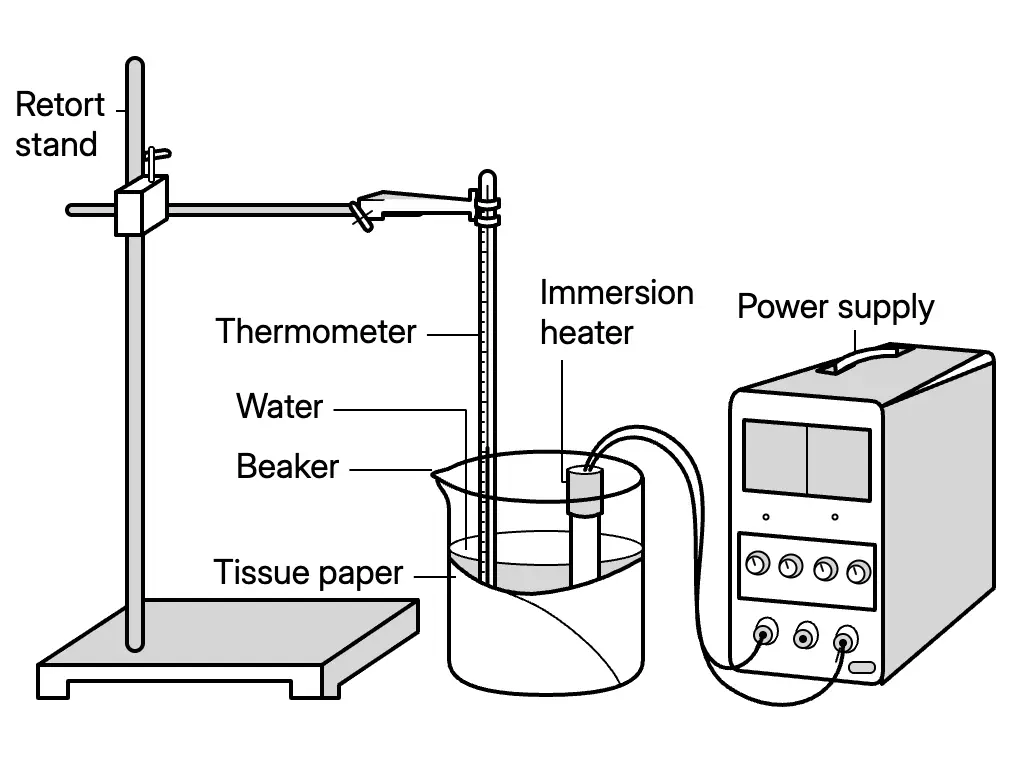
Experiment 4.1 - Specific Heat Capacity of Water
Aim: determine the specific heat capacity of water.
Apparatus: power supply, immersion heater, beaker, stopwatch, thermometer, retort stand and electronic balance. Materials: water and tissue paper.
Apparatus for determining the specific heat capacity of water
Wrap the beaker in tissue paper. Place it on the balance and zero the reading.
Fill it three-quarters full with water and record water mass, m.
Immerse the heater and thermometer in the water, with the thermometer supported by the retort stand. Record initial temperature, θ1.
Switch on the heater and start timing together; observe the temperature reading.
After five minutes, switch off the heater. Record the highest reading as final temperature, θ2.
Record heater power P (W), heating time t (s), mass m (kg) and both temperatures.
The immersion heater converts electrical energy into heat: Q=Pt; hence Pt=mc(θ2−θ1).
c=m(θ2−θ1)Pt
Experiment 4.2 - Specific Heat Capacity of Aluminium
Aim: determine the specific heat capacity of aluminium.
Apparatus: power supply, immersion heater, 1 kg aluminium block, stopwatch, thermometer and retort stand. Material: tissue paper.
Wrap the block in tissue paper and fit the heater and thermometer into the block’s holes.
Record initial block temperature, θ1.
Switch on the heater and start timing together.
After five minutes, switch off the heater and record the highest thermometer reading, θ2.
Record P, t, m, θ1 and θ2; calculate c=Pt/[m(θ2−θ1)].
Applications and Natural Phenomena
Application
Explanation
Wooden houses
Wood heats slowly because of its high specific heat capacity; its insulating property also limits heat entering in hot climates or escaping in cold climates.
Woks and clay pots
Metal woks heat quickly for rapid frying. Clay pots have a high specific heat capacity and keep food hot longer.
Car radiator
A pump circulates water through the engine block to absorb heat, then to the radiator; fan-drawn cool air removes heat through cooling fins.
Space capsule
The outer layer needs a high specific heat capacity and melting point to withstand heating during atmospheric re-entry.
Green buildings
The Diamond Building uses a concrete roof insulated with styrofoam boards. Styrofoam has a high specific heat capacity, reducing heat absorption and indoor temperature.
Pot body and handle
Aluminium bodies heat quickly; plastic handles heat slowly and are safer to hold.
Sea breeze, daytime: land has a lower specific heat capacity than the sea and heats faster. Warm air above land rises; cooler air moves from sea to land.
Land breeze, night: the sea has a higher specific heat capacity than land and cools more slowly. Warm air above the sea rises; cooler air moves from land to sea.
Worked Calculations
Heating a metal block:m=0.5kg, P=50W, t=90s; temperature rises from 20 to 45∘C.
c=0.5(45−20)50(90)=360Jkg−1∘C−1
Assumption: all heater energy enters the block; no heat is lost to the surroundings.
Mixing water: 20 g at 100∘C is mixed with 200 g at 28∘C. With final temperature y, equate heat released = heat absorbed:
0.02(4200)(100−y)=0.20(4200)(y−28)
924y=31920,y=34.55∘C
Assumption: heat passes only between the two water portions; none is exchanged with the surroundings.
Cluster Homes and Extreme Heat
Cluster homes share three walls with neighbouring homes; doors and windows are at the front. This arrangement saves land, but residents can experience extreme heat during El Nino.