Matter exists as solid, liquid and gas. Molecular bonds are stronger in solids than liquids; gas molecules move freely and have the weakest bonds.
Latent heat is absorbed or released during a change of phase without a temperature change.
Melting (solid to liquid) and boiling (liquid to gas) absorb heat. Freezing (liquid to solid) and condensation (gas to liquid) release heat.
The heat required for a phase change depends on the mass and type of substance.
Specific latent heat, l: heat absorbed or released when 1 kg of a substance changes phase without changing temperature.
l=mQ,Q=ml
Q is heat in J; m is mass in kg. S.I. unit of l: Jkg−1.
Specific latent heat of fusion, lf: heat absorbed in melting, or released in freezing, 1 kg at constant temperature.
Specific latent heat of vaporisation, lv: heat absorbed in boiling, or released in condensation, 1 kg at constant temperature.
Temperature depends on average molecular kinetic energy. During phase change, latent heat changes molecular bonds rather than increasing or decreasing this average kinetic energy.
Heating and Cooling Curves
Stage
Molecular explanation
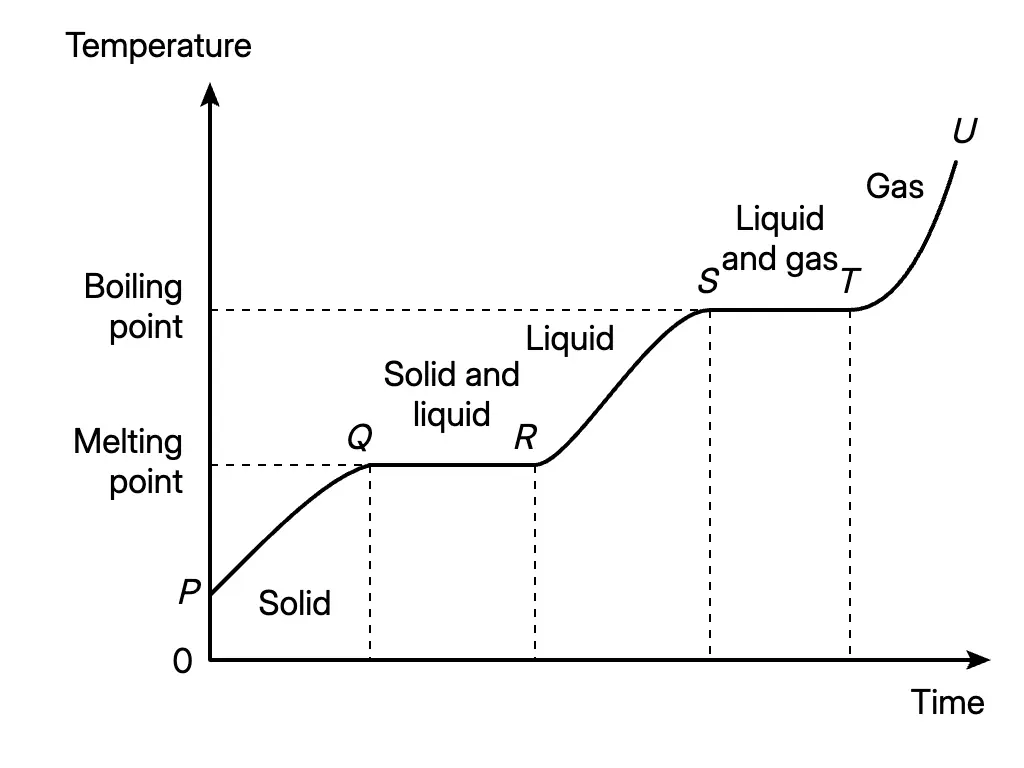
Heating a solid, liquid or gas
Heat absorption increases molecular kinetic energy and temperature.
Melting plateau
Solid and liquid coexist. Absorbed latent heat weakens bonds and frees molecules from fixed positions; temperature remains constant until all solid melts.
Boiling plateau
Liquid and gas coexist. Absorbed latent heat breaks bonds and separates molecules far apart; temperature remains constant until all liquid boils.
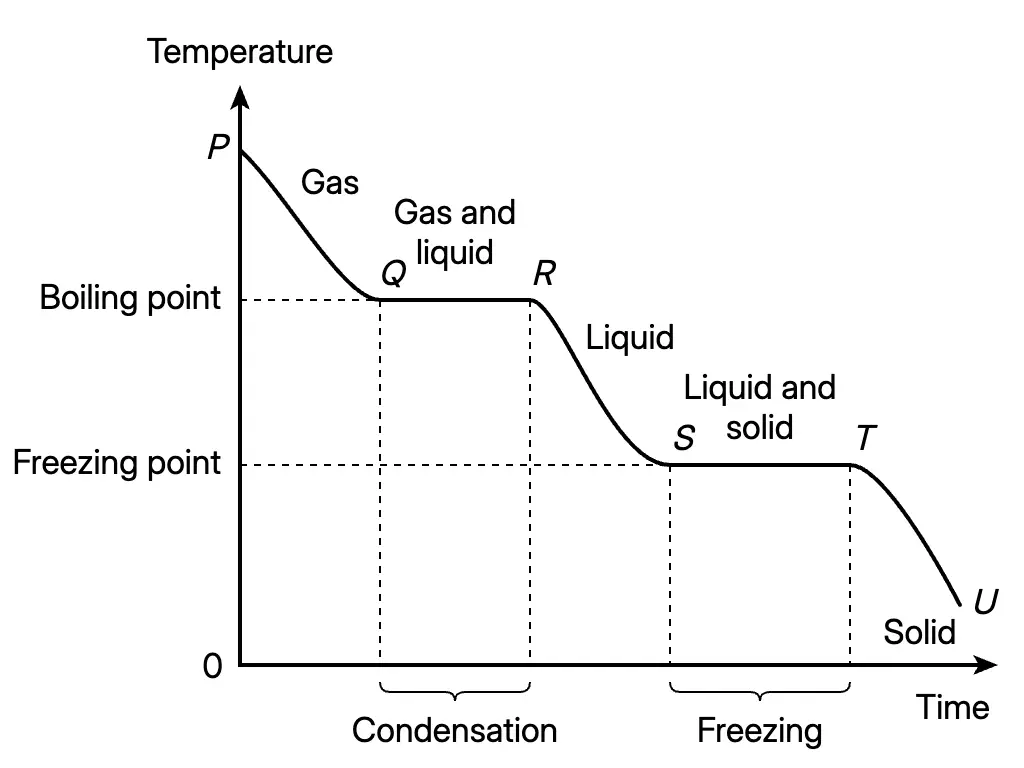
Cooling a gas, liquid or solid
Heat release decreases molecular kinetic energy and temperature.
Condensation plateau
Gas and liquid coexist. Latent heat is released as molecular bonds form; temperature remains constant until all gas condenses.
Freezing plateau
Liquid and solid coexist. Latent heat is released as bonds strengthen and molecules vibrate around fixed positions; temperature remains constant until all liquid freezes.
Heating curveCooling curve
Comparing Substances
Each substance has its own specific latent heat. Ice requires more heat per kilogram to melt than wax; water requires more heat per kilogram to vaporise than petrol.
Substance
Melting point / ∘C
lf / Jkg−1
Wax
46–68
1.45×10⁵–2.10×10⁵
Lead
327
0.25×10⁵
Copper
1 083
2.07×10⁵
Ice
0
3.34×10⁵
Olive oil
6
2.67×10⁵
Ethanol
−114
1.04×10⁵
Oxygen
−219
0.14×10⁵
Nitrogen
−210
0.26×10⁵
Substance
Boiling point / ∘C
lv / Jkg−1
Lead
1 750
8.59×10⁵
Copper
2 566
47.3×10⁵
Water
100
2.26×10⁶
Petrol
35–200
3.49×10⁵
Diesel
180–360
2.56×10⁵
Ethanol
78
8.55×10⁵
Oxygen
−183
2.13×10⁵
Nitrogen
−196
2.00×10⁵
Petrol and diesel are different hydrocarbons with different boiling ranges.
Vaporisation requires more heat per kilogram than fusion of the same substance: boiling breaks molecular bonds and separates molecules far apart; melting weakens bonds while molecules remain close.
Experiment 4.3A - Specific Latent Heat of Fusion of Ice
Aim: determine lf of ice.
Apparatus: immersion heater, filter funnels, beakers, electronic balances, power supply, stopwatch and retort stands. Material: crushed ice.
Zero each balance with its collecting beaker in place.
Prepare an experiment set with a heater in crushed ice in a funnel, and a control set with a switched-off heater in crushed ice in a funnel. Initially keep collecting beakers and balances away from the funnels.
Switch on the experiment-set heater only. Once water drips at a steady rate, put the beakers and balances under their funnels and start timing.
After 10 minutes, record collected water masses: experiment set m1 and control set m2.
Switch off the heater and record its power, P.
Record m1, m2 (kg), P (W) and t (s). Use the mass difference in the calculation:
lf=m1−m2Pt
Experiment 4.3B - Specific Latent Heat of Vaporisation of Water
Aim: determine lv of water.
Apparatus:500 W immersion heater, power supply, beaker, electronic balance and stopwatch. Materials: water and tissue paper.
Set the tissue-wrapped beaker of water and immersion heater on the balance.
Switch on the heater and wait until the water boils.
At boiling, start timing and record initial balance reading, m1.
After five minutes, record final reading, m2.
Switch off the heater and record its power, P.
Record m1, m2 (kg), t (s) and P (W). The decrease in mass is the water vaporised:
lv=m1−m2Pt
Cooling and Heating Applications
Evaporation causes cooling: liquid molecules absorb heat from the surroundings to break bonds and become vapour; the surroundings lose heat.
Condensation releases latent heat for heating, including steaming food and heating espresso coffee.
Sweat evaporation: sweat absorbs heat from the body as it evaporates. Air circulation increases the evaporation rate.
Refrigerators and air conditioners use cooling from evaporation. In a refrigerator, the cooling agent circulates through these stages:
The compressor compresses the gas, increasing its pressure and temperature.
In the condenser, the gas condenses and releases latent heat outside.
The liquid flows through the expansion valve.
In the evaporator, it evaporates and absorbs latent heat from inside the refrigerator.
The gas returns to the compressor.
Worked Calculations
Melting ice: a 480 W heater operates for 120 s; the balance reading decreases by 0.172 kg as melted water drains away. The ice mass melted is 0.172 kg.
lf=0.172480(120)=3.35×10⁵Jkg−1
Assumptions: only the heater melts the ice; all meltwater leaves the container; all heater energy is absorbed by the ice; no heat enters from the surroundings.
Water to steam: change 0.75 kg water at 30∘C to steam at 100∘C in two stages: heat water to its boiling point, then vaporise it without further temperature rise.
Q=mcΔθ+mlv
Q=0.75(4.20×10³)(100−30)+0.75(2.26×10⁶)=1.92×10⁶J
Assumptions: all heater energy is absorbed by the water; no heat is lost during heating or phase change.