2.4 - Inertia
Inertia and Newton’s First Law of Motion
- Inertia is an object’s tendency to retain its state of rest or straight-line motion at constant velocity.
- Newton’s First Law of Motion: an object remains at rest or moves at uniform velocity unless an external force acts on it.
- When a tablecloth is jerked quickly, objects on it tend to remain at rest. Similarly, a coin tends to remain at rest when the thin cardboard supporting it is jerked horizontally.
Mass and the Inertial Balance
- Greater mass means greater inertia: a bowling ball is harder to set in motion or stop than a lighter football.
- The horizontal oscillation of an inertial balance is not affected by gravitational force; its period depends on the mass attached.
- An inertial balance can determine astronauts’ body mass from their oscillation periods in a spaceship.
Experiment 2.2: Relationship between Inertia and Mass
- Inference: inertia depends on mass.
- Hypothesis: the greater an object’s mass, the greater its inertia.
- Aim: investigate the relationship between inertia and mass.
- Manipulated variable: mass of plasticine, .
- Responding variable: period of oscillation, .
- Constant variable: distance between the G-clamp and plasticine.
- Apparatus: stopwatch, G-clamp, ruler and jigsaw blade.
- Materials: plasticine of masses 20.0, 30.0, 40.0, 50.0 and 60.0 g.
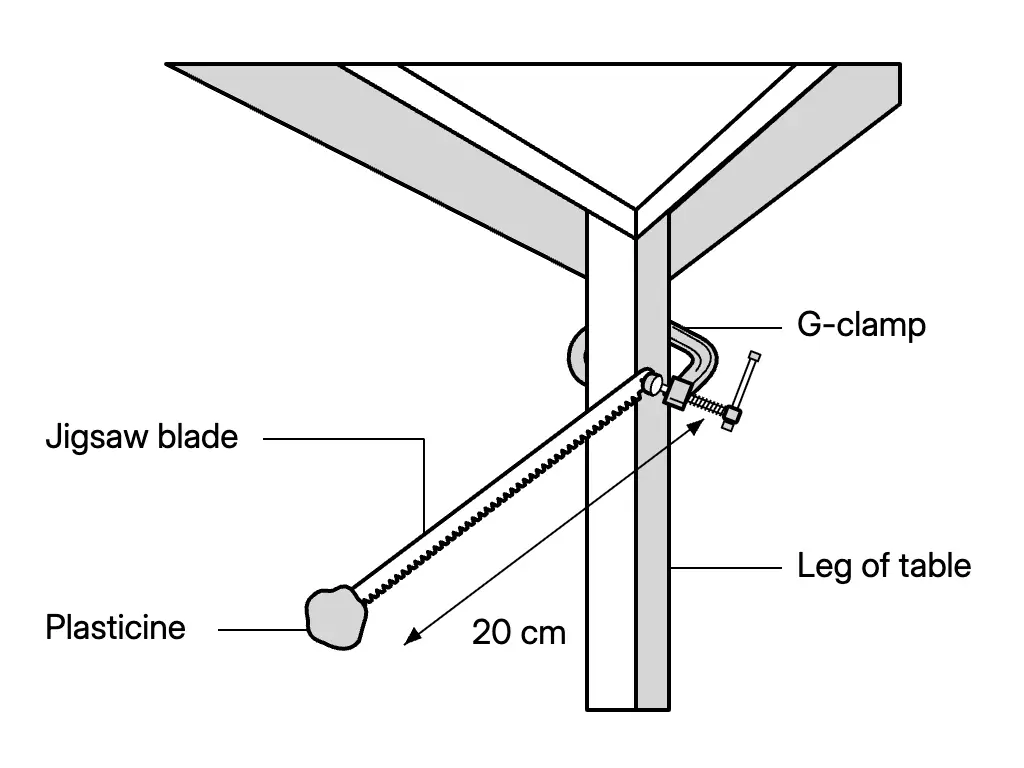
- Clamp the jigsaw blade to a table leg and attach 20.0 g of plasticine to its free end. Keep the clamp-to-plasticine distance at 20 cm.
- Displace the free end horizontally and release it to oscillate.
- Record time for 10 complete oscillations.
- Repeat the timing to obtain .
- Repeat with the other four masses, keeping the clamp-to-plasticine distance fixed.
- Calculate the mean time and period; analyse a graph of against :
- Record each mass, the two times, mean time and period.
- Conclusion: inertia increases with mass; the balance’s horizontal oscillation depends on the attached mass.
Effects in Daily Life
| Situation | Explanation or protective measure |
|---|---|
| Wet umbrella | When rotation stops suddenly, moving water droplets continue moving and leave the umbrella. |
| Bus passengers | A sudden start throws passengers backwards as their bodies tend to remain at rest; a sudden stop throws them forwards as they tend to keep moving. |
| Sauce bottle | Sauce continues downwards and leaves the bottle when the downward-moving bottle stops suddenly. |
| Oil tanker | Separate tank compartments reduce the impact of the petrol’s inertia on the tank walls during sudden stopping. |
| Roller coaster | Restraints keep riders seated when speed and direction change suddenly. |
| Car occupants | Seat belts prevent occupants from being thrown forwards and injured when a car stops abruptly. |
Answer practice questions to test your knowledge
Practice