2.3 - Free Fall Motion
Free Fall and Gravitational Acceleration
- Free fall occurs when gravity is the only force affecting an object’s motion; air resistance and friction are absent or neglected.
- In air, resistance can cause objects to fall at different rates. In a vacuum, objects of different masses fall with the same acceleration: a feather and a ball bearing released together from the same height reach the floor together.
- Gravitational acceleration, , is acceleration caused by gravitational force. Near Earth’s surface, its average value is .
- In a uniform gravitational field, a freely falling object’s downward velocity increases by each second.
- Galileo’s demonstrations established equal falling acceleration when air resistance is neglected, contrary to Aristotle’s view that falling rate depended on weight, shape and orientation.
Experiment 2.1: Determining Earth’s Gravitational Acceleration
- Aim: determine Earth’s gravitational acceleration.
- Apparatus: photogate system, electronic timer, electromagnetic release, steel ball and a container to catch the ball. The setup places two photogates below the release on a tripod stand with a height adjuster.
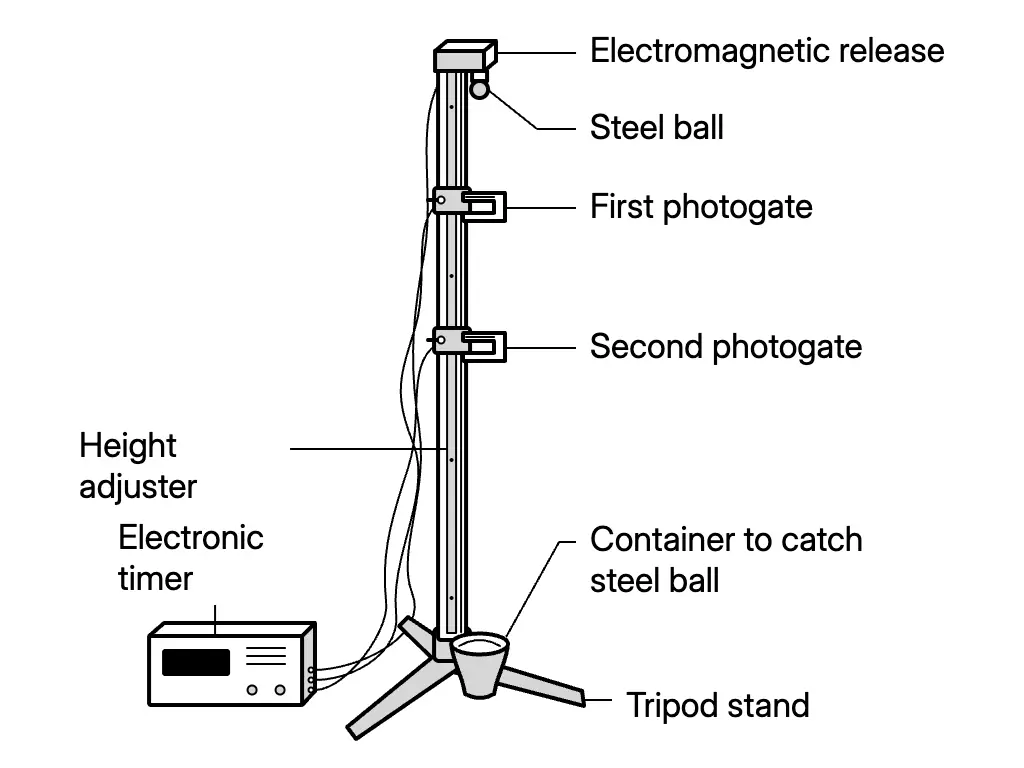
- Position the second photogate 30.0 cm below the first. Align the ball so that it passes through both photogates into the container.
- Release the steel ball using the electromagnetic release.
- Record the elapsed times from release to the first and second photogates as and .
- Repeat with photogate separations of 40.0, 50.0, 60.0 and 70.0 cm.
- For each separation , calculate with in metres, then calculate the mean of the five values:
The recorded quantities are , , and calculated . Compare the mean with the equatorial value .
Variation of Gravitational Acceleration
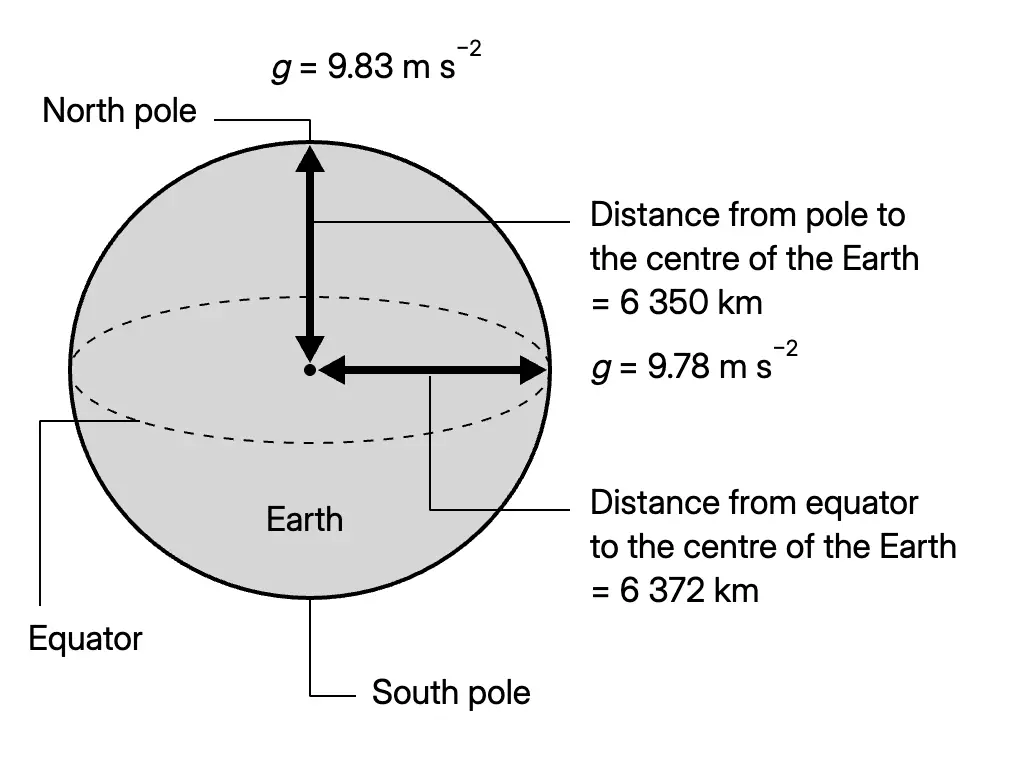
- Earth is not a perfect sphere. Its equatorial surface is farther from its centre than its polar surface.
- At the equator, the distance to Earth’s centre is 6372 km and .
- At the poles, the distance is 6350 km and .
- The equatorial value is therefore smaller. The general value used for surface calculations is .
Vertical Motion Equations and Signs
For motion under gravity alone:
- Taking upwards as positive, downward acceleration is .
- A ball thrown upwards has positive initial velocity; its velocity becomes zero at maximum height.
- An object released from rest has . Downward displacement and velocity are negative under this sign convention.
Amirah’s ball, thrown vertically upwards at , neglecting air resistance:
Chan’s stone, released from a 10 m cliff, neglecting air resistance:
Choose the positive time and the downward velocity; the stone reaches the ground moving downwards.
Answer practice questions to test your knowledge
Practice