5.4 - Hydrogen Bond
Formation of Hydrogen Bonds
- A hydrogen bond is an attraction between:
- a hydrogen atom covalently bonded to a highly electronegative nitrogen, oxygen or fluorine atom; and
- a nitrogen, oxygen or fluorine atom in another molecule.
- Icebergs float because ice is less dense than water.
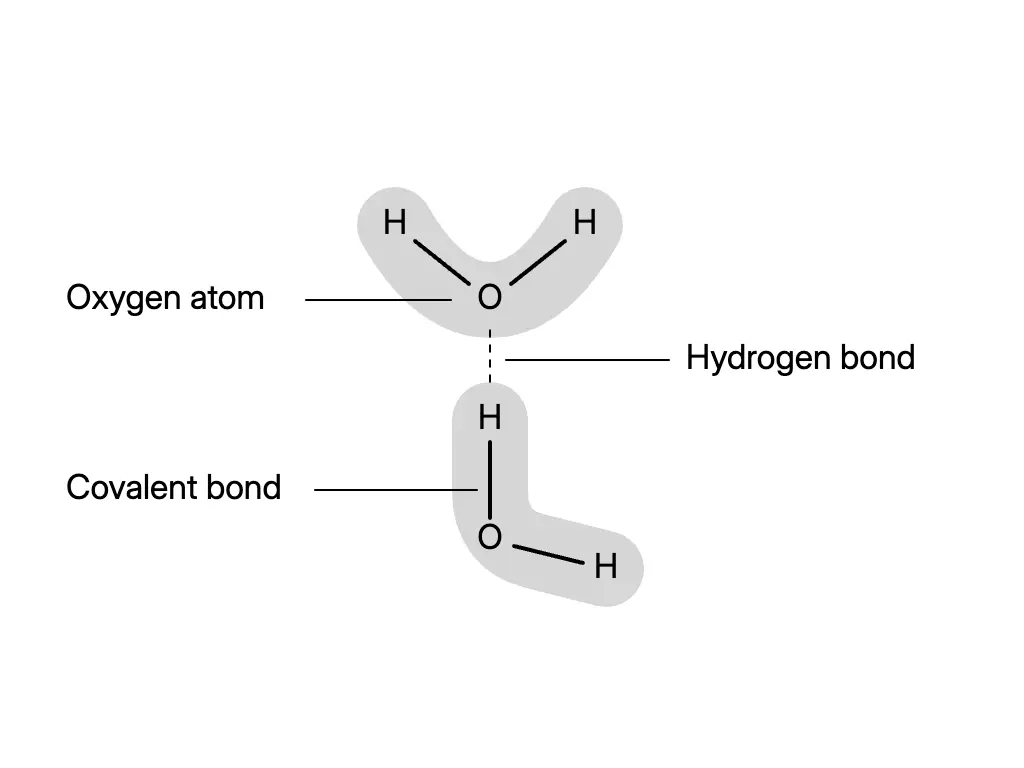
- Within a water molecule, hydrogen and oxygen are joined by covalent bonds. A hydrogen bond forms between a hydrogen atom in one water molecule and an oxygen atom in another water molecule.
- Hydrogen fluoride, , and ammonia, , can also form hydrogen bonds between their molecules.
Roles in Daily Life
- Protein molecules in dry hair form hydrogen bonds with one another.
- When hair is wet, the protein molecules stop forming hydrogen bonds with one another and instead form hydrogen bonds with water molecules. Water molecules bridge different hair proteins. This makes wet hair stick together.
- Cellulose contains hydrogen atoms bonded to oxygen atoms. Water on a wet finger forms hydrogen bonds with cellulose, causing paper to stick to the finger.
Effects on Physical Properties
Boiling Point
- A liquid boils when attraction forces between its molecules are overcome.
- Ethanol, , has hydrogen bonds as well as weak Van der Waals attraction forces between its molecules.
- More heat is required to overcome both forces, so ethanol has a higher boiling point than molecules such as chlorine that do not form hydrogen bonds.
Solubility in Water
- Ethanol dissolves in water because hydrogen bonds form between ethanol molecules and water molecules.
- The oxygen atom in ethanol can form a hydrogen bond with a hydrogen atom in water; the hydrogen of ethanol’s hydroxyl group can form a hydrogen bond with an oxygen atom in water.
Answer practice questions to test your knowledge
Practice