5.2 - Ionic Bond
Formation of Ions
- An ionic bond involves electron transfer between a metal atom and a non-metal atom.
- A metal atom donates valence electron(s) and becomes a positively charged ion, or cation.
- A non-metal atom accepts electron(s) and becomes a negatively charged ion, or anion.
- Electron transfer gives both ions a stable duplet or octet electron arrangement.
For sodium and fluorine:
- A sodium atom, with electron arrangement 2.8.1, donates one electron to form with arrangement 2.8.
- A fluorine atom, with arrangement 2.7, accepts one electron to form with arrangement 2.8.
- Donating one electron is easier for sodium than accepting seven; accepting one is easier for fluorine than donating seven.
- has 11 protons and 10 electrons, giving a net charge of +1. has 9 protons and 10 electrons, giving a net charge of −1.
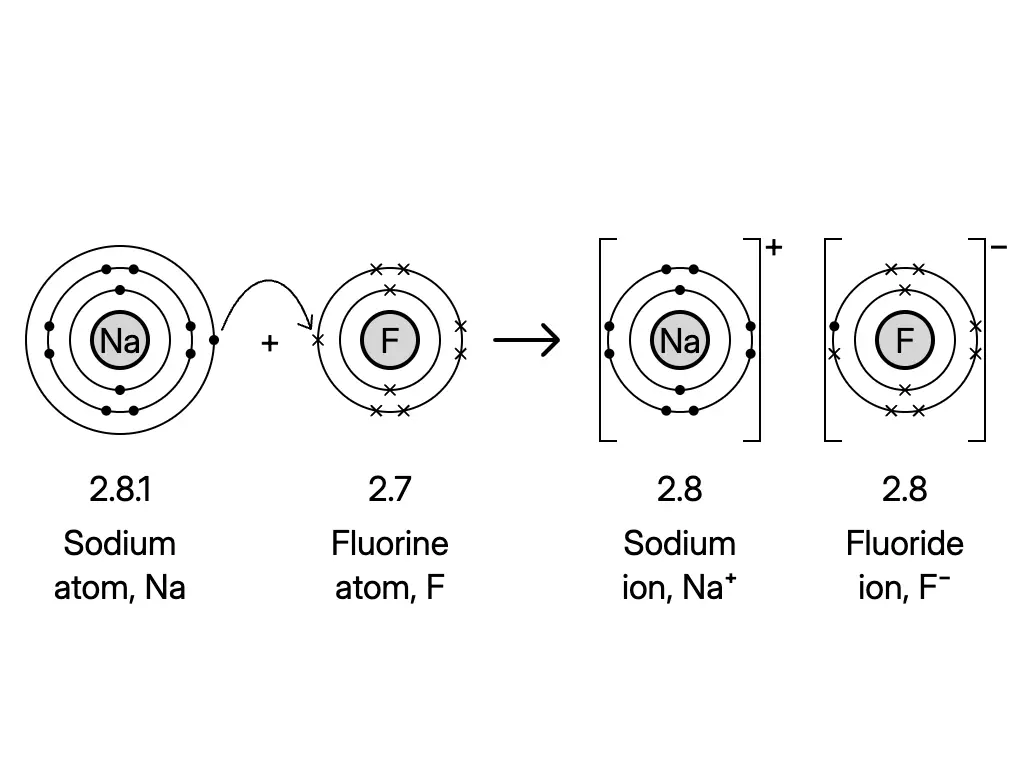
Formation of an Ionic Bond
Oppositely charged ions attract one another through a strong electrostatic attraction force.
This electrostatic attraction is the ionic bond.
In sodium fluoride, and attract to form the ionic compound .
Ionic compounds are electrically neutral overall: the total positive charge equals the total negative charge.
- Other ionic-compound examples include magnesium oxide, ; sodium chloride, ; and sodium oxide, .
- Sodium fluoride is added to toothpaste to strengthen teeth.
Answer practice questions to test your knowledge
Practice