Sexual Reproduction, Development and Growth in Humans and Animals
15.2 - Gametogenesis in Humans
The Necessity of Gametogenesis
- Gametogenesis is the production of reproductive cells (gametes) in the gonads: testes in males and ovaries in females.
- It produces haploid gametes ().
- During fertilisation, the sperm nucleus fuses with the ovum nucleus in the Fallopian tube to form a diploid zygote ().
Spermatogenesis
- Spermatogenesis is sperm production in the seminiferous tubules.
- Sertoli cells provide nutrients during sperm production.
- Sperms move from the seminiferous tubules to the epididymis and leave through the sperm duct.
- FSH and testosterone stimulate spermatogenesis; LH stimulates testosterone secretion in the testes.
Stages of Spermatogenesis
- Primordial germ cells divide by mitosis to form diploid spermatogonia ().
- Spermatogonia grow into diploid primary spermatocytes ().
- Each primary spermatocyte undergoes meiosis I to form two haploid secondary spermatocytes ().
- Each secondary spermatocyte undergoes meiosis II to form two haploid spermatids (); four spermatids form in total.
- Spermatids differentiate and specialise to form sperms.
Oogenesis
- Oogenesis is the production of secondary oocytes or female gametes in the ovaries.
- It begins before birth.
Stages of Oogenesis
- Before birth, primordial germ cells divide by mitosis to form diploid oogonia ().
- Each oogonium develops into a primary oocyte enclosed by follicular cells, forming a primary follicle. The primary oocyte starts meiosis I but stops at prophase I.
- From puberty to menopause, FSH stimulates follicle development every month.
- The primary oocyte completes meiosis I, forming a large secondary oocyte () and a small first polar body ().
- The secondary oocyte starts meiosis II and stops at metaphase II; the mature Graafian follicle releases it during ovulation.
- If a sperm penetrates it, the secondary oocyte completes meiosis II to form an ovum and a polar body. The remaining polar bodies disintegrate.
- After ovulation, the remaining follicle forms the corpus luteum. With fertilisation, it secretes oestrogen and progesterone; without fertilisation, it and the secondary oocyte degenerate and are removed through menstruation.
Structure of Sperm and Graafian Follicle
Structure of a Sperm
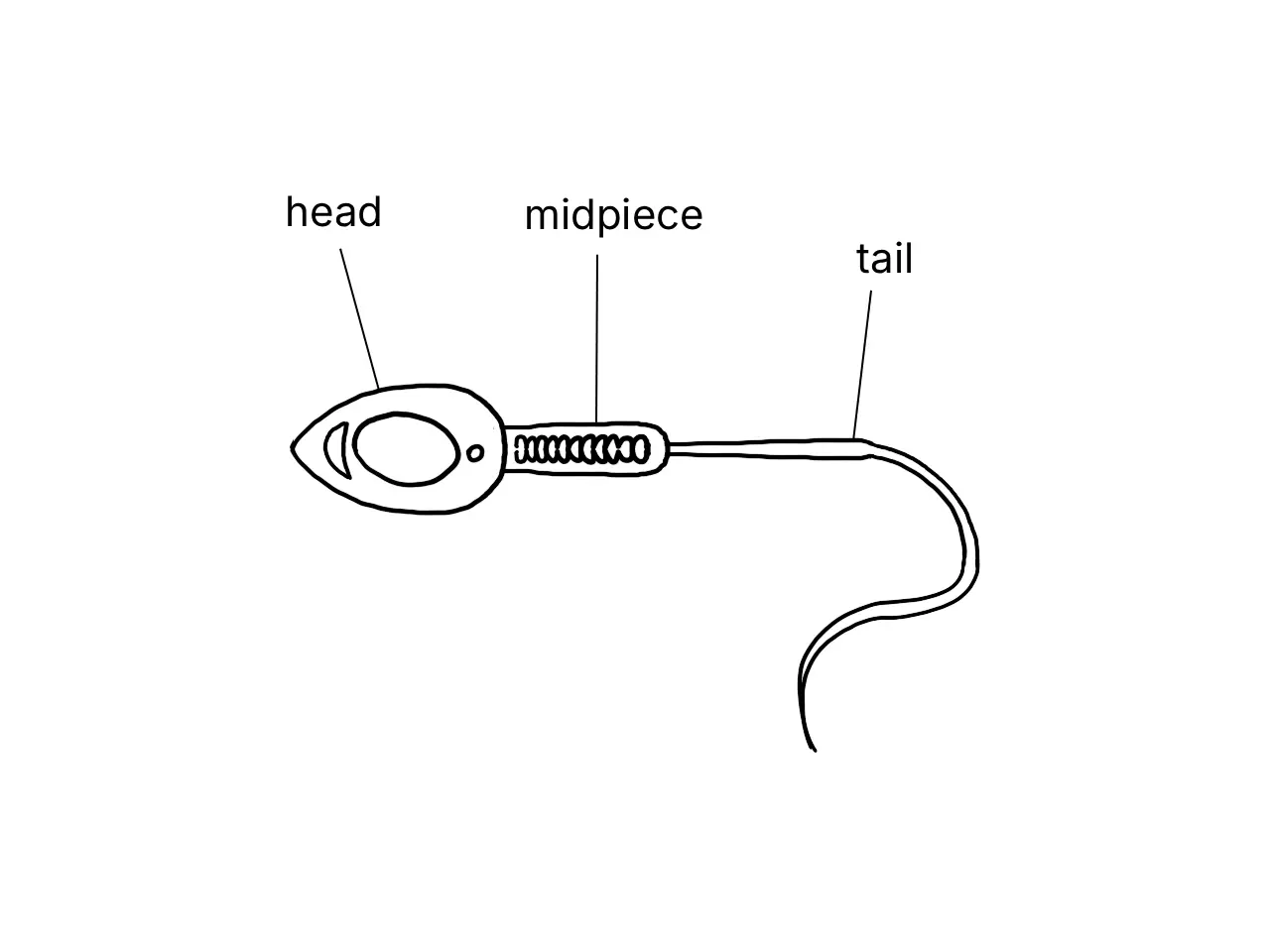
- Head: Contains the nucleus.
- Midpiece: Packed with mitochondria that generate energy for swimming.
- Tail: Enables the sperm to swim to the Fallopian tube for fertilisation.
Structure of a Graafian Follicle
- A large secondary oocyte is surrounded by a jelly coat and follicular cells.
- The secondary oocyte and follicular cells form the Graafian follicle.
Comparison between Spermatogenesis and Oogenesis
Similarities
- Both are gametogenesis processes in reproductive organs.
- Both produce haploid gametes involved in fertilisation.
Differences
| Spermatogenesis | Oogenesis |
|---|---|
| Occurs in the testes. | Occurs in the ovaries. |
| One spermatogonium produces four functional sperms after meiosis. | One oogonium produces one functional secondary oocyte and three non-functional polar bodies after meiosis. |
| Sperms are small and have a head, midpiece and tail. | Secondary oocytes are large and spherical. |
| Meiosis I produces two secondary spermatocytes. | Meiosis I produces one secondary oocyte and one polar body. |
| Meiosis is completed. | Meiosis II is completed only after fertilisation. |
| Spermatids differentiate into sperms. | The secondary oocyte does not differentiate. |
| Continuous from puberty to old age; millions form daily. | Begins in the female foetus, resumes at puberty, stops at menopause; one secondary oocyte is released per menstrual cycle. |
Answer practice questions to test your knowledge
Practice