6.2 — Chemical Cell
Simple Chemical Cell
- A simple chemical cell consists of:
- two different metals immersed in an electrolyte;
- an external circuit connecting the metals with connecting wires.
- Chemical changes in the cell produce electric current.
- Energy conversion: chemical energy → electrical energy.
- The positions of the two metals in the electrochemical series determine their terminals:
- The more electropositive metal donates electrons more readily and becomes the negative terminal.
- The less electropositive metal becomes the positive terminal.
- Electrons flow through the external circuit from the negative terminal to the positive terminal.
Magnesium–Copper Chemical Cell
- Components:
- Magnesium electrode.
- Copper electrode.
- Copper(II) sulphate solution, , as the electrolyte.
- Voltmeter and connecting wires in the external circuit.
- Magnesium is above copper in the electrochemical series and is more electropositive.
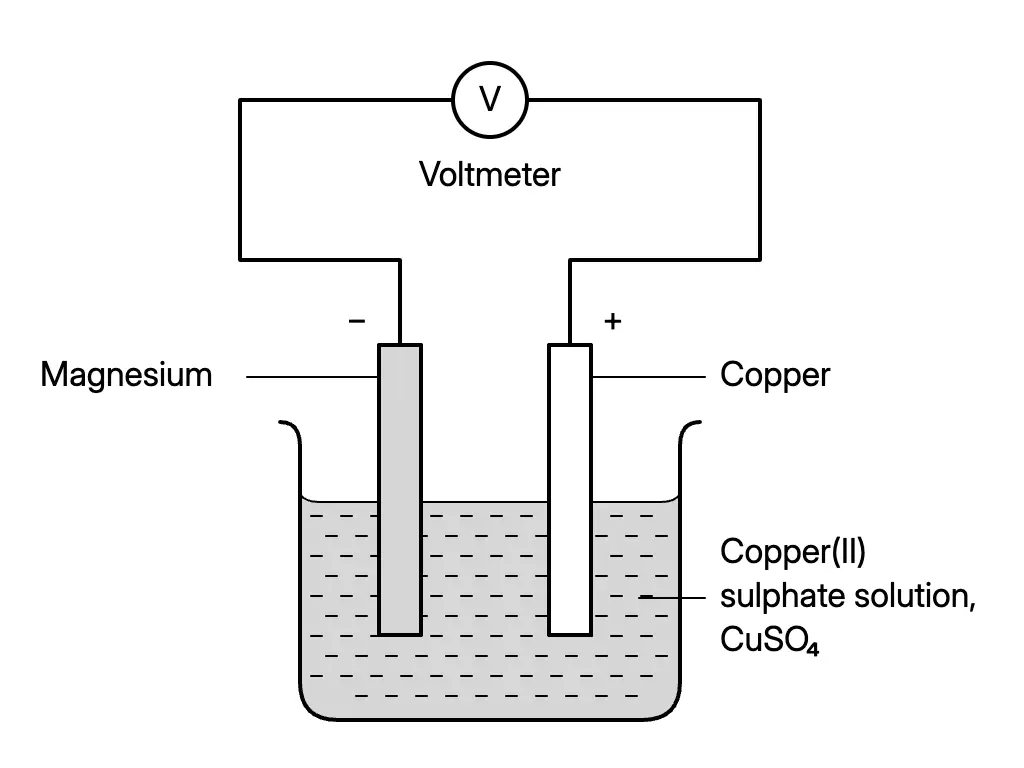
At magnesium—the negative terminal
- Magnesium donates electrons more readily than copper.
- Magnesium atoms form magnesium ions and dissolve in the copper(II) sulphate solution.
- The released electrons flow through the external circuit from magnesium to copper.
At copper—the positive terminal
- Electrons from magnesium reach the copper electrode.
- Copper(II) ions receive the electrons instead of hydrogen ions because copper(II) ions are less electropositive than hydrogen ions.
- Solid copper forms and is deposited on the copper strip.
Energy and electron-flow summary
- Chemical reactions release electrons at magnesium.
- The movement of electrons through the external circuit produces electric current.
- The voltmeter detects the potential difference.
- Overall conversion: chemical energy → electrical energy.
Activity 6.2 — Building a Simple Chemical Cell
- Aim: Build a simple chemical cell.
- Materials: sandpaper, two magnesium ribbons, two copper strips and sodium chloride solution, .
- Apparatus: measuring cylinder, beaker, connecting wires with crocodile clips and voltmeter.
- Clean two magnesium ribbons and two copper strips with sandpaper.
- Measure and pour of sodium chloride solution into a clean beaker.
- Immerse one magnesium ribbon and one copper strip in the solution.
- Connect both metals to the voltmeter with connecting wires.
- Turn on the switch; observe and record the voltmeter reading.
- Repeat using a pair of magnesium ribbons, then a pair of copper strips.
| Pair of metals | Voltmeter result and inference |
|---|---|
| Magnesium–copper | Reading is detected; two different metals produce electrical energy. |
| Magnesium–magnesium | No reading; identical metals do not form a simple chemical cell. |
| Copper–copper | No reading; identical metals do not form a simple chemical cell. |
Generating Electrical Energy from Various Sources
- The chemical-cell concept can generate electrical energy using electrolytes from:
- fruits;
- other plant parts, including vegetables;
- seawater.
- A functional cell requires:
- two different metals as electrodes;
- a source containing an electrolyte;
- connecting wires forming an external circuit.
- Chemical reactions involving the two different metals and the electrolyte convert chemical energy into electrical energy.
Activity 6.3 — STEM chemical-cell project
- Work in groups to apply the chemical-cell concept to different sources.
- Plan and build a simple chemical cell using fruits, other plant parts or seawater.
- Use two different metals as electrodes and connect them through an external circuit.
- Demonstrate that the design converts chemical energy into electrical energy.
- Present the simple chemical-cell design.
Answer practice questions to test your knowledge
Practice