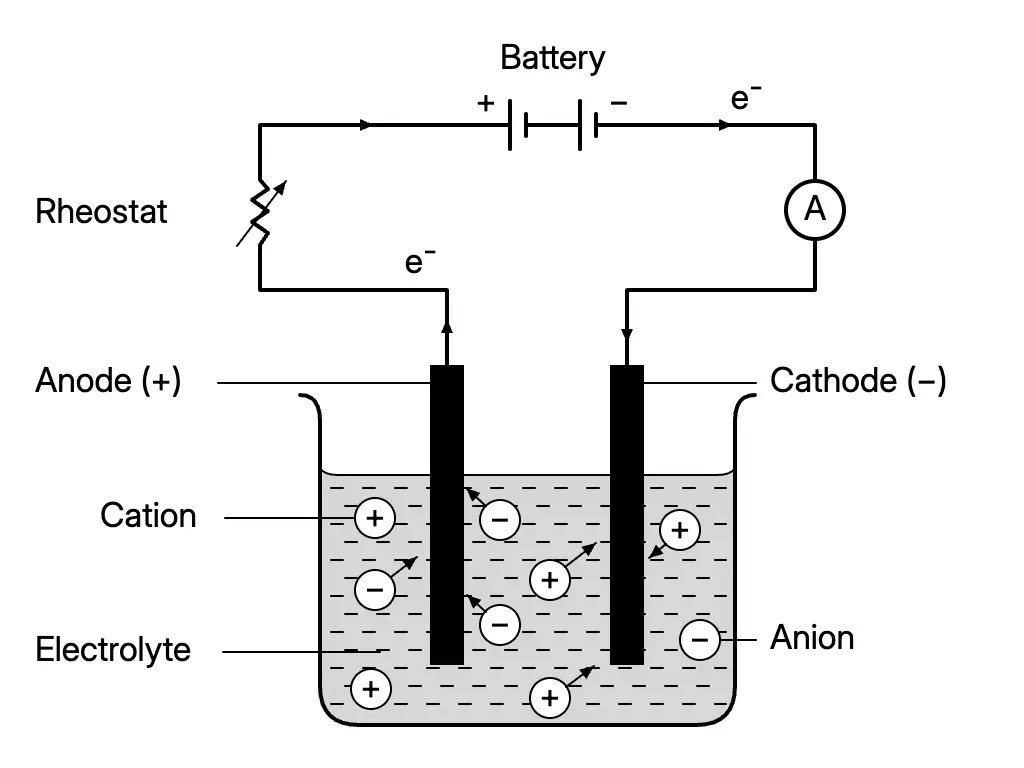
6.1 — Electrolytic Cell Electrochemistry and Electrolysis Electrochemistry: the study in chemistry of the relationship between electrical and chemical phenomena.Two types of electrochemical cell : Electrolytic cell: electric current flows through an electrolyte to produce a chemical reaction; electrical energy → chemical energy through electrolysis.Chemical cell (voltaic cell or galvanic cell): chemical changes in the cell produce an electric current; chemical energy → electrical energy . Electrolysis: decomposition of a compound in the molten or aqueous state into its constituent elements when electric current flows through it.Structure of an Electrolytic Cell Electrical source: produces the electric current required for electrolysis; electrolysis cannot occur without current flowing through the electrolyte.Electrode: electrical conductor connected to the battery that allows electric current to enter or leave the electrolyte. Anode (+): electrode connected to the positive terminal of the electrical source.Cathode (−): electrode connected to the negative terminal of the electrical source.Electrolyte: substance that conducts electricity in the molten or aqueous state and undergoes chemical change. An ionic compound containing positive ions (cations ) and negative ions (anions ) that can move freely. Non-electrolyte: substance that does not conduct electricity in the molten or aqueous state.Electrolytes Non-electrolytes Molten lead(II) bromide, PbB r 2 Naphthalene, C 10 H 8 Molten sodium chloride, NaCl Acetamide, C H 3 CON H 2 Sodium hydroxide solution, NaOH Glucose solution, C 6 H 12 O 6 Copper(II) sulphate solution, CuS O 4 Ethanol, C 2 H 5 OH
Example of ion formation in an electrolyte: NaCl → N a + + C l −
Electrolytic cell Activity 6.1 — Drawing and labelling an electrolytic cell Draw the electrolytic cell individually. Label the anode , cathode and electrolyte . Present the labelled drawing. Electrolysis Process Cations move towards the cathode (negative electrode) .Anions move towards the anode (positive electrode) .During electrolysis of molten lead(II) bromide, PbB r 2 Lead(II) ions, P b 2 + Bromide ions, B r − An ionic compound in the solid state cannot conduct electricity because its ions cannot move freely. When a positive ion is discharged , it receives one or more electrons, becomes neutral and forms an atom or molecule. When a negative ion is discharged , it donates one or more electrons, becomes neutral and forms an atom or molecule. Experiment 6.1 — Ionic Compounds in Different States Aim: Study electrolysis of ionic compounds in solid, molten and aqueous states.Problem statement: Can ionic compounds in solid, molten and aqueous states be electrolysed?Hypotheses: Ionic compounds in molten and aqueous states can be electrolysed. Ionic compounds in the solid state cannot be electrolysed. Variables: Manipulated: state of ionic compound—solid, molten or aqueous. Responding: condition of the light bulb. Constant: type of electrode. Materials: solid lead(II) bromide, PbB r 2 0.1 mol d m − 3 CuS O 4 Apparatus: battery, carbon electrodes, connecting wires with crocodile clips, crucible, tripod stand, pipe clay triangle, Bunsen burner, switch, beaker, light bulb, electrolytic cell, spatula and test tubes.A. Solid and molten ionic compound Safety: Teacher demonstration in a fume chamber. Bromine gas is poisonous; do not inhale it.
Half-fill a dry crucible with solid lead(II) bromide powder. Place it on a pipe clay triangle and tripod stand. Connect the carbon electrodes, switch, battery and light bulb. Turn on the switch; observe the bulb. Heat the solid until it melts. Complete the circuit again; observe the bulb. B. Aqueous ionic compound Half-fill the electrolytic cell with 0.1 mol d m − 3 Fill two test tubes completely with the same solution and invert them over the electrodes. Turn on the switch for 5 minutes ; observe the bulb. Material Observation and inference Solid PbB r 2 Bulb does not light; no freely moving ions, so electrolysis does not occur. Molten PbB r 2 Bulb lights; ions move freely, so electrolysis occurs. Aqueous CuS O 4 Bulb lights; ions move freely, so electrolysis occurs.
Conclusion: The hypotheses are accepted. Ionic compounds can be electrolysed in the molten and aqueous states but not in the solid state.Purpose of the bulb: indicate the flow of electric current during electrolysis.Factors Affecting the Products of Electrolysis Three factors determine which ions are discharged at the electrodes during electrolysis of aqueous solutions:
Position of ions in the electrochemical series .Concentration of electrolyte .Type of electrode .1. Position of ions in the electrochemical series Metals are arranged according to the tendency of their atoms to donate electrons. The higher a metal is in the series, the more easily its atoms donate electrons. Ions lower in each electrochemical series have a higher tendency to be discharged . Cations: ease of discharge increases downward Anions: ease of discharge increases downward K + F − N a + S O 4 2 − C a 2 + N O 3 − M g 2 + C l − A l 3 + B r − Z n 2 + I − F e 2 + O H − S n 2 + P b 2 + H + C u 2 + A g +
Sodium sulphate solution, N a 2 S O 4 Ions present: N a + S O 4 2 − H + O H − At the cathode: N a + H + H + N a + Hydrogen gas is produced. At the anode: S O 4 2 − O H − O H − S O 4 2 − Oxygen gas is produced. Copper(II) sulphate solution, CuS O 4 Ions present: C u 2 + S O 4 2 − H + O H − At the cathode: C u 2 + H + Copper is deposited. At the anode: O H − S O 4 2 − Oxygen gas is produced. Experiment 6.2 — Effect of position in the electrochemical series Aim: Study the effect of ion position in the electrochemical series on its tendency to be discharged.Problem statement: How does ion position affect the tendency to be discharged at an electrode?Hypothesis: The lower an ion is in the electrochemical series, the more easily it is discharged.Variables: Manipulated: position of ion in the electrochemical series. Responding: product at the electrode. Constant: electrolyte concentration and type of electrode. Materials: 0.5 mol d m − 3 Mg ( N O 3 ) 2 0.5 mol d m − 3 N a 2 S O 4 Apparatus: battery, carbon electrodes, connecting wires with crocodile clips, electrolytic cell, ammeter, test tubes and switch.Half-fill the cell with magnesium nitrate solution. Fill two test tubes completely with the same solution and invert one over each electrode. Turn on the switch; collect the gases until the test tubes are almost full. Test each gas with glowing and burning wooden splinters. Repeat with sodium sulphate solution. Electrode Gas test and identification Anode Glowing splinter relights → oxygen. Cathode Burning splinter produces a ‘pop’ sound → hydrogen.
Both electrolytes produce oxygen at the anode and hydrogen at the cathode . Ions discharged in both electrolytes: O H − H + Conclusion: The hypothesis is accepted; the lower ion in the electrochemical series is discharged more readily.2. Concentration of electrolyte A negative ion with a higher concentration is more likely to be discharged at the anode . Selection of a positive ion at the cathode remains determined by its position in the electrochemical series. Concentrated and dilute sodium chloride solutions contain N a + C l − H + O H − At the cathode in both solutions, H + N a + hydrogen gas forms. At the anode: 1.0 mol d m − 3 C l − O H − chlorine gas forms.0.0001 mol d m − 3 O H − C l − O H − oxygen gas forms. Experiment 6.3 — Effect of ion concentration Safety: Chlorine gas is poisonous.
Aim: Study the effect of ion concentration in an electrolyte on the selection of ion discharged at the anode.Problem statement: How does hydrochloric acid concentration affect the selection of ion discharged at the anode?Hypothesis: Ions of a higher concentration are selected for discharge at the anode.Variables: Manipulated: concentration of ions in the electrolyte. Responding: product at the anode. Constant: type of electrode. Materials: 1.0 mol d m − 3 0.0001 mol d m − 3 HCl Apparatus: battery, carbon electrodes, connecting wires with crocodile clips, electrolytic cell, ammeter, test tubes, litmus papers and switch.Half-fill the cell with 1.0 mol d m − 3 Fill two test tubes with the acid and invert them over the electrodes. Turn on the switch; collect the gas released at the anode until the test tube is almost full. Test it using a glowing splinter and moist blue and red litmus papers. Repeat using 0.0001 mol d m − 3 Electrolyte Product and identifying observation at the anode 1.0 mol d m − 3 HCl Chlorine; moist blue litmus turns red and is then bleached. 0.0001 mol d m − 3 HCl Oxygen; a glowing wooden splinter relights.
Conclusion: The hypothesis is accepted. Concentrated hydrochloric acid discharges C l − O H − 3. Type of electrode If the anode metal is the same metal as the metal ion in the electrolyte: Anode atoms ionise into positive ions and dissolve in the electrolyte. Metal ions are discharged and deposited as metal atoms at the cathode. Metal-ion concentration remains unchanged because the rate of ion formation at the anode equals the rate of ion discharge at the cathode. If the anode substance is different from the metal ion in the electrolyte: Anode atoms do not dissolve. Negative ions are discharged at the anode. The less electropositive positive ion is discharged at the cathode. Silver nitrate solution, AgN O 3 Ions present: A g + N O 3 − H + O H − Silver electrodes Carbon electrodes At the cathode, A g + At the cathode, A g + At the anode, silver atoms ionise; the silver electrode dissolves. At the anode, O H − Silver-ion concentration remains unchanged. Silver-ion concentration decreases.
Experiment 6.4 — Effect of electrode type Aim: Study the effect of electrode type on the selection of ion discharged at an electrode.Problem statement: How does electrode type affect the selection of ion discharged at the anode?Hypotheses: With carbon electrodes in copper(II) sulphate solution, O H − With copper electrodes, C u 2 + Variables: Manipulated: electrode type—carbon or copper. Responding: product at the anode. Constant: type and concentration of electrolyte. Materials: 0.1 mol d m − 3 CuS O 4 Apparatus: battery, carbon electrodes, copper electrodes, connecting wires with crocodile clips, electrolytic cell, ammeter, test tubes and switch.Half-fill the cell with copper(II) sulphate solution. Fill a test tube with the solution and invert it over the anode. Use carbon electrodes; turn on the switch for 15 minutes . Test gas from the anode with a glowing wooden splinter. Repeat by replacing the carbon electrodes with copper electrodes. Electrode Observation and inference at the anode Carbon Gas relights a glowing splinter; O H − Copper No gas; copper atoms ionise and C u 2 +
Conclusion: The hypotheses are accepted; the type of electrode affects the ion selected for discharge at the anode.Applications of Electrolysis in Industries Extraction of metals: potassium, sodium, calcium, magnesium and aluminium are extracted from their molten ores or salts by electrolysis.Purification of metals: Impure metal = anode; pure metal = cathode. Anode metal dissolves to form ions. Metal ions move to the cathode, are discharged and deposit as pure metal. Electroplating of metals: gold, platinum or silver is coated onto another metal to make it more attractive and resistant to corrosion.Wastewater treatment by electrocoagulation: combines electrolysis and coagulation .Electrocoagulation sequence At a metal anode such as aluminium, metal atoms ionise in the electrolyte to produce A l 3 + At the carbon cathode, H + A l 3 + O H − floc .Floc trapped by hydrogen bubbles floats to the surface. Remaining floc sinks and accumulates at the bottom. Answer practice questions to test your knowledge
Practice