9.3 - Polymer
Polymer and Monomer
- A polymer is a large chain-shaped molecule formed by the combination of smaller molecular units.
- A monomer is the small molecular unit that forms a polymer.
- Polymers are classified as natural polymers or synthetic polymers.
- A natural polymer occurs naturally; a synthetic polymer is made by humans using chemicals.
| Polymer | Monomer | Use |
|---|---|---|
| Starch | Glucose | Provides energy |
| Protein | Amino acid | Builds cells and body tissues |
| Natural rubber | Isoprene | Makes rubber-based products |
| Polythene | Ethene | Plastic bottles, plastic bags and pails |
| Polystyrene | Styrene | Packaging containers for electrical equipment |
| Perspex | Methyl methacrylate | Aeroplane mirrors and vehicle windows |
| Synthetic rubber | Neoprene | Gloves, vehicle tyres and shoe soles |
Polymerisation and Depolymerisation
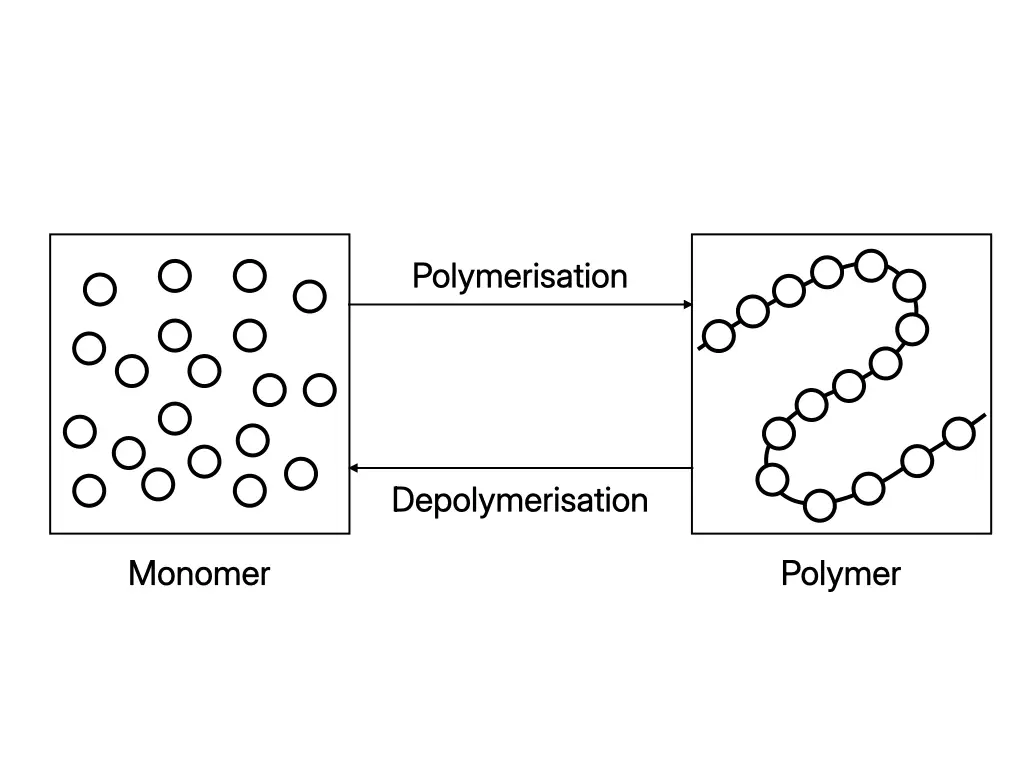
- Polymerisation: monomers join through the formation of chemical bonds to produce a large, chain-shaped polymer molecule.
- Depolymerisation: a chain-shaped polymer molecule is split into its monomers through a chemical reaction.
Addition Polymerisation
- Addition polymerisation involves the same type of monomer; double bonds break and become single bonds.
- Example: ethene monomers form polythene.
Natural Rubber
- The milky fluid obtained by tapping a rubber tree is called latex.
- Latex is processed into natural rubber, a natural polymer that contributes to Malaysia’s economy.
- Natural rubber is elastic, soft, unable to withstand heat, a good electrical insulator and not permeable to air.
Action of Acid and Alkali on Latex
Why Latex Remains Liquid
- Each chain-shaped rubber molecule is covered by a protein membrane.
- Negative charges surround the outer surface of the membrane.
- Like charges make the rubber molecules repel one another; they do not collide, so latex remains liquid.
Acid Coagulates Latex
- Acid supplies positively charged hydrogen ions.
- Hydrogen ions neutralise the negative charges on the protein membrane.
- Rubber molecules collide; the protein membranes break.
- Rubber polymer chains are released, become entangled and form solid lumps.
- Latex left exposed also coagulates because bacteria produce acid that neutralises the protein membranes.
Alkali Preserves Latex
- Alkali supplies hydroxide ions that neutralise hydrogen ions from the acid produced by bacteria.
- Negative charges remain on the protein membranes.
- Rubber molecules continue to repel one another; latex remains liquid.
- Ammonia solution, an alkali, prevents the coagulation of latex.
Activity 9.3: Properties of Natural Rubber
- Aim: To study the properties of natural rubber.
- Materials: Rubber strip and water.
- Apparatus: Boiling tube, retort stand and clamp, Bunsen burner.
A. Elasticity
- Stretch and twist a strip of natural rubber.
- Release it and observe whether it returns to its original shape.
- Observation: The strip returns to its original shape; natural rubber is elastic.
B. Effect of Heat
- Put a small piece of the rubber strip into a boiling tube containing water.
- Heat the water slowly, then allow the rubber to cool.
- Test its elasticity again.
- Observation: The rubber becomes less elastic; natural rubber cannot withstand heat.
Activity 9.4: Effect of Acid and Alkali on Latex
- Aim: To study the effect of acid and alkali on latex.
- Materials: Latex, ethanoic acid and ammonia solution.
- Apparatus: Three beakers, dropper and glass rod.
- Safety: Wear gloves when handling ethanoic acid and ammonia solution.
Procedure and Observations
- Label three beakers P, Q and R; add 20 ml latex to each.
- Add 10 drops ethanoic acid to P and stir → latex coagulates; a white solid forms.
- Add 10 drops ammonia solution to Q and stir → latex remains liquid and does not coagulate.
- Add nothing to R → latex eventually coagulates because bacterial action produces acid.
- Inference: Acid coagulates latex; alkali prevents coagulation.
Vulcanisation of Rubber
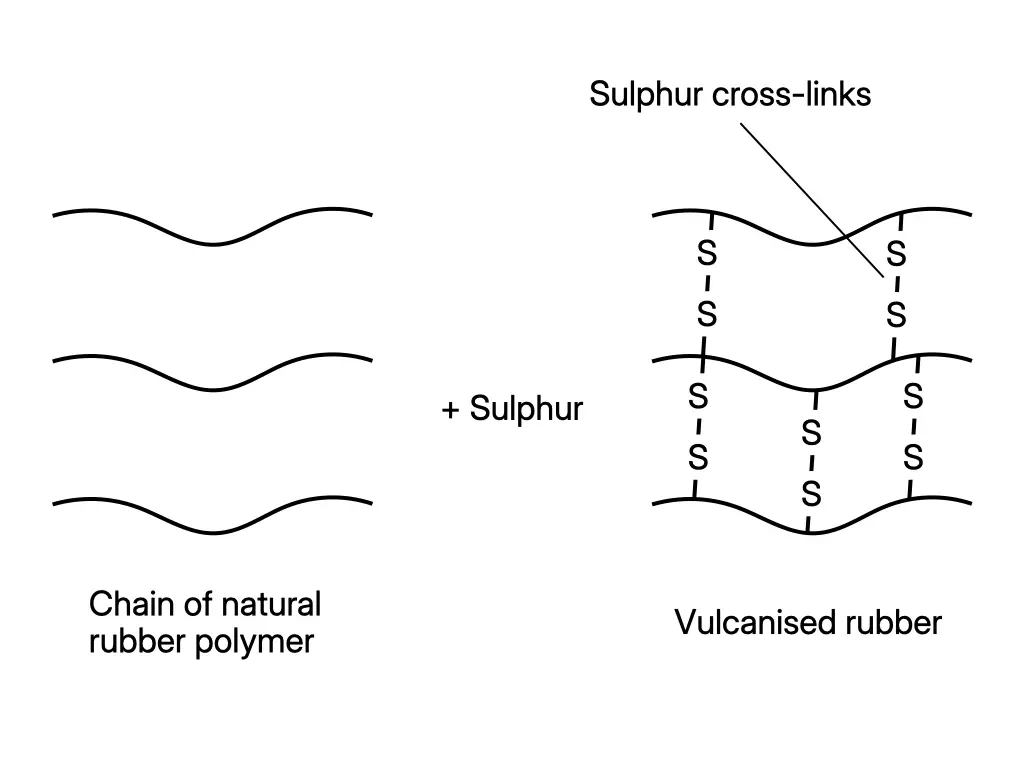
- Natural rubber is too soft and not sufficiently heat-resistant for products such as vehicle tyres.
- Vulcanisation is the process of heating rubber with sulphur.
- Charles Goodyear’s method heated natural rubber with 1%–3% sulphur by mass.
- During vulcanisation, sulphur atoms form sulphur cross-links between the chains of natural-rubber polymer molecules.
- The product is vulcanised rubber.
- When force is applied, cross-linked chains are difficult to slide over one another.
- When heated, its molecular structure is difficult to break.
- Therefore, vulcanised rubber is harder and more heat-resistant than natural rubber.
| Natural rubber | Vulcanised rubber |
|---|---|
| No sulphur cross-links between polymer chains | Sulphur cross-links join polymer chains |
| Soft and less elastic | Hard and more elastic |
| Cannot withstand heat | Resistant to heat |
| Polymer chains slide more easily | Polymer chains are difficult to slide |
Characteristics and Uses of Vulcanised Rubber
- Hard and more elastic.
- Resistant to heat.
- Good electrical insulator.
- Not easily oxidised in air.
- Does not react with acids and alkalis.
- Not permeable to liquids and air.
- Uses: vehicle tyres, rubber gloves and shoe soles.
Latest Rubber-based Technology
- Cuplump Modified Asphalt (CMA): used as asphalt concrete for road surfacing so that roads last longer, resist heat, produce less noise and develop fewer cracks.
- Getah Colour: painting paint made from latex for visual art.
- Railway pads: rubber pads placed between the rails and the train engine reduce vibration and noise.
Answer practice questions to test your knowledge
Practice