9.1 - Alloy
What is an Alloy?
- An alloy is a mixture of several types of metals or a mixture of metal and non-metal in a certain percentage.
- Common alloys: steel, pewter, bronze, brass and duralumin.
- Alloying is the process of forming an alloy to improve the properties of a pure metal.
- The composition or percentage of each element can be changed to suit the alloy’s use.
Steel
- Composition: iron 99% + carbon 1%.
- Properties: hard and strong.
- Uses: construction materials for buildings and bridges; frames of vehicles and railway tracks.
Pewter
- Composition: tin 96% + copper 3% + antimony 1%.
- Properties: lustrous and resistant to corrosion.
- Use: decorative items such as photo frames.
Bronze
- Composition: copper 88% + tin 12%.
- Properties: hard, resistant to corrosion and attractive in colour.
- Uses: monuments, metal sculptures, coins and medals.
Brass
- Composition: copper 75% + zinc 25%.
- Properties: strong, shiny, malleable and gold in colour.
- Uses: keys, door knobs and musical instruments such as trumpets.
Duralumin
- Composition: aluminium 95% + copper 3% + magnesium 1% + manganese 1%.
- Properties: light, strong and resistant to corrosion.
- Use: frames of aircraft and aeroplanes.
Why are Alloys Produced?
- Most pure metals are soft and corrode easily.
- Pure-metal atoms are arranged regularly in layers.
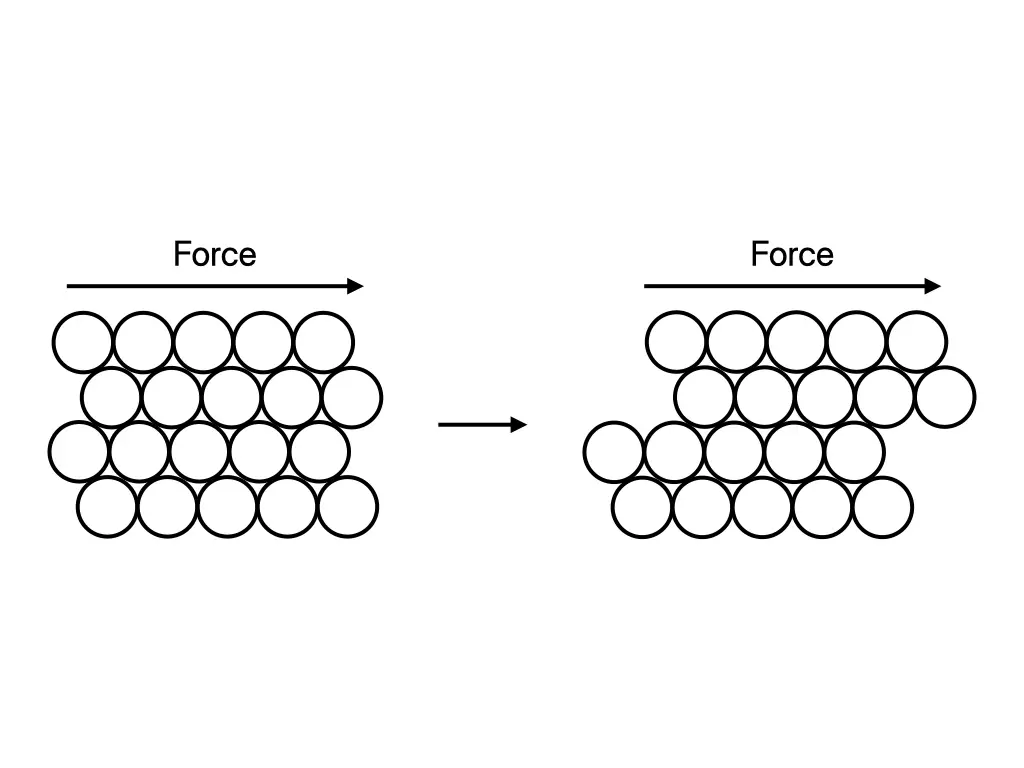
- When a force is applied, the layers slide over one another easily; the metal changes shape.
- During alloying, atoms of another metal or non-metal are mixed with the pure metal.
- The foreign atoms have different sizes and disrupt the regular arrangement.
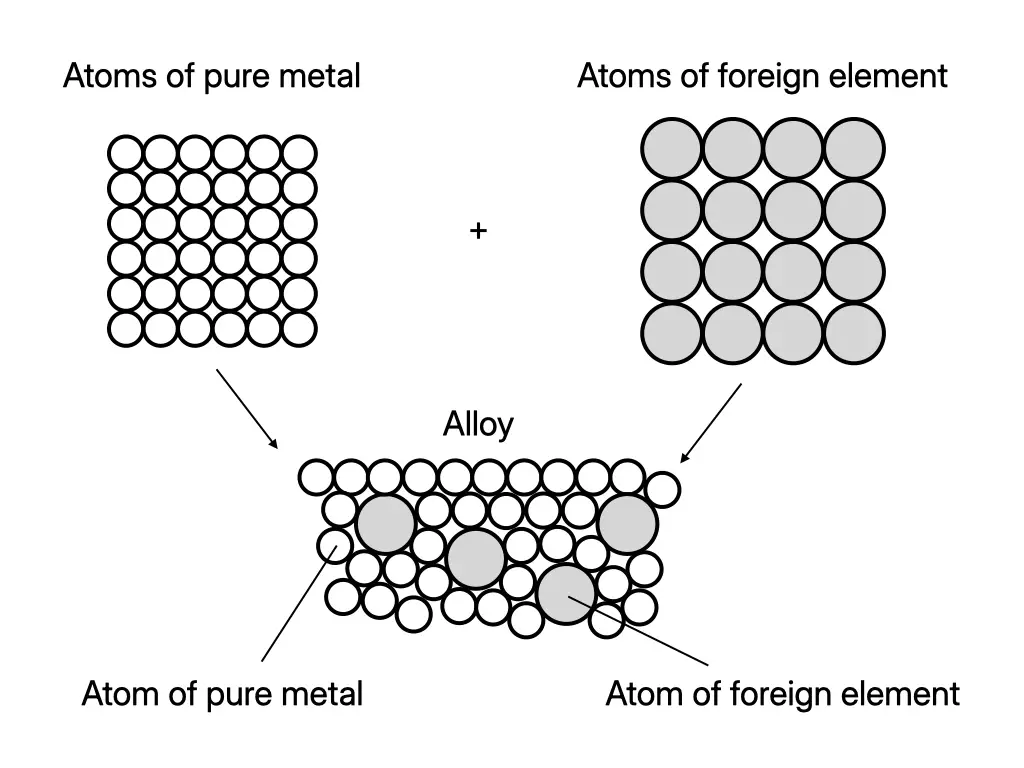
- The layers become difficult to slide over one another; the alloy is stronger and harder than its pure metal.
| Pure metal | Alloy |
|---|---|
| Same-sized atoms arranged regularly in layers | Foreign atoms of different sizes disrupt the regular layers |
| Layers slide easily when force is applied | Layers are difficult to slide when force is applied |
| Usually softer | Stronger and harder |
Particle-model description: draw equal-sized circles in straight layers for a pure metal. For an alloy, insert different-sized circles among the pure-metal atoms so that the layers are no longer regular.
Experiment 9.1: Hardness of an Alloy and a Pure Metal
- Aim: To study the hardness of alloys compared to pure metals.
- Problem statement: Is an alloy harder than a pure metal?
- Hypothesis: An alloy is harder than a pure metal.
- Manipulated variable: Type of metal block.
- Responding variable: Diameter of the dent.
- Constant variables: Diameter of steel ball, height of the weight and mass of the weight.
- Materials: Copper block, bronze block, cellophane tape and thread.
- Apparatus: Steel ball, 1 kg weight, retort stand and clamps, ruler and metre rule.
Procedure
- Fix a steel ball on a copper block with cellophane tape beneath a 1 kg weight.
- Hang the weight 50 cm above the copper block.
- Release the weight so that it falls onto the steel ball.
- Measure the diameter of the dent on the copper block.
- Repeat twice on different parts of the block; calculate the average diameter.
- Repeat using a bronze block.
Result and Inference
- Copper: larger average dent → softer.
- Bronze: smaller average dent → harder.
- Bronze contains tin atoms of a different size among copper atoms. The disrupted layers are more difficult to slide.
- Conclusion: Bronze, an alloy, is harder than copper, its pure metal. The hypothesis is accepted.
Experiment 9.2: Resistance to Corrosion
- Aim: To study the resistance to corrosion of alloys compared to pure metals.
- Problem statement: Is an alloy more resistant to corrosion than a pure metal?
- Hypothesis: An alloy is more resistant to corrosion than a pure metal.
- Manipulated variable: Type of nail.
- Responding variable: Presence of a brown layer on the nail.
- Constant variables: Size of nail, type of solution and duration of experiment.
- Materials: Iron nail, steel nail and water.
- Apparatus: Test tubes and test tube rack.
Procedure
- Clean both nails with sandpaper. Label two test tubes P and Q.
- Add 10 ml of water to each test tube.
- Put an iron nail into P and a steel nail into Q.
- Leave both test tubes in a rack for one week.
- Record the presence of a brown layer on each nail.
Result and Inference
- Iron nail: brown layer forms; the pure metal rusts.
- Steel nail: no brown layer, or less brown layer, forms; the alloy is more resistant to corrosion.
- Conclusion: Steel is more resistant to corrosion than iron. The hypothesis is accepted.
Uses of Alloys in Daily Life
- Steel → skyscrapers: hard and resistant to corrosion.
- Duralumin → aircraft bodies: light and strong.
- Brass → musical instruments: shiny and resistant to corrosion.
Superconductor Alloys
- Some metals and non-metals show superconducting properties at low temperatures and are mixed to form superconductor alloys.
- A superconductor conducts electric current with high efficiency without resistance.
- It can repel a magnetic field and levitate above a magnet.
- Maglev trains: superconductor alloys in high-powered railway tracks allow the train to levitate, eliminate friction between the track and train body, and move very fast.
- Magnetic resonance imaging (MRI): niobium-titanium and niobium-tin alloys are used in MRI machines for medical imaging.
Answer practice questions to test your knowledge
Practice