6.1 Support, Movement and Growth in Animals
Types of Support in Animals
- A skeleton is the support system for all types of animals.
- Vertebrates consist of fish, amphibians, reptiles, birds and mammals.
| Type of support | Structure, functions and examples |
|---|---|
| Endoskeleton | Support for all vertebrates, including humans; made up of internal bones or cartilage; supports body weight, protects internal organs, maintains body shape and provides attachment sites for muscles to move body parts; examples: cat, frog, crocodile, fish and eagle |
| Exoskeleton | Support for most invertebrates; consists of an outer layer of hard, waxy chitin or a shell; supports body weight, maintains body shape, protects internal organs and provides attachment sites for muscles; examples: spider, prawn, crab and scorpion |
| Hydrostatic skeleton | Support for some soft-bodied invertebrates; consists of a muscular wall enclosing a fluid-filled body cavity; fluid pressure acts in all directions, making the soft body firm; maintains and controls body shape and assists movement; examples: earthworm, leech, starfish and jellyfish |
Exoskeleton Size and Growth
- A growth curve is a graph of a growth unit against time.
- Growth units include height (cm), volume (cm³), wet mass (g) and dry mass (g).
- A growth curve shows an organism’s growth phases and growth rate.
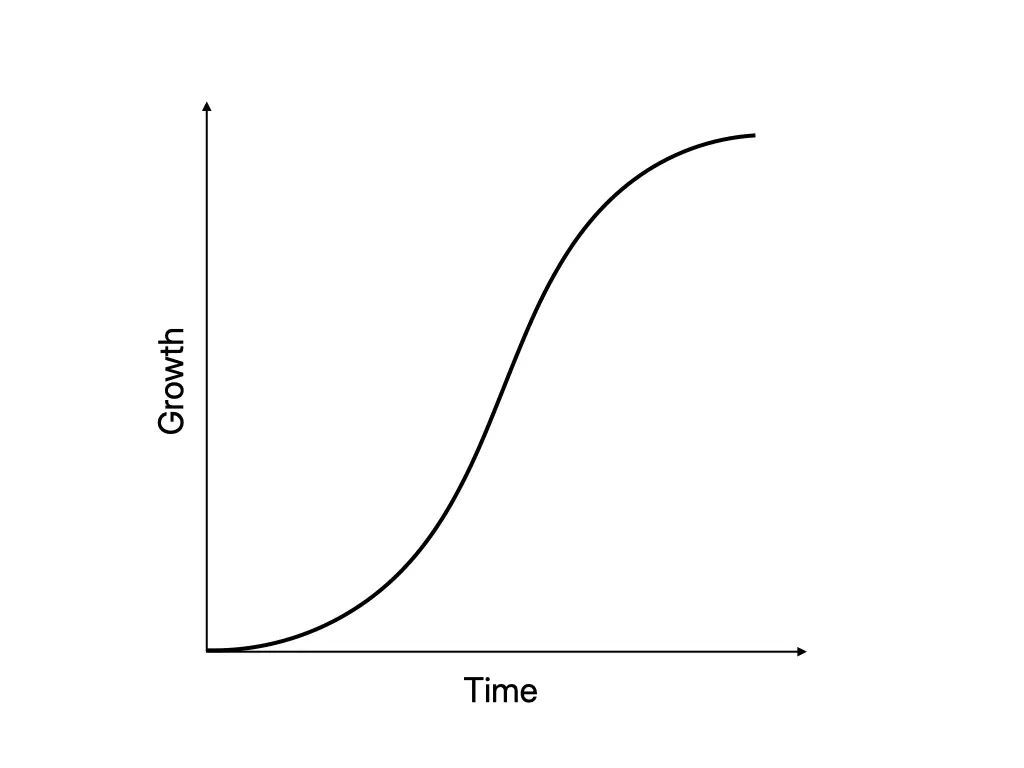
- The basic growth curve of organisms is sigmoid-shaped, but its pattern varies among organisms.
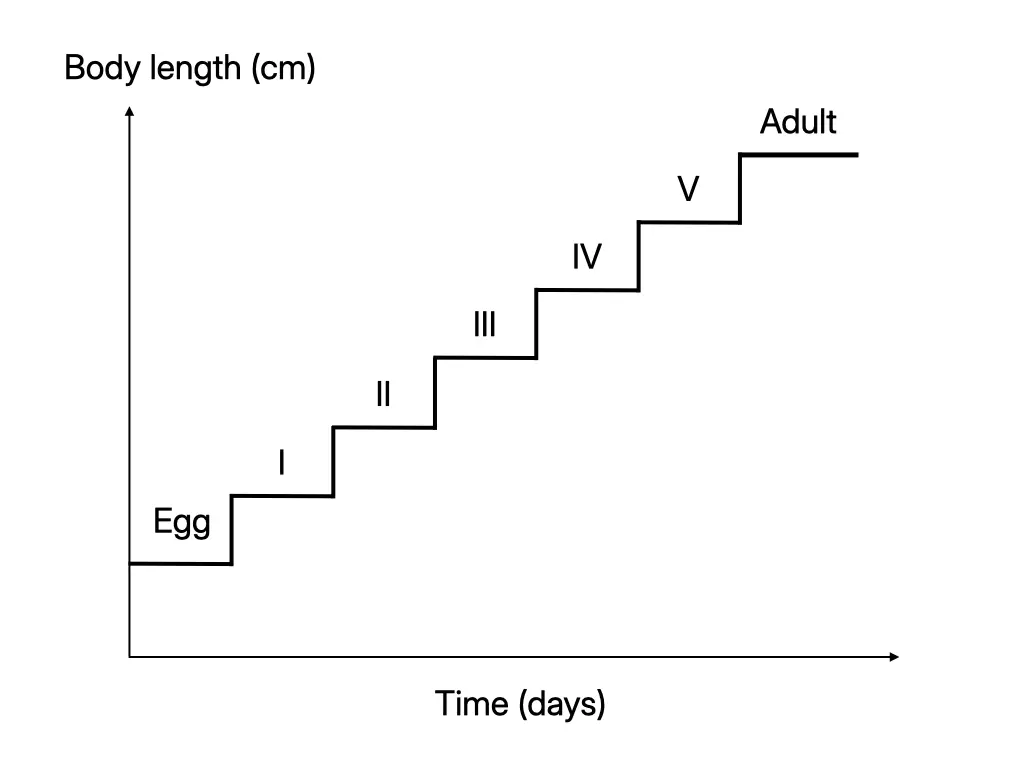
- Animals with an exoskeleton, such as cockroaches and grasshoppers, show a step-shaped growth curve because:
- the exoskeleton is made of hard chitin and cannot expand;
- the animal repeatedly sheds its exoskeleton until adulthood;
- a new, soft exoskeleton forms under the old exoskeleton.
- Ecdysis: the process of shedding the old exoskeleton.
- During ecdysis:
- The animal inhales air to expand its body.
- Expansion breaks the old, hard exoskeleton.
- Rapid growth increases body size before the new exoskeleton hardens.
- A hormone controls each stage of ecdysis.
- At the nymph stage, the animal eats a large amount of food to build new tissues and increase mass.
Interpreting the Step-shaped Growth Curve
- Vertical section: sudden growth occurs during ecdysis while the new exoskeleton is soft.
- Horizontal section: zero growth in body length occurs while the exoskeleton is hard; this stage is called an instar.
- Several instars and ecdyses occur before the animal becomes an adult.
Activity 6.2: Growth Curve of an Animal with an Exoskeleton
Aim: Study the growth curve of an animal with an exoskeleton.
Apparatus: Ruler
- Observe pictures of five grasshopper nymphs, A–E, and an adult grasshopper over days 1–30.
- Measure each grasshopper from the end of the head to the end of the abdomen.
- Record each length in centimetres.
- Plot grasshopper length (cm) against time (day).
Interpretation: The curve is step-shaped because growth in body length occurs rapidly during ecdysis and stops during each instar.
Hydrostatic Skeleton and Movement
- An earthworm has a fluid-filled body cavity and moves with the aid of chaetae, the bristles at the sides of its body.
- Its body wall contains circular muscles and longitudinal muscles that act antagonistically.
| Muscle action | Effect on the body segment |
|---|---|
| Circular muscles contract; longitudinal muscles relax | Segment becomes thin and long |
| Longitudinal muscles contract; circular muscles relax | Segment becomes thick and short |
Movement of an Earthworm
- Alternating contraction and relaxation begins at the anterior and passes towards the posterior.
- Circular muscles contract and longitudinal muscles relax in some segments.
- These segments become long and thin; their chaetae release their grip so the body can extend forwards.
- Longitudinal muscles contract and circular muscles relax in other segments.
- These segments become short and thick; their chaetae grip the ground.
- Hydrostatic pressure transfers body fluid into the shortening region, pulling the posterior forwards.
- Repeated alternating waves move the earthworm forwards.
Functions of the Endoskeleton in Animals
Terrestrial Vertebrates
- Require a strong and rigid endoskeleton to support the body.
- Have a large skeleton proportional to body size.
- The pectoral girdle and pelvic girdle mainly support body weight and articulate with the limbs.
- In four-legged terrestrial vertebrates such as camels and horses, the curved vertebral column:
- strengthens support for attached muscles;
- enables the vertebral column to withstand gravitational force.
- Example: an elephant needs strong pectoral and pelvic girdles to support its body weight.
Aquatic Vertebrates
- Have a smaller endoskeleton relative to body size.
- Their pectoral and pelvic girdles are small and weak.
- Water buoyancy supports body weight; therefore, an aquatic vertebrate such as a whale can grow larger than the size of its skeleton.
Birds
- Have bone structures adapted for flight:
- a flat, broad sternum provides a large attachment site for flight muscles;
- hollow, light bones reduce body weight;
- a relatively small skull makes flight easier.
Human Skeletal System
- The human skeleton is made up of 206 bones of various sizes and shapes.
- It is divided into the axial skeleton and appendicular skeleton.
Axial Skeleton
| Structure | Composition and function |
|---|---|
| Skull | Consists of cranial bones and facial bones; cranial bones protect the brain; facial bones form the basic framework of the face and support the teeth |
| Vertebral column | Consists of 33 small bones called vertebrae; connected vertebrae form a strong, flexible column that protects the spinal cord |
| Ribs and sternum | 12 pairs of ribs articulate with thoracic vertebrae; 7 pairs join the sternum directly, 3 pairs join indirectly through cartilage and the last 2 pairs hang freely; protect the heart and lungs |
Appendicular Skeleton
- Pectoral girdle:
- a pair connects the upper limbs to the axial skeleton;
- consists of the clavicle and scapula.
- Upper limb:
- consists of the humerus, radius, ulna, carpus, metacarpus and phalanx;
- the rounded upper humerus articulates with the pectoral girdle;
- the lower humerus articulates with the radius and ulna;
- the radius and ulna articulate with the carpus to form the wrist;
- the metacarpus forms the palm and articulates with the carpus;
- the phalanges form the fingers and articulate with the metacarpus.
- Pelvic girdle:
- consists of a pair of hip bones and articulates with the axial skeleton;
- supports body weight;
- protects the bladder and reproductive organs.
- Lower limb:
- consists of the femur, patella, tibia, fibula, tarsus, metatarsus and phalanx;
- the rounded upper femur articulates with the pelvic girdle;
- the lower femur articulates with the tibia and fibula;
- the tibia and fibula form the calf and articulate with the tarsus at the ankle;
- the tarsus articulates with the metatarsus, which forms the foot;
- the metatarsus articulates with the phalanges of the toes.
Experiment 6.1: Strength of Compact and Hollow Bones
- Large terrestrial vertebrates such as elephants have large, compact and strong bones because the endoskeleton supports their entire body weight.
- Birds have hollow bones that are:
- light and strong;
- able to allow faster movement;
- able to reduce the need for calcium and phosphorus.
Aim: Compare the strength of a compact bone with a hollow bone.
Problem statement: Is a hollow bone stronger than a compact bone?
Hypothesis: A hollow bone is stronger than a compact bone.
Variables:
- Manipulated: Type of cylinder—hollow or compact
- Responding: Number of textbooks supported by the cylinders
- Constant: Length and diameter of each cylinder
Materials: A4 paper, cellophane tape, box covers
Apparatus: Textbooks, scissors
- Roll A4 paper into a hollow cylinder 2.5 cm in diameter. Tape its upper and lower ends. Make three more identical cylinders.
- Attach the four hollow cylinders to the corners of a box cover to make table model A.
- Roll A4 paper into a compact cylinder 2.5 cm in diameter. Tape its upper and lower ends. Make three more identical cylinders.
- Attach the four compact cylinders to another box cover to make table model B.
- Place textbooks one at a time on each model until its paper cylinders bend.
- Record the number of textbooks supported by each model.
| Model | Observation |
|---|---|
| A: hollow cylinders | Supports more textbooks before bending |
| B: compact cylinders | Supports fewer textbooks before bending |
Conclusion: Hollow cylinders are stronger than compact cylinders of the same length and diameter; the hypothesis is accepted.
Support System and Animal Stability
- An effective support system allows an animal to move smoothly and efficiently.
- Centre of gravity: the balance point of a support system or object; the point through which its total weight acts to balance its position.
- Stability: the ability of an object to maintain its original position.
| Factor | Relationship with stability |
|---|---|
| Centre of gravity | A lower centre of gravity gives greater stability; a higher centre of gravity gives lower stability |
| Base area | A larger base area gives greater stability; a smaller base area gives lower stability |
- A giraffe is less stable while standing because it has a high centre of gravity.
- A tortoise and crocodile are naturally more stable because they have low centres of gravity.
Solutions to Stability Problems
- Giraffe drinking water:
- spreads its legs to increase the base area;
- lowers its centre of gravity;
- becomes less likely to topple.
- Stationary kangaroo:
- stands on two hind legs and does not use its forelegs for standing;
- uses its tail as a strut;
- the tail increases its base area and prevents it from toppling.
Answer practice questions to test your knowledge
Practice