5.2 Inheritance
Inheritance in Humans
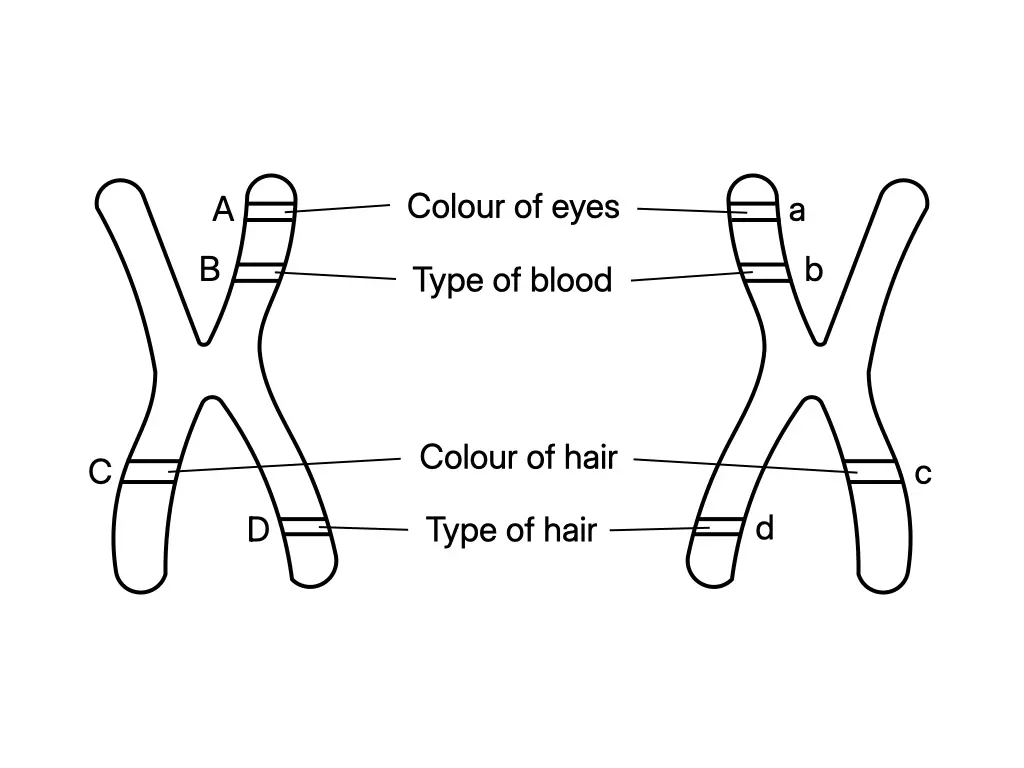 Example of dominant and recessive alleles in chromosomes
 - Inheritance: the transmission of characteristics from parents to their children.
- Examples of inherited characteristics: hair type and pupil colour.
- Characteristics pass through genes, the basic units of inheritance on chromosomes.
- Characteristic: an obvious inherited feature determined by genes, such as pupil colour.
- Trait: a variant of a particular characteristic that distinguishes individuals; pupil-colour traits include black, brown and blue.
- A pair of genes at the same locus on homologous chromosomes controls one trait. This pair is called alleles.
| Dominant allele | Recessive allele |
|---|
| Displays its characteristic and masks the recessive allele | Displays its characteristic only when the dominant allele is absent; both alleles must be recessive |
| Capital letter, for example T | Lowercase letter, for example t |
- Each individual inherits two copies of a gene for each trait: one from the mother and one from the father.
| Dominant trait | Recessive trait |
|---|
| Able to roll the tongue | Unable to roll the tongue |
| Black hair | Blonde hair |
| Free earlobe | Attached earlobe |
Mechanism of Inheritance
- Gregor Mendel, the “Father of Genetics”, first discovered the mechanism of inheritance systematically and in depth.
- He used pure-bred pea plants in monohybrid-cross experiments.
- A monohybrid cross studies one characteristic at a time, for example height: tall or dwarf.
- Genotype: genetic information in an organism.
- Phenotype: physical characteristics displayed by an organism.
- First filial generation, F₁: first generation produced by a cross.
- Second filial generation, F₂: generation produced when F₁ individuals are crossed.
Mendel’s Monohybrid Cross: Pea-Plant Height
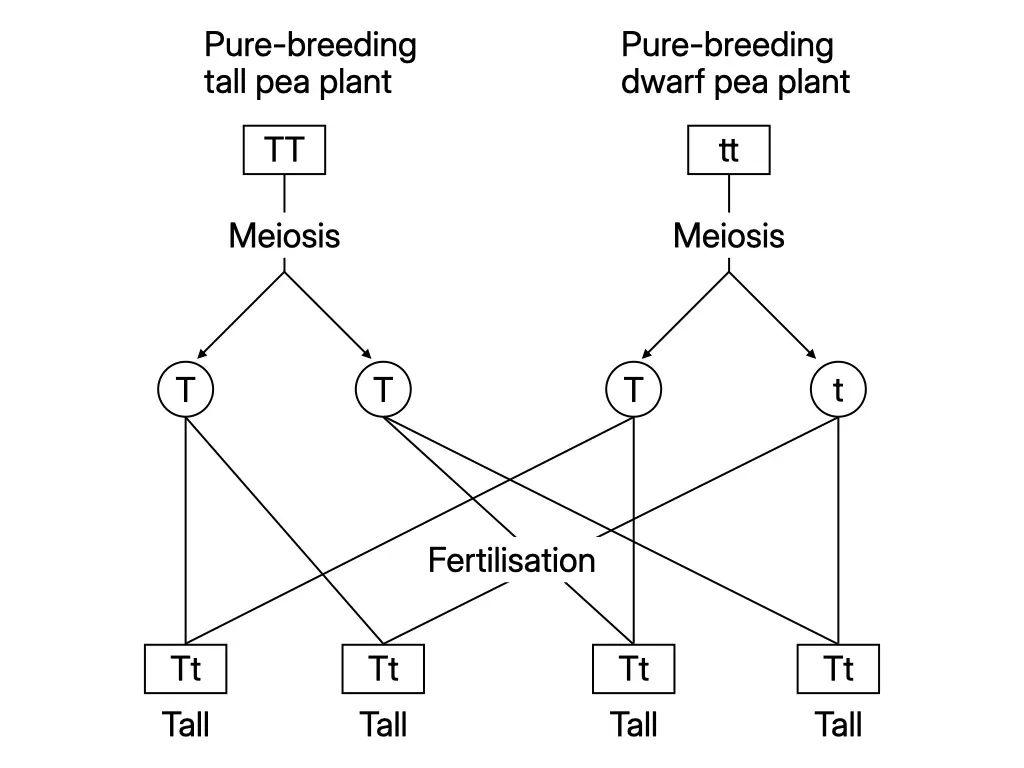 Schematic diagram of monohybrid crossing for height
 | Item | Pure-bred parental cross |
|---|
| Parental phenotype | Pure-bred tall × pure-bred dwarf |
| Parental genotype | TT × tt |
| Gametes | T and t |
| F₁ genotype | All Tt |
| F₁ phenotype | All tall |
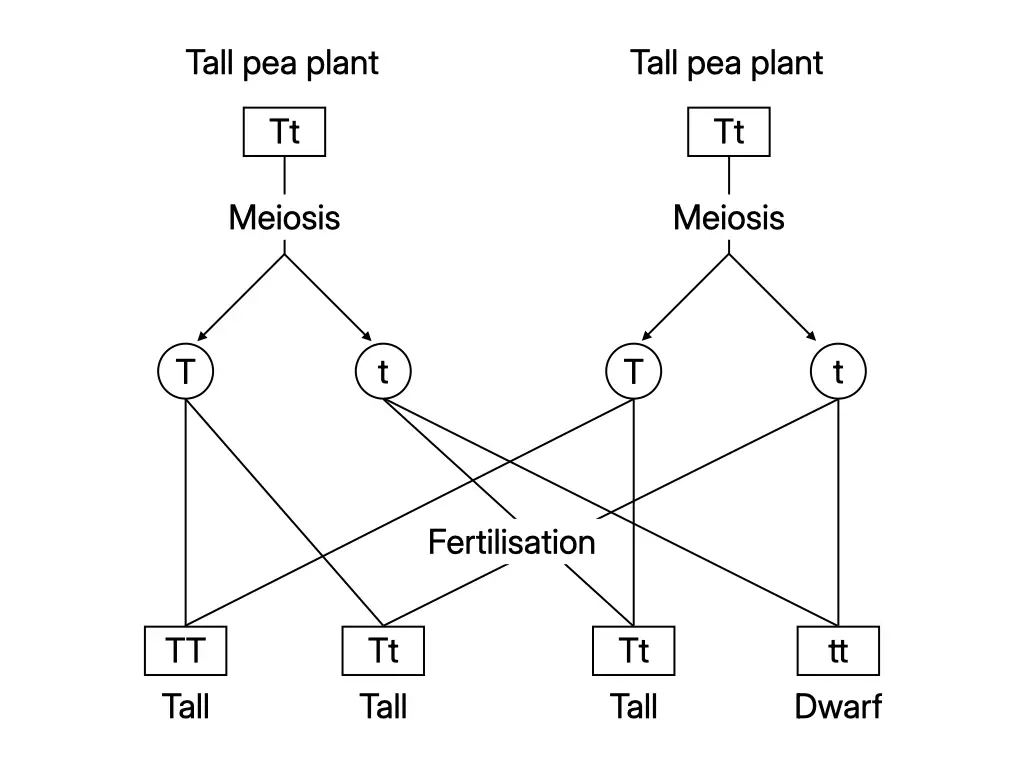 Schematic diagram of monohybrid crossing of the second filial generation for height
 | Item | F₁ cross |
|---|
| Parental genotype | Tt × Tt |
| Gametes from each parent | T and t |
| F₂ genotypes | TT, Tt, Tt, tt |
| Genotype ratio | 1 TT : 2 Tt : 1 tt |
| Phenotype ratio | 3 tall : 1 dwarf |
Human Trait Example: Ability to Roll the Tongue
- Let B = dominant allele for able to roll the tongue; b = recessive allele for unable to roll the tongue.
- Father BB (able) × mother bb (unable) → gametes B and b → all F₁ children Bb, able to roll the tongue.
Activity 5.2: Predicting Monohybrid Ratios
Aim: Predict genotype and phenotype ratios for a monohybrid cross.
- Work in groups.
- Obtain an incomplete inheritance schematic for a monohybrid cross involving one pea-plant characteristic studied by Mendel.
- Complete the inheritance schematic.
- Present it to the class.
Inheritance of Sex
- Human chromosome composition: 44 autosomes + 2 sex chromosomes.
- Male: 44 + XY; female: 44 + XX.
- After meiosis, sperm carries 22 + X or 22 + Y; every ovum carries 22 + X.
- The type of sperm that fertilises the ovum determines the child’s sex.
| Fertilisation | Child |
|---|
| Sperm 22 + X + ovum 22 + X | 44 + XX, female |
| Sperm 22 + Y + ovum 22 + X | 44 + XY, male |
- At every pregnancy, the probability of a male child and a female child is equal: 50% each.
Answer practice questions to test your knowledge
Practice