Nuclear Energy
12.2 The Production of Nuclear Energy
Meaning of Nuclear Energy
- Nuclear energy is energy resulting from reactions in the nucleus of atoms.
- It is produced through nuclear fission and nuclear fusion.
Nuclear Fission
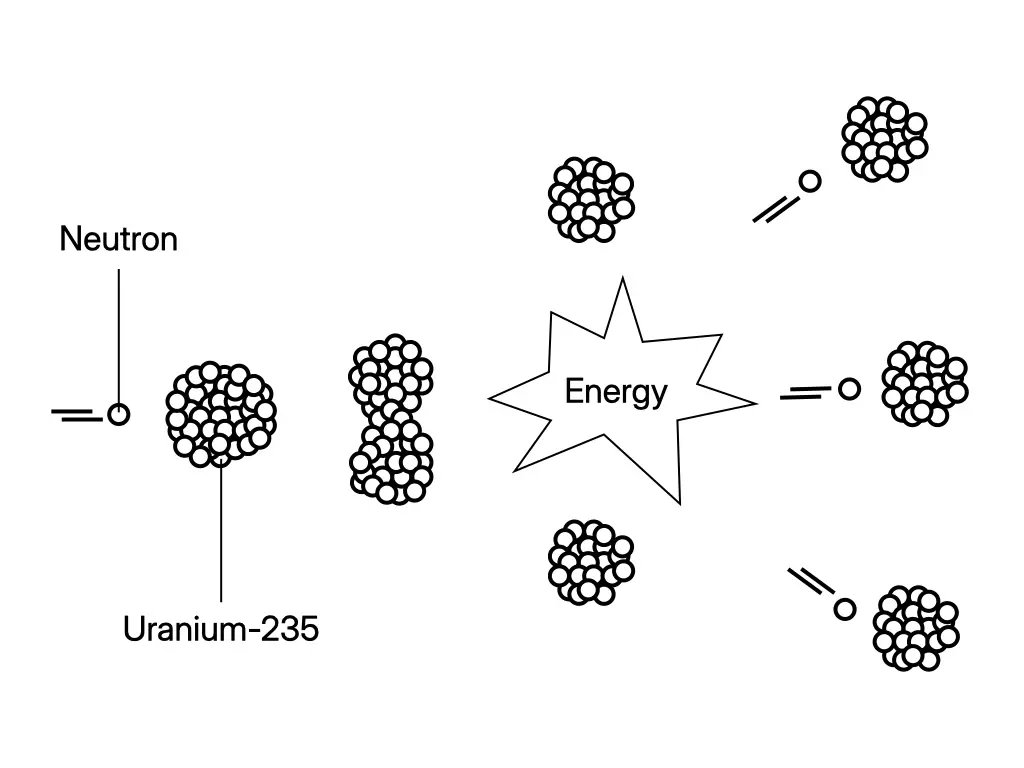
- Nuclear fission is the process of splitting a heavy radioactive nucleus into two or more nuclei which are lighter and more stable, together with the release of energy.
- A slow neutron bombards a heavy radioactive nucleus such as uranium-235.
- The bombardment splits the nucleus into two or more lighter, stable nuclei and releases a large amount of energy.
- A neutron may bombard and split another new nucleus of large mass. Continuous fission forms a chain reaction.
Diagram description — nuclear fission of uranium-235:
- A slow neutron bombards a uranium-235 nucleus.
- The heavy nucleus splits into lighter, more stable nuclei.
- Energy and neutrons are released.
- The released neutrons can initiate further fission.
Nuclear Fusion
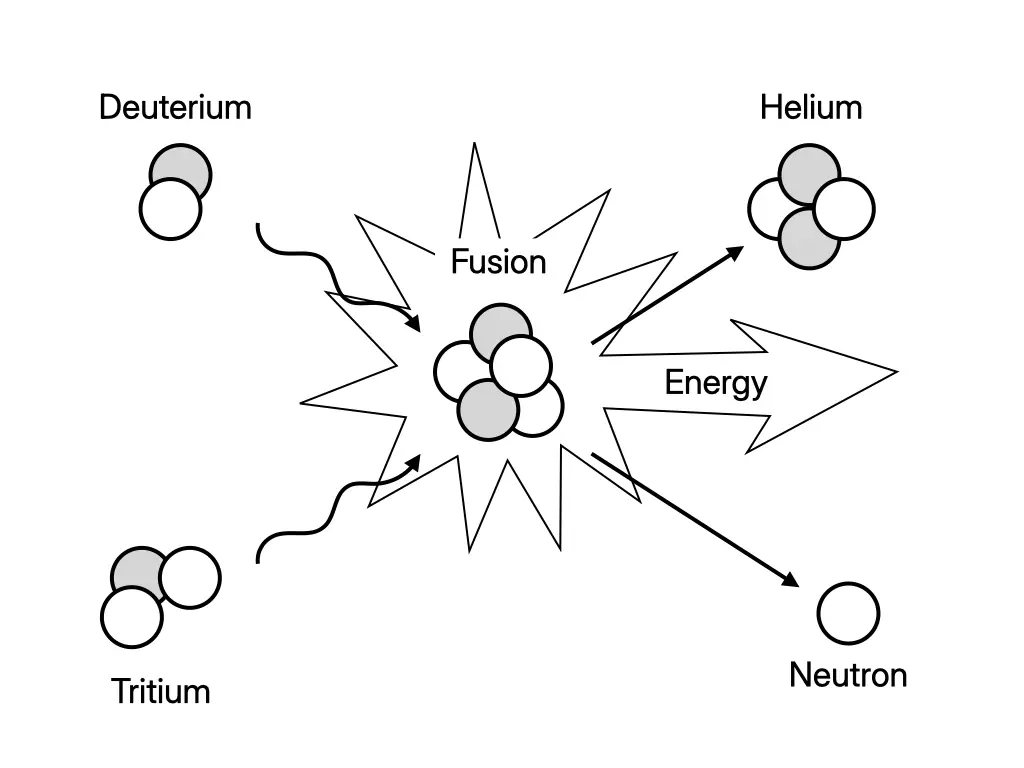
- Nuclear fusion is the process of fusing or combining two light radioactive nuclei to form a heavier nucleus, with the release of energy.
- Example: deuterium and tritium, which are hydrogen isotopes, combine to form a helium nucleus, releasing a neutron and energy.
- Occurs at a very high temperature.
- Releases more nuclear energy than nuclear fission.
- Occurs continuously in the Sun because the Sun has hydrogen isotopes and a high temperature.
- Energy released by fusion in the Sun is the main energy source for life on Earth.
| Nuclear fission | Nuclear fusion |
|---|---|
| Splits one heavy radioactive nucleus into lighter, more stable nuclei | Combines two light radioactive nuclei into a heavier nucleus |
| Example: uranium-235 bombarded by a slow neutron | Example: deuterium combines with tritium |
| Can produce a chain reaction | Requires a very high temperature |
| Releases a large amount of energy | Releases more nuclear energy than fission |
Generating Electricity from Nuclear Energy
- The main use of nuclear energy is to generate electricity in a nuclear power station.
- A nuclear power station consists of a nuclear reactor and a generator.
Nuclear reactor components:
- Uranium fuel rods: Release heat energy through nuclear fission to heat the gas flowing through the reactor core.
- Graphite moderator: Slows down neutrons.
- Boron control rods: Absorb surplus neutrons and control the rate of the nuclear fission reaction.
- Cooling agent: Absorbs heat produced by the nuclear reaction.
- Concrete shield: Prevents radioactive radiation from leaking out of the reactor.
Energy-generation sequence:
- Nuclear fission in the uranium fuel rods releases heat energy.
- The cooling agent absorbs the heat and transfers it to water, producing hot steam.
- Steam rotates the turbine, causing magnets in the generator to spin.
- The electricity generator generates electricity by electromagnetic induction when the magnets spin inside a coil.
- The condenser cools and condenses the steam into water.
- The water is pumped back through the system; the cooling tower cools the circulating water.
Nuclear Energy in Selected Countries
- Lack of other energy sources: Countries lacking coal and petroleum avoid the high cost of importing these sources by using nuclear energy.
- Vast country and high population density: China can produce enough electricity through nuclear energy for its large area and population.
- Source of national income: Slovakia can sell surplus electricity to neighbouring countries.
- Sophisticated technology: Continuous research and development enables countries to improve nuclear technology and reduce reactor risks; an example is Argonne National Laboratory, United States of America.
TRIGA PUSPATI Reactor
- Malaysia has a 1 megawatt nuclear reactor owned by the Malaysian Nuclear Agency.
- TRIGA PUSPATI Reactor (RTP) began operating on 28 June 1982.
- It is a pool-type reactor designed to allow experiments in the reactor core.
- Used only for training, research and radioisotope production, not electricity generation.
- To generate electricity from nuclear energy, Malaysia would need a reactor capable of producing 1 000 megawatts.
Answer practice questions to test your knowledge
Practice