Force and Motion
11.1 - Linear Motion
Linear motion is the motion of an object in a straight path.
Distance and Displacement
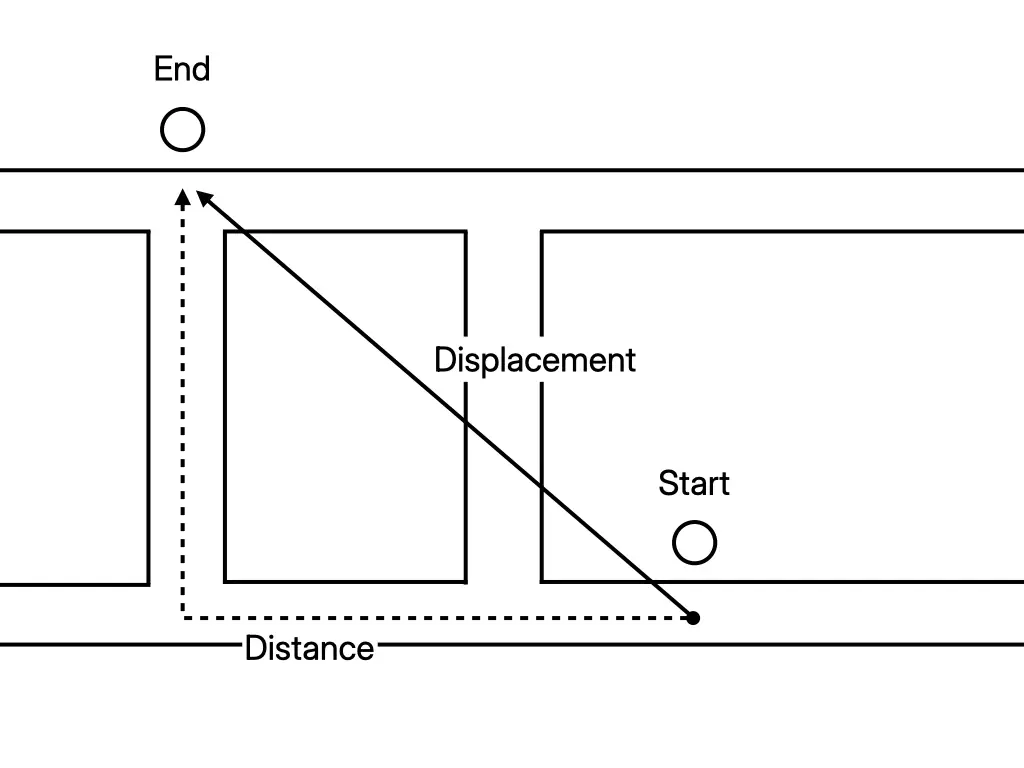
- Distance: total length of the path travelled by an object.
- Displacement: shortest distance connecting two locations in a specified direction.
- S.I. unit for both quantities: metre (m).
| Distance | Displacement |
|---|---|
| Depends on the entire path travelled. | Depends only on the initial and final positions. |
| Has magnitude only. | Has magnitude and direction. |
For a complete round trip back to the starting point:
- Distance = total length of the whole route.
- Displacement = .
Example: two perpendicular paths of each give:
Speed, Average Speed, Velocity and Acceleration
| Quantity | Meaning and equation |
|---|---|
| Speed | Rate of change of distance: |
| Average speed | Rate of change of total distance travelled: |
| Velocity | Rate of change of displacement: |
| Acceleration | Rate of change of velocity: |
- S.I. unit of speed, average speed and velocity: metre per second ().
- S.I. unit of acceleration: metre per second per second ().
- In , = acceleration, = final velocity, = initial velocity and = time taken.
- A positive or negative velocity sign represents the direction of motion.
- Acceleration occurs when velocity increases.
- Deceleration occurs when velocity decreases; its acceleration value is negative.
Solving Numerical Problems
Average-speed example: a runner records .
Acceleration example: a runner accelerates from rest to in .
Ticker Timer and Types of Linear Motion
- A ticker timer produces dots on a ticker tape to study the velocity and acceleration of a moving object.
- The ticker timer vibrates at 50 vibrations per second (50 Hz).
- One tick is the time interval between two adjacent dots.
- A photogate accurately measures very rapid motion or motion over a short time.
- Number of ticks = number of spaces between dots = number of dots .
- For a five-tick strip, .
| Pattern of successive strips/dots | Type of motion |
|---|---|
| Equal spacing | Uniform velocity |
| Spacing increases uniformly | Uniformly increasing velocity (uniform acceleration) |
| Spacing decreases uniformly | Uniformly decreasing velocity (uniform deceleration) |
| Irregular spacing | Non-uniform velocity |
Activity 11.2: Determining Velocity and Acceleration
Aim: Determine the velocity and acceleration of an object using a ticker timer.
Materials and apparatus: ticker tape, ticker timer, runway, wooden block, trolley, metre ruler and alternating current supply.
- Set up the apparatus with the runway inclined using the wooden block.
- Switch on the ticker timer and allow the trolley to move down the runway.
- Collect the ticker tape and cut it into five strips of 10 ticks each.
- Arrange the strips side by side to form a ticker-tape chart and record each strip’s length.
- Calculate the velocity of each strip using .
- Calculate acceleration using the velocities of strips 1 and 5 and .
Answer practice questions to test your knowledge
Practice