7.3 - Einstein’s Photoelectric Theory
Photon Absorption and Einstein’s Equation
- Albert Einstein introduced his photoelectric theory in 1905 and received the 1921 Nobel Prize for this achievement.
- Light transfers energy in discrete photons, each carrying .
- One electron absorbs a photon’s energy completely. Part releases the electron from the metal; the remainder becomes the photoelectron’s kinetic energy.
- Surface electrons generally acquire the maximum kinetic energy, compared with electrons deeper inside the metal.
- Work function is the minimum energy required to release a photoelectron from the metal surface.
- Einstein’s photoelectric equation follows conservation of energy:
- : electron mass; : maximum photoelectron velocity.
- At the threshold frequency , the electron is emitted with zero kinetic energy:
- Below : photon energy is insufficient for emission. At : emission occurs with . Above : the emitted electron has kinetic energy.
- A higher frequency supplies more energy per photon. Increasing intensity at the same frequency supplies more photons, without increasing each photon’s energy; suitable photons transfer energy immediately rather than requiring gradual accumulation.
Work Function, Threshold Frequency and Graphs
Different metals have different threshold frequencies and work functions. Higher means higher and greater minimum energy for emission.
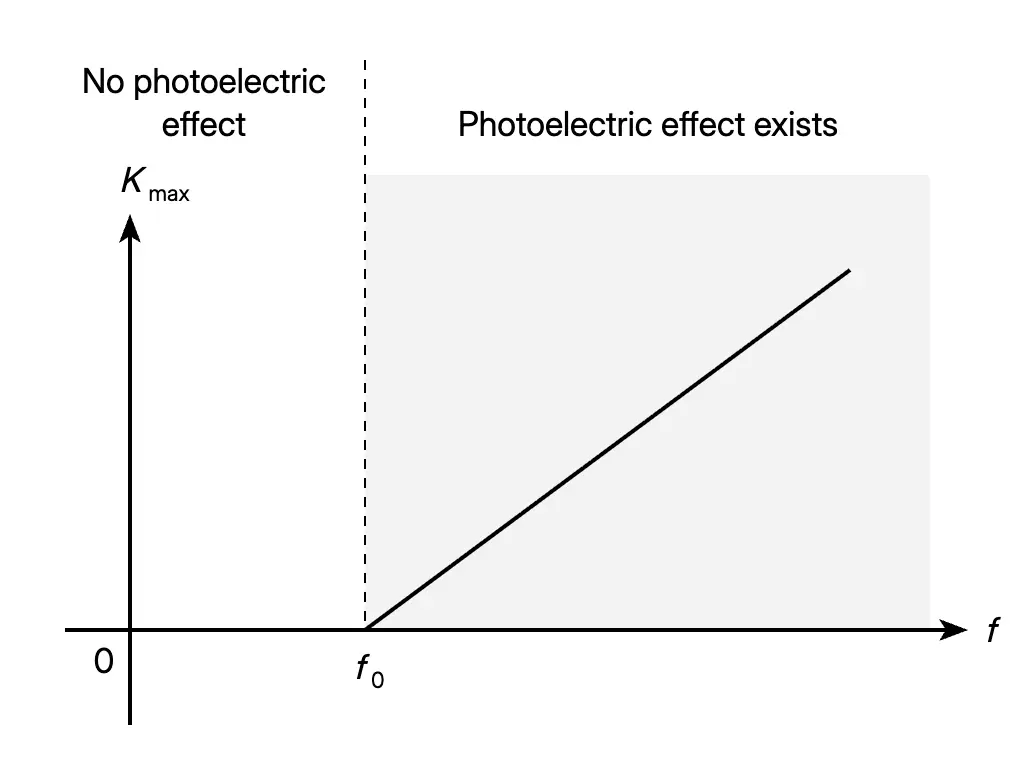
The against graph is a straight line with positive gradient and does not pass through the origin:
- Frequency-axis intercept: .
- Gradient: , when kinetic energy is expressed in J and frequency in Hz.
- From , extrapolation to gives ; this extrapolation does not represent emitted electrons below the threshold.
Different metals give parallel lines with the same gradient but different frequency-axis intercepts.
Threshold-frequency data for calculating work functions using :
| Metal | Threshold frequency / |
|---|---|
| Ta | 1.03 |
| Ti | 1.05 |
| Mo | 1.11 |
| Au | 1.23 |
| Pd | 1.24 |
| Ir | 1.27 |
| Pt | 1.36 |
Worked Photoelectric Calculations
- Use and .
- Blue light on clean caesium: and .
- Lithium graph example: the frequency-axis intercept gives .
- 550 nm monochromatic light on a metal with : use the supplied , and .
- Red and blue light on one photocell: red light has ; blue light has and produces twice the maximum kinetic energy, .
- Threshold wavelength is the maximum wavelength that permits emission:
Photoelectric Current in a Photocell
- A photocell contains an evacuated glass tube.
- Its semi-cylindrical cathode, coated with light-sensitive metal, is connected to negative potential. A metal-rod anode, positioned along the cathode’s axis, is connected to positive potential.
- Suitable light releases electrons from the cathode; attraction to the anode produces photoelectric current in the external circuit.
- A higher work function requires a shorter maximum wavelength for emission. At a suitable frequency, increasing light intensity increases the photoelectric current.
| Photocell coating | Work function and emission thresholds |
|---|---|
| Caesium | ; ; maximum wavelength 579 nm. |
| Lithium | ; ; maximum wavelength 496 nm. |
Applications of the Photoelectric Effect
- Solar-powered street lamps: solar cells supply electrical energy that is stored in batteries during daylight. Batteries power the LED lamps at night.
- Solar electricity generation: the Noor Complex in the Sahara Desert has a projected capacity of 580 MW for one million residents.
- Automatic-door light detectors: an infrared beam and photocell act as a switch. Interrupting the beam cuts the photoelectric current, keeping the door open.
- Camera image sensors: convert light into electrical signals that are processed into digital images.
- International Space Station (ISS): solar panels supply electrical energy for its operation; its 16 solar-panel wings generate 84–120 kW. Each wing measures 35 m × 12 m and contains 33 000 solar cells.
Answer practice questions to test your knowledge
Practice