7.2 - Photoelectric Effect
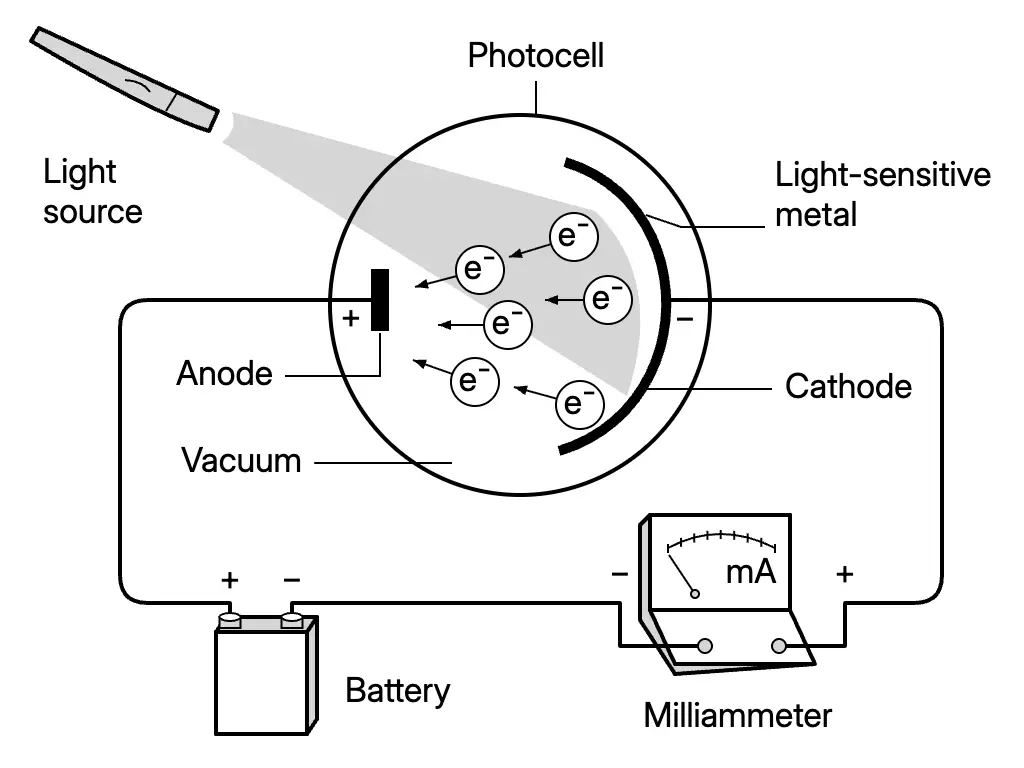
Photoelectric Effect and the Photocell Circuit
- Photoelectric effect is the emission of electrons from a metal surface illuminated by light of a suitable frequency. The emitted electrons are photoelectrons.
- In the photocell circuit:
- Light illuminates the light-sensitive metal cathode, releasing photoelectrons.
- The anode at positive potential attracts the photoelectrons through the vacuum.
- Their movement from cathode to anode produces current in the circuit, measured by a milliammeter. A battery supplies the potential difference.
Determining Planck’s Constant with LEDs
- Aim: determine Planck’s constant using a Planck’s constant kit.
- Apparatus: a 9 V battery, 1 kΩ potentiometer, red, orange, green and blue LEDs, milliammeter and voltmeter.
- Procedure and analysis:
- Connect the kit using the red LED, with the milliammeter measuring LED current and the voltmeter measuring the voltage across the LED.
- Adjust the potentiometer to 0.2 V and record the current.
- Repeat at 0.4 V, 0.6 V, 0.8 V, …, 3.0 V.
- Plot current against voltage . Determine the activation voltage from the voltage-axis intercept.
- Repeat with orange, green and blue LEDs.
- Record and calculate for each LED, expressing wavelength in metres.
- Plot against , determine the gradient and calculate .
| LED colour | Wavelength / nm |
|---|---|
| Red | 623 |
| Orange | 586 |
| Green | 567 |
| Blue | 467 |
- and .
- Relationship: has a linear relationship with ; shorter LED wavelength corresponds to higher activation voltage.
Four Characteristics of the Photoelectric Effect
- Higher frequency produces photoelectrons with higher kinetic energy.
- A metal has a threshold frequency , the minimum light frequency required for photoelectric emission.
- Kinetic energy is independent of light intensity. Increasing intensity does not make photoelectrons more energetic.
- Emission is instantaneous when suitable-frequency light strikes the surface, even at low intensity. Thermionic emission requires heating and may take time.
Why Classical Theory Fails
| Classical prediction | Experimental observation |
|---|---|
| Continuous wave energy should permit emission at any light frequency. | Emission requires a minimum frequency; increasing intensity cannot remove this requirement. |
| Dim light should require time for electrons to accumulate sufficient energy. | Suitable-frequency light produces instantaneous emission even when dim. |
Answer practice questions to test your knowledge
Practice