6.2 - Nuclear Energy
Nuclear Energy
- Nuclear energy, also called atomic energy, is released during radioactive decay, nuclear fission and nuclear fusion.
- Fusion of hydrogen nuclei in the Sun’s core releases nuclear energy, which reaches the Sun’s surface as light and heat.
- Nuclear research in Malaysia began with the establishment of the Tun Ismail Atomic Research Centre (PUSPATI) on 19 September 1972. The centre became the Malaysian Nuclear Agency (ANM).
Nuclear Fission
- Nuclear fission splits a heavy nucleus into two or more lighter nuclei and releases a large amount of energy.
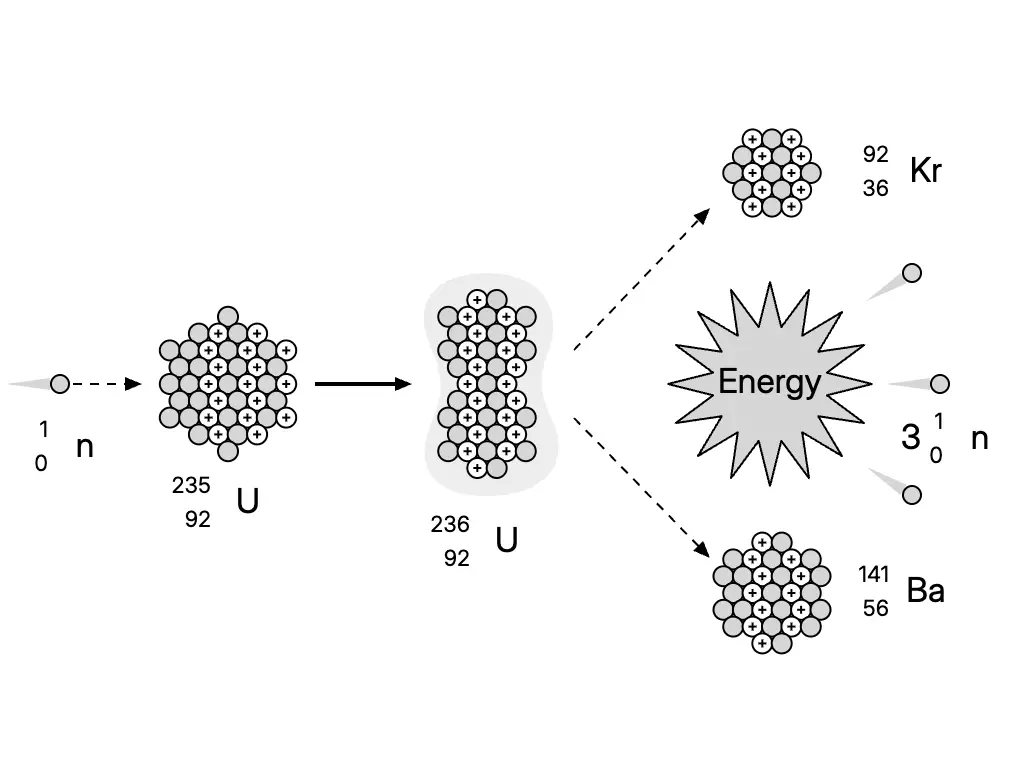
- In the uranium-235 example:
- A neutron bombards a uranium-235 nucleus.
- An unstable uranium-236 nucleus forms.
- It splits into barium-141, krypton-92 and three neutrons, releasing energy.
Nuclear Fusion
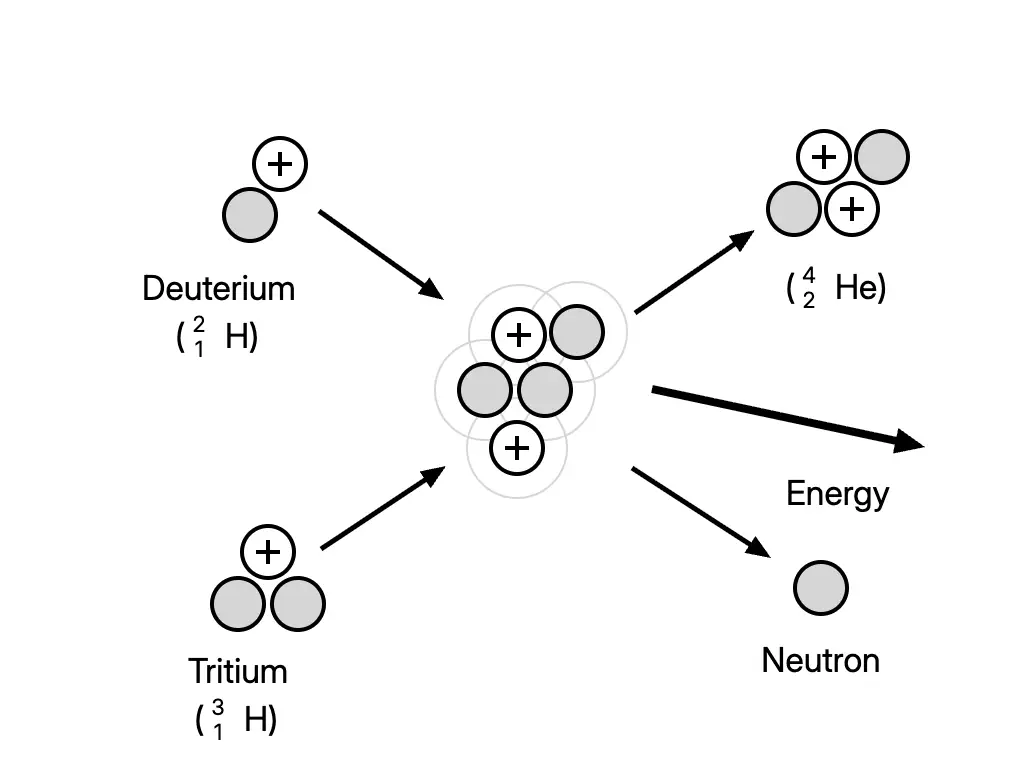
- Nuclear fusion combines small, light nuclei into a heavier nucleus and releases a large amount of energy.
- Fusion requires extremely high temperature and pressure.
- Deuterium, , and tritium, , fuse to produce helium-4 and one neutron:
- Both fission and fusion release nuclear energy and involve a mass defect.
Atomic Mass Unit
- Atomic masses are very small, so the atomic mass unit (amu) provides a relative measure using a carbon-12 atom as the reference.
- Carbon-12 is the reference because carbon occurs in many compounds on Earth. The Avogadro number, , is the number of atoms in one mole of carbon-12.
- One carbon-12 atom has a mass of 12 amu. Therefore, 1 amu equals one-twelfth of the mass of a carbon-12 atom.
Mass Defect and Einstein’s Equation
- Mass defect, , is the decrease in total mass during a nuclear reaction or radioactive decay: the products have less total mass than the initial particles.
- Include all particles, including incident and emitted neutrons, in the mass totals.
- For the uranium-235 fission example, the neutron mass is 1.00867 amu, uranium-235 mass 235.04392 amu, barium-141 mass 140.91441 amu and krypton-92 mass 91.92611 amu.
- Einstein’s equation relates the mass defect to the energy released:
- : total energy released in joules; : mass defect in kilograms; : speed of light in vacuum, .
- Convert the mass defect from amu to kg before substituting into .
- Nuclear energy can also be expressed in megaelectronvolts (MeV):
Worked Nuclear Energy Examples
- Radium-226 alpha decay:
- Using the supplied masses 226.54 amu, 222.018 amu and 4.003 amu:
- Deuterium–tritium fusion: using deuterium 2.014 amu, tritium 3.016 amu, helium-4 4.003 amu and neutron 1.009 amu:
Generation of Electrical Energy
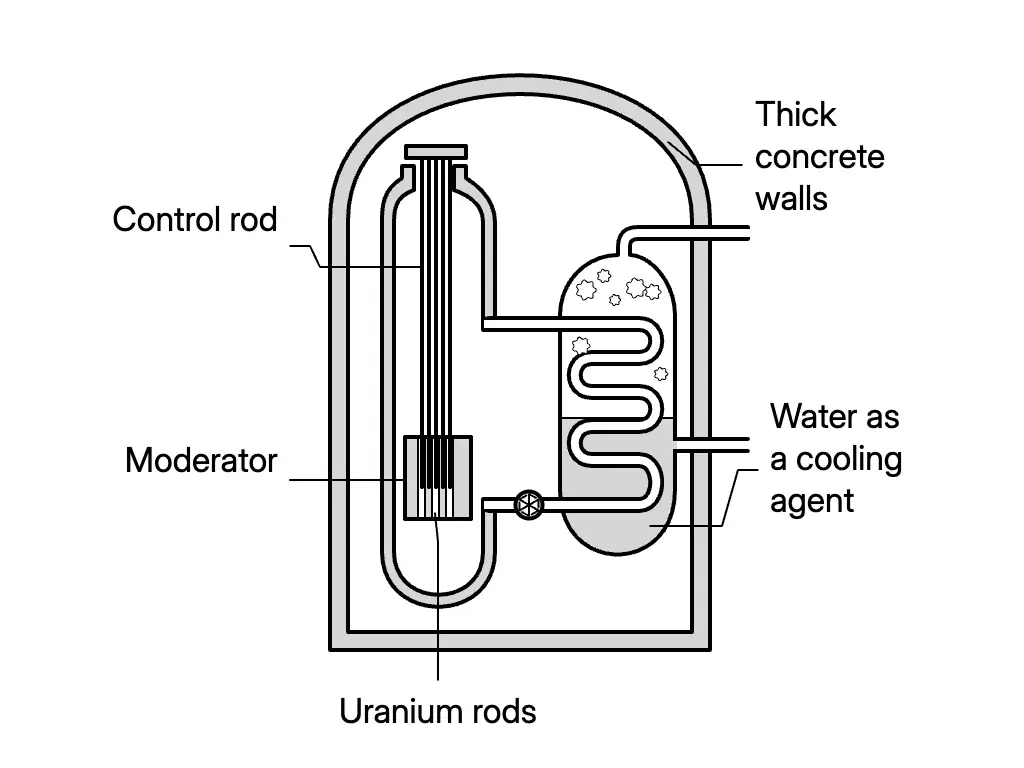
- Uranium-235 fission and the ensuing chain reaction produce heat in the reactor core.
- Water pumped through the core absorbs the heat. The steam generator (heat exchange system) transfers heat to water to produce high-pressure steam.
- High-pressure steam flows to and rotates the turbine.
- The turbine rotates the magnet or coil of the generator, producing electrical energy. Steam condenses back into water in the condenser.
- Electrical energy reaches consumers through the power supply transmission system.
- The system includes water pumps, a condenser and a cooling tower for its water and cooling circuits.
- TRIGA PUSPATI (RTP) in Bangi is a research reactor for nuclear science and education. Malaysia has no nuclear reactors for electricity generation.
Chain Reaction and Reactor Control
- In the illustrated fission reaction, one uranium-235 nucleus produces two daughter nuclei, three fast-moving neutrons and energy.
- The neutrons bombard other uranium-235 nuclei, causing further fission and releasing more neutrons. This continuing process is a chain reaction.
- The chain reaction in the reactor core must be controlled, and the structure must prevent radioactive radiation from leaking into the surroundings.
| Reactor component | Function and material |
|---|---|
| Control rods | Absorb excess neutrons to control the reaction rate; made of boron or cadmium. |
| Moderator | Slows fast-moving neutrons so further fission can occur; made of graphite or water. |
| Uranium rods | Fuel that releases nuclear energy through fission. |
| Water coolant | Absorbs heat from the chain reaction for steam production and controls reactor temperature. |
| Thick concrete walls | Prevent radioactive radiation from escaping to the surroundings. |
Nuclear Energy as an Alternative Energy Source
- Coal, natural gas and water are sources used for electricity generation in Malaysia. Nuclear energy is used for electricity generation in countries including the United States, Japan, France, India and China.
- Nuclear energy offers an alternative for meeting increasing electricity demand and reducing reliance on fossil fuels.
- The suitability of nuclear, coal and hydropower plants depends on these factors:
- Construction, operating and maintenance costs.
- Location of the power plant.
- Effects on ecosystems and carbon footprint.
- Safety and health issues.
- Available technology and expertise.
- Waste management issues.
Answer practice questions to test your knowledge
Practice