Radioactive decay occurs when an unstable nucleus emits radioactive radiation and becomes more stable.
Decay is random and spontaneous: temperature, pressure and other physical factors do not influence it.
The three types of radiation are alpha particles, beta particles and gamma rays.
In nuclear notation ZAX, A is the nucleon number and Z is the proton number. The original nucleus is the parent nucleus; the nucleus produced is the daughter nucleus.
Alpha Decay
An alpha particle, 24He, is a helium nucleus containing two protons and two neutrons.
An unstable nucleus emits an alpha particle and forms a more stable nucleus of a new element.
The daughter’s proton number decreases by 2 and nucleon number decreases by 4.
ZAX→Z−2A−4Y+24He
Example: polonium-210 decays to lead-206.
84210Po→82206Pb+24He
Beta Decay
A beta particle, −10e, is a fast-moving electron.
A neutron in an unstable nucleus changes into a proton and an electron:
01n→11p+−10e
The proton remains in the nucleus; the electron leaves with high kinetic energy.
The daughter’s proton number increases by 1; its nucleon number does not change.
ZAX→Z+1AY+−10e
Example: sodium-24 decays to magnesium-24.
1124Na→1224Mg+−10e
Gamma Decay and Combined Emissions
Gamma rays are high-frequency electromagnetic radiation with no mass and no charge.
An excited nucleus emits excess energy as gamma radiation and becomes less energetic and more stable.
Its proton number and nucleon number remain unchanged.
ZAX→ZAX+γ
Example: an excited cobalt-60 nucleus releases gamma radiation without changing its nuclear composition.
2760Co→2760Co+γ
One decay can emit more than one type of radiation. Uranium-234 emits an alpha particle and gamma radiation:
92234U→90230Th+24He+γ
Half-life and Decay Series
Half-life, T21, is the time taken for half the initial radioactive nuclei in a sample to decay.
After one half-life, half the original parent nuclei remain undecayed. As parent nuclei decay, daughter nuclei form.
A daughter nucleus may also be unstable. A decay series continues through successive decays until a stable nucleus forms.
The uranium-238 series ends at stable lead-206. Each unstable member has its own half-life.
Parent nucleus → daughter nucleus
Radiation emitted; parent half-life
92238U→90234Th
α; 4.5×10⁹ years
90234Th→91234Pa
β; 24.1 days
91234Pa→92234U
β; 1.8 minutes
92234U→90230Th
α; 2.5×10⁵ years
90230Th→88226Ra
α; 7.5×10⁴ years
88226Ra→86222Rn
α; 1 622 years
86222Rn→84218Po
α; 3.83 days
84218Po→82214Pb
α; 3.05 minutes
82214Pb→83214Bi
β,γ; 26.8 minutes
83214Bi→84214Po
β,γ; 19.7 minutes
84214Po→82210Pb
α; 1.64×10⁻⁴ seconds
82210Pb→83210Bi
β; 22.26 years
83210Bi→84210Po
β; 5.0 days
84210Po→82206Pb
α; 138.4 days
Radioisotopes are isotopes with unstable nuclei that can emit radioactive radiation.
Radioactive substances are stored in thick, sealed lead containers for safety.
Radioactive Dating of Rocks
Uranium-238 becomes trapped when rocks form and slowly decays through its series to lead-206.
Measure the lead-206 : uranium-238 ratio in a rock sample to estimate its age. A higher ratio indicates an older rock.
This geological dating method also helps estimate the age of the Earth.
Uranium-238’s long half-life makes its decay rate low and the dating process suitable for very old rocks.
Activity and the Decay Curve
Activity is the number of decays per second. It is directly proportional to the number of radioactive nuclei present at that time.
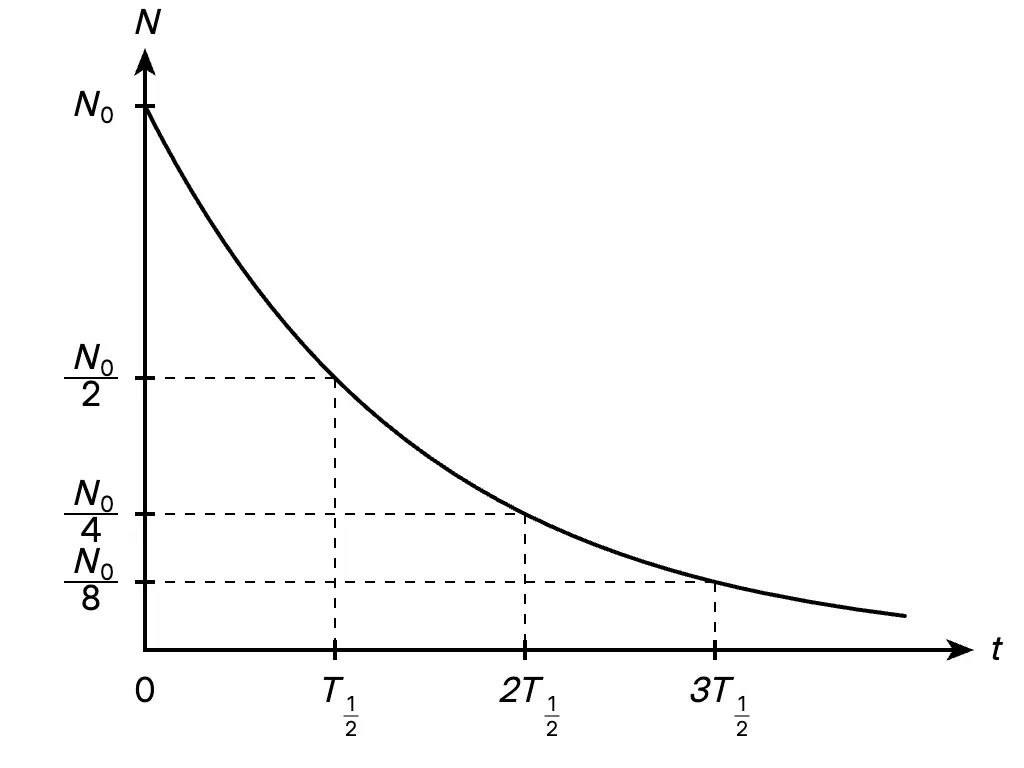
A decay curve plots the number of undecayed nuclei, N, against time, t. N decreases as time increases.
To read the half-life from a curve:
Identify the initial number, N0.
Find N0/2 on the vertical axis and read its corresponding time on the curve.
The interval for a further decrease from N0/2 to N0/4 is another half-life.
For samples with the same initial number of nuclei, a shorter half-life means a higher decay rate.
In a dice model, each die represents a nucleus. Dice showing 3 represent decayed nuclei; their number in each throw represents activity. Remaining dice represent undecayed nuclei. Choosing 1 instead of 3 gives the same decay probability because every face is equally likely.
n=T21t,N=(21)nN0
n is the number of half-lives; the repeated-halving series uses positive integer values of n.
The number of decayed parent nuclei is N0−N.
Activity follows the same halving relationship:
A=(21)nA0
A0 is initial activity and A is the activity after time t.
Number of half-lives
Fraction undecayed
Fraction decayed
0
1
0
1
1/2
1/2
2
1/4
3/4
3
1/8
7/8
4
1/16
15/16
5
1/32
31/32
Radioactive decay curve
Worked Half-life Examples
Activity after a given time: initial activity 480s−1, half-life 6 minutes, elapsed time 30 minutes.
n=630=5,A=(21)5(480)=15s−1
Time to reach 25% activity: with a half-life of 10 days, the sequence 100%→50%→25% takes two half-lives.
t=2(10)=20days
Age of volcanic rock: argon-40 : potassium-40 is 3 : 1, with no argon initially trapped. Potassium-40 has a half-life of 1 250 million years.
After one half-life, parent and daughter nuclei have a 1 : 1 ratio. After two, potassium-40 remaining is N0/4 and argon-40 formed is 3N0/4, giving 3 : 1.