1.4 - Elasticity
Elasticity and Spring Extension
- Elasticity is a material’s ability to regain its original shape and size when the applied force is removed.
- An applied force can change an object’s shape and size. An elastic exercise cord returns to its original length after stretching.
- Spring extension is the increase in length caused by a stretching force:
- is original length; is stretched length. Extension is the change in length, rather than the final length.
Experiment: Force and Extension of a Spring
- Inference: applied force affects spring extension.
- Hypothesis: a greater force produces a greater extension.
- Aim: determine the relationship between force and spring extension.
| Variable | Quantity |
|---|---|
| Manipulated | Force |
| Responding | Extension |
| Constant | Stiffness of the spring |
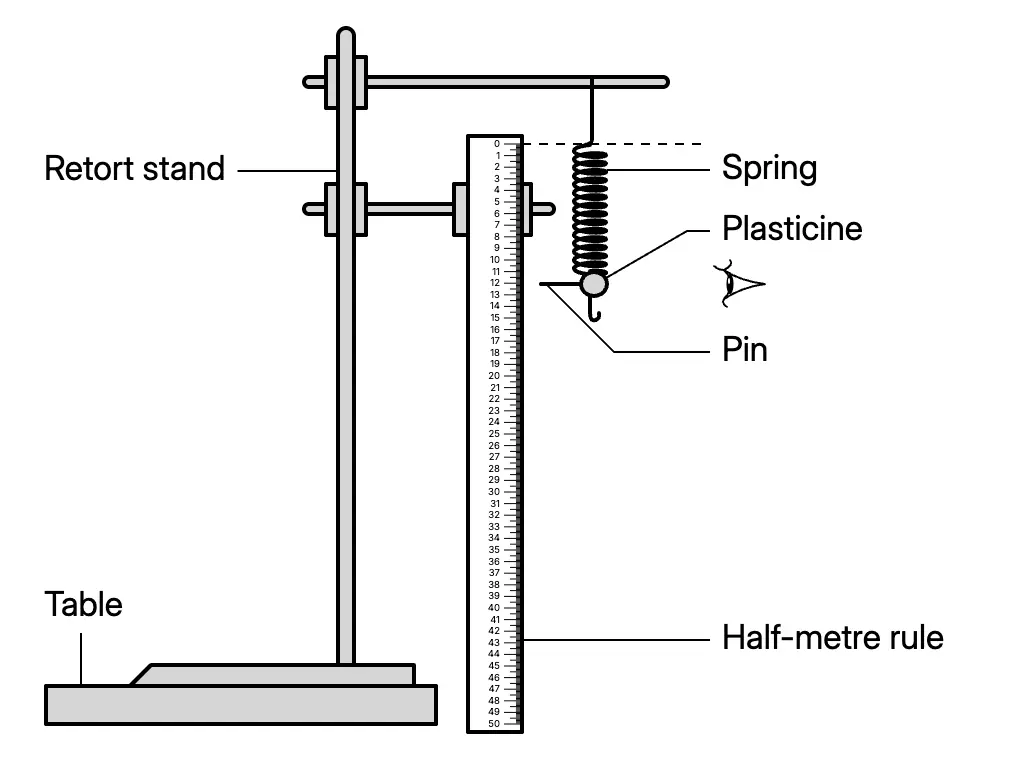
- Apparatus: spring at least 10 cm long; five 10 g, five 20 g and five 50 g slotted weights; half-metre rule; two retort stands with clamps.
- Materials: pin, plasticine and thread.
- Suspend the spring next to the rule; align the rule’s zero mark with the spring’s upper end. Attach the pin using plasticine as the lower-end pointer.
- Record the initial pin position to obtain original length .
- Increase the applied force using the supplied slotted weights and measure the stretched length and extension.
- Record mass, applied force, stretched length and extension; plot extension against force .
- Precaution: keep extension within half the original length to avoid overstretching and allow the spring to regain its length.
- Result: the against graph is a straight line through the origin.
- Conclusion: spring extension is directly proportional to applied force within the elastic limit.
Hooke’s Law and Spring Constant
- Hooke’s law: spring extension is proportional to the applied force provided the spring’s elastic limit is not exceeded.
- is the spring constant. With in N and in m, its unit is .
- On a force against extension graph, equals the gradient. Keep the graph’s axes in the stated order.
Elastic Potential Energy
- Elastic potential energy equals the work done to stretch the spring and the area under the against graph.
- Within Hooke’s law, force rises linearly from 0 to , so average force is . The graph’s area is a right-angled triangle:
- Substitute :
- Use in N and in m to obtain energy in joules, J.
- Comparing spring graphs: at extension 0.20 m, spring R requires 8 N, while spring S requires 16 N. From , their spring constants are and respectively.
- From , R stores 0.80 J and S stores 1.60 J at that extension. S has the steeper graph, is stiffer and stores more elastic potential energy at the same extension.
Factors Affecting the Spring Constant
- Compare springs by applying equal loads and observing their extensions. The spring with the smaller extension has the larger .
- Compare one characteristic at a time; the spring pairs comparing thickness, diameter and length use the same material.
| Factor | Effect on , with other characteristics unchanged |
|---|---|
| Material | varies with the material. |
| Spring length | Shorter: larger ; longer: smaller . |
| Spring diameter | Smaller coil diameter: larger ; larger coil diameter: smaller . |
| Thickness of spring wire | Thicker wire: larger ; thinner wire: smaller . |
- Distinguish coil diameter from wire thickness: their effects on differ.
Identical Springs in Series and Parallel
- Let a single spring extend by under force .
| Arrangement of two identical springs | Force and extension |
|---|---|
| Series | Each spring experiences and extends by ; system extension is . |
| Parallel | Each spring experiences and extends by ; system extension is . |
- In series, add the extensions along the arrangement. In parallel, the total force is shared equally among identical springs and their extensions are equal.
Worked Example: Series, Parallel and Mixed Arrangements
- Each spring has original length 50 mm and extends by 6 mm under 12 N:
- Two springs P and Q in series: each tension is 12 N and each extension is 6 mm. System extension is 12 mm; total length is .
- Two springs R and S in parallel: each tension is and each extension is . System extension is 3 mm; total length is .
- Three parallel springs T, U and V in series with W: T, U and V each carry and extend by . W carries 12 N and extends by 6 mm.
- The parallel group extends by 2 mm; the mixed system extends by and has total length .
Answer practice questions to test your knowledge
Practice