3.2 - Kepler’s Laws
Kepler’s First Law: Law of Orbits
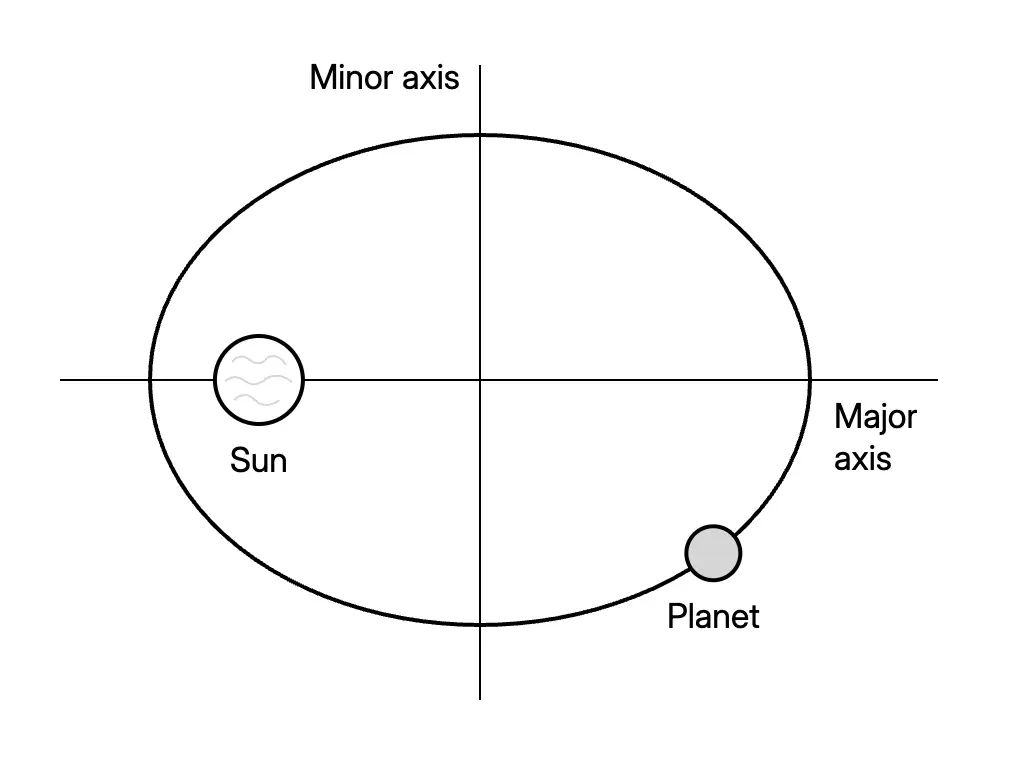
- Every planet follows an elliptical orbit, with the Sun at one focus of the ellipse.
- An ellipse has two foci. Its major axis is longer than its minor axis.
- Most planetary orbits have axes of almost equal length, so they are nearly circular. Their motion can be approximated as circular, with orbital radius equal to the average planet–Sun distance.
Kepler’s Second Law: Law of Areas
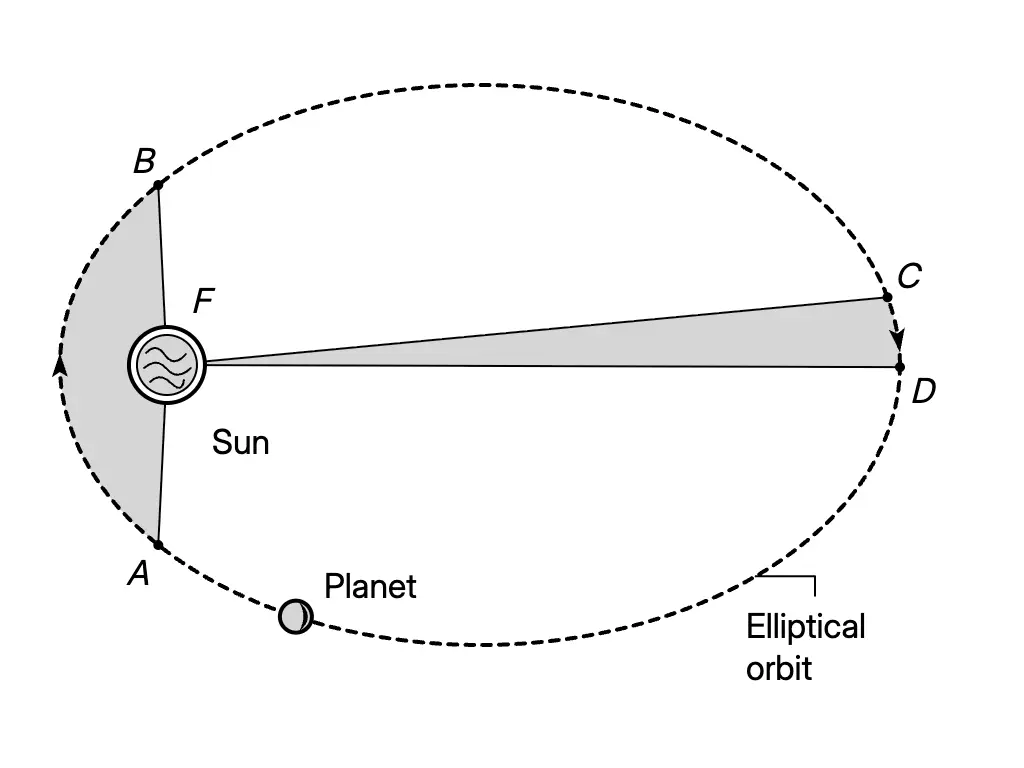
- The line joining a planet to the Sun sweeps out equal areas in equal time intervals.
- In the same time, a planet travels a longer arc when nearer the Sun and a shorter arc when farther away. Its linear speed is higher near the Sun and lower farther away.
- In the equal-area example, areas AFB and CFD are equal; arc AB is longer than arc CD, so the speed from A to B is greater.
Kepler’s Third Law: Law of Periods
- The square of a planet’s orbital period, , is directly proportional to the cube of its orbital radius, :
- A planet farther from the Sun has a larger orbital radius and takes longer to complete an orbit. Earth takes 1 year; Saturn takes 29.5 years.
Deriving Kepler’s Third Law
- Assume a circular orbit. Let be the Sun’s mass and the planet’s mass. Gravitational force supplies centripetal force:
- One orbit covers in time , so .
- Substitute and rearrange:
- For bodies orbiting the same central body, and are constant, so is constant and .
- In the Sun–planet system, is the Sun’s mass. In the Earth–satellite system, is Earth’s mass.
Comparing Two Orbits
- Divide the expressions for two bodies orbiting the same central body:
- Use the same unit for both periods and the same unit for both radii. When substituting into with SI , use seconds and metres.
- For a satellite at height , use , not alone.
- To find an unknown radius, take the cube root after rearranging; to find an unknown period, take the square root.
Worked Examples
- Mars’s orbital radius: Earth’s orbital radius is ; Earth and Mars have periods 1.00 year and 1.88 years. The required information is Earth’s orbital radius and both periods:
- Research satellite’s period: its height is 380 km, Earth’s radius is , and the Moon’s orbital radius and period are and 655.2 hours:
Answer practice questions to test your knowledge
Practice