3.1 - Newton’s Universal Law of Gravitation
Gravitational Force and Newton’s Law
- Gravitational force is an attractive force between bodies. It is a universal force because it acts between any two bodies in the universe, including the Sun, Earth and Moon.
- Gravitational attraction brings a jumping person back to the ground, holds air molecules around Earth and keeps the Moon orbiting Earth.
- Both bodies experience forces of equal magnitude towards each other. A falling leaf and Earth attract each other; Earth’s much greater mass makes its movement imperceptible.
- Newton’s Universal Law of Gravitation relates the force to the product of the masses and the square of their centre-to-centre distance:
| Symbol | Meaning and unit |
|---|---|
| Gravitational force, | |
| , | Masses of the two bodies, |
| Distance between their centres, | |
| Gravitational constant: |
Calculating Gravitational Force and Mass
- Identify the two masses and their centre-to-centre distance.
- Choose and rearrange if a mass is unknown.
- Substitute values in SI units and calculate.
- For a 2.0 kg durian, with Earth’s mass and :
- A rocket at the same distance experiences . Its mass is:
Effects of Mass and Distance
- With distance fixed, increasing either mass increases the force.
- With masses fixed, increasing the distance decreases the force according to the inverse-square relationship.
- Attraction between small masses is very weak. Two people of masses 50 kg and 70 kg, separated by 1 m, experience a force of only .
- Apply the same law to bodies on Earth’s surface, Earth and a satellite, or Earth and the Sun. Use the distance between centres for .
Gravitational Acceleration and the Constant
- Let be Earth’s mass, the object’s mass and the distance between their centres. Equate Newton’s Second Law with gravitational attraction:
- Cancelling shows that does not depend on the object’s mass. It depends on Earth’s mass and the distance from Earth’s centre.
- At Earth’s surface, , where is Earth’s radius:
- At height above the surface, :
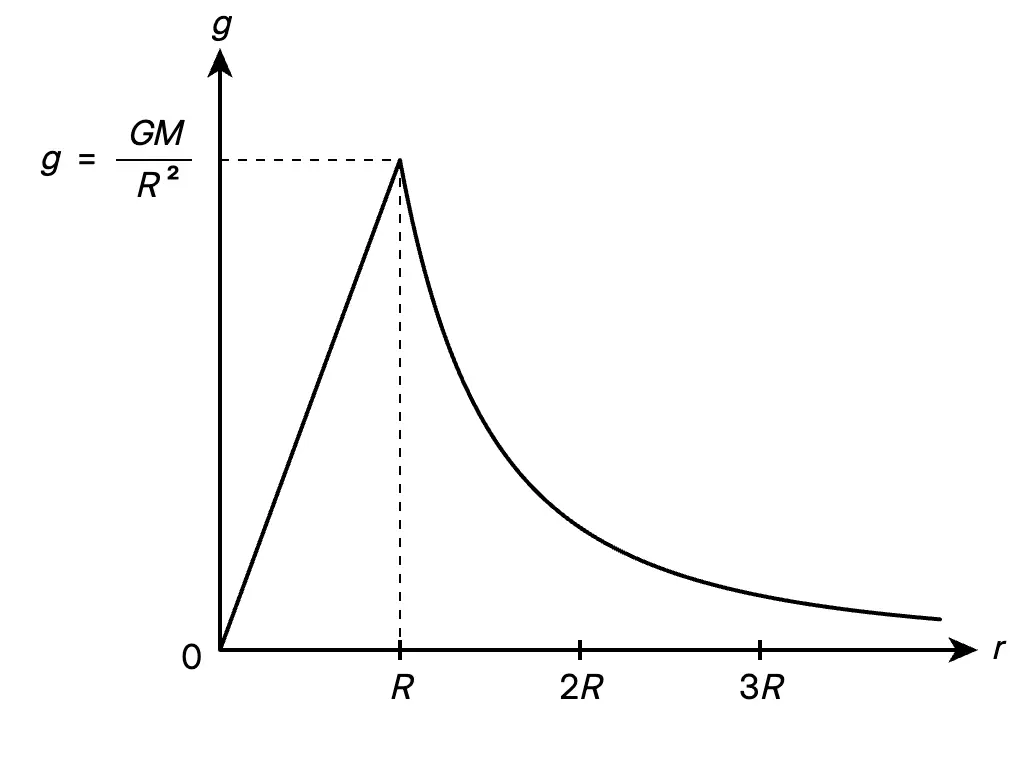
- The graph of against shows below the surface (), reaching its maximum at the surface. For , and approaches zero far from Earth.
- With and :
- A radar imaging satellite at 480 km has :
Importance of Gravitational Acceleration
- Use to compare surface gravitational acceleration on planets, the Moon and the Sun, using each body’s mass and radius.
- Knowing allows the force on an object to be calculated using . This supports space exploration and continuity of life.
- Astronauts travelling far from Earth or near other planets may experience low or high gravity. The human factors considered include density changes, bone fragility, lung size, blood circulation and blood pressure.
Centripetal Force and Circular Motion
- In uniform circular motion, speed remains constant but the direction of motion, and therefore velocity, changes continuously.
- Centripetal force acts towards the centre of the circle. Its magnitude depends on mass , linear speed and radius :
- For a body rotated at uniform speed with the string almost horizontal, the effect of gravitational force on its circular motion can be ignored.
- In the Centripetal Force Kit, the hanging slotted weights create tension in the string, which supplies the centripetal force on the rotating rubber stopper.
- For fixed and , a higher speed requires a larger force; for fixed and , a smaller radius requires a larger force.
- A 7.2 kg iron ball moving at in a circle of radius 1.8 m experiences:
Satellites and Centripetal Acceleration
- Newton predicted that an object launched at low speed would return to Earth, whereas sufficient linear speed could keep it moving around Earth.
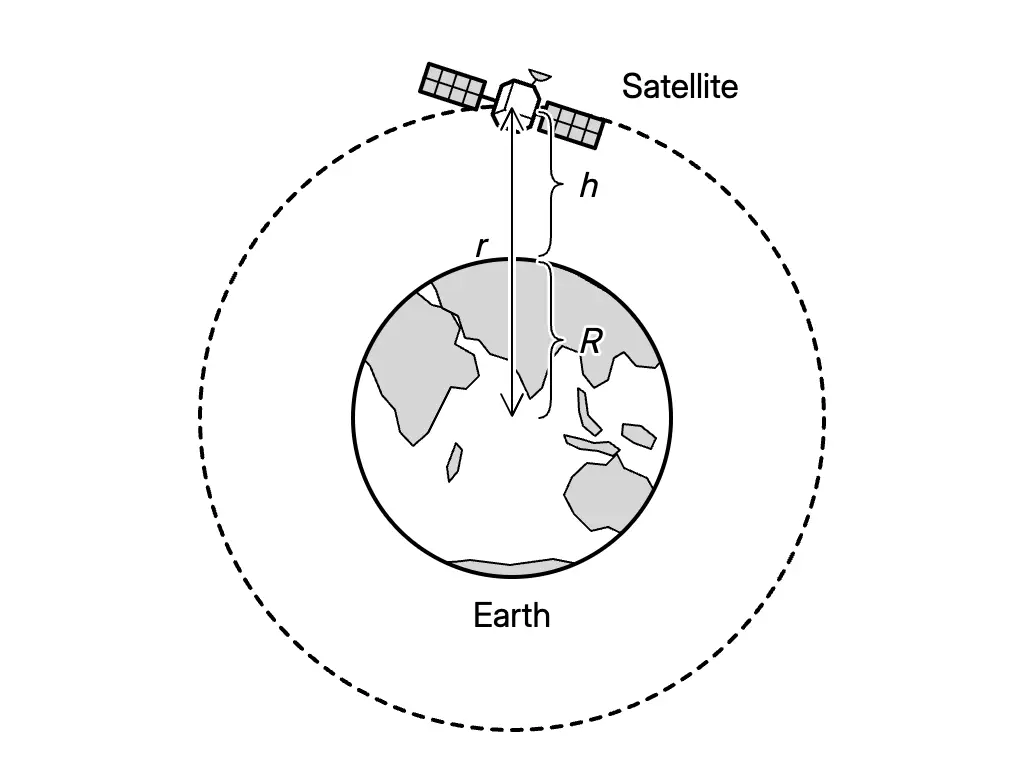
- An orbiting satellite can continue moving without rocket thrust. Earth’s gravitational force provides its centripetal force, directed towards Earth’s centre.
- Equating with gives centripetal acceleration:
- For a weather satellite at , with and :
Determining the Mass of Earth and the Sun
- For a circular orbit, a body travels in one orbital period :
- Equate gravitational and centripetal forces, cancel the orbiting body’s mass , substitute for and rearrange:
- To determine Earth’s mass, use the orbital radius and period of the Moon or a satellite.
- To determine the Sun’s mass, use the orbital radius and period of a planet.
- Use in metres and in seconds with the SI value of .
Answer practice questions to test your knowledge
Practice