5.5 - Application of Nanotechnology in Industry
Nanoscience and Nanotechnology
- Nanoscience studies the processing of substances at the nanoscale, between and .
- Nanotechnology develops substances or devices by exploiting the properties of nanoparticles.
- Nanomaterial examples include gold nanoparticles (), graphene sheets () and carbon nanotubes with a diameter of .
- Very small particles can penetrate skin more easily and coat surfaces more evenly, enabling specialised applications.
| Field | Applications |
|---|---|
| Semiconductors and electronics | Smaller, more efficient semiconductors; highly conductive wiring |
| Energy and electricity | Smaller, more efficient solar cells; longer-lasting batteries |
| Textile | Water-, fire- and dirt-resistant fabrics; anti-wrinkle and UV-protective fabrics |
| Medical | Highly sensitive testing devices; more effective drug-delivery systems |
| Agriculture | More effective pesticides; highly efficient, thorough fertilisation |
| Food | Nanoscale additives; antimicrobial packaging |
Graphene
Graphene is a carbon allotrope, alongside diamond and graphite, at the nanoscale.
Its carbon atoms form covalently bonded sheets. Graphene sheets can form graphite, carbon nanotubes and fullerene balls.
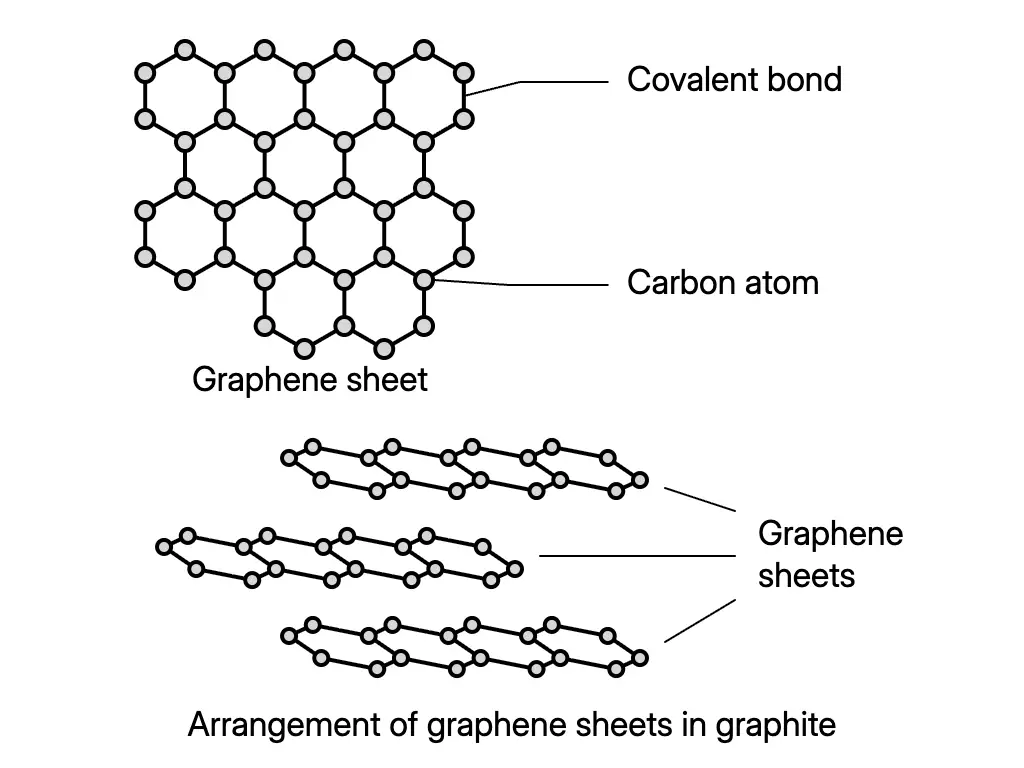
Graphene structure Physical properties: strong and hard, transparent, elastic, impermeable, a good conductor of heat and electricity, and very low electrical resistance.
Chemical properties: graphene sheets burn at a lower temperature than graphite; graphene is the most reactive carbon allotrope. Graphene oxide has been synthesised for use as a catalyst.
Uses include superior conductors in electronics, high-strength polymer composites, high-surface-area sensors, membranes for water filtration and separating water from gaseous mixtures, biomedical sensors, tissue engineering and drug-delivery systems, and flexible long-lasting batteries and supercapacitors.
Answer practice questions to test your knowledge
Practice