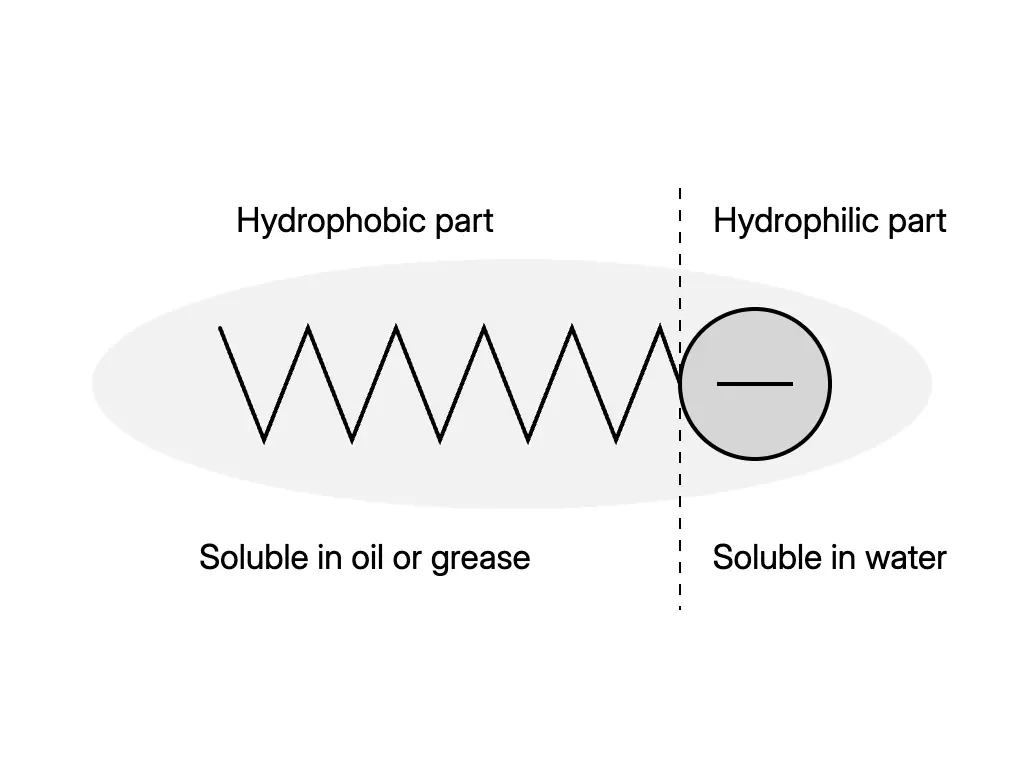
Soap is a sodium or potassium salt of a fatty acid. Its general formula is RCOO−Na+ or RCOO−K+.
R is a saturated or unsaturated alkyl group with at least 8 carbon atoms, usually 12–20.
Fatty acids from animal fats or vegetable oils can also be neutralised with alkalis to produce soap.
Examples include sodium laurate, CH3(CH2)10COONa, from coconut oil and sodium palmitate, CH3(CH2)14COONa, from palm oil.
Detergent is a non-soap cleaning agent. Detergents are sodium salts of sulphonic acids and are usually made from synthetic sources such as petroleum fractions.
The two main groups are sodium alkyl sulphates, ROSO3−Na+, and sodium alkylbenzene sulphonates.
Preparation of Soap and Detergent
Soap is prepared by saponification, the alkaline hydrolysis of oils or fats. Natural triglycerides react with concentrated sodium hydroxide or potassium hydroxide to form glycerol and fatty-acid salts.
Oil or fat+concentrated alkali→soap+glycerol
Detergents are prepared from petroleum fractions in two stages:
Sulphonation or sulphation: concentrated H2SO4 reacts with alkylbenzene to form alkylbenzene sulphonic acid, or with a long-chain alcohol to form alkyl hydrogen sulphate. Water is also produced.
Neutralisation:NaOH neutralises these products to form sodium alkylbenzene sulphonate or sodium alkyl sulphate, respectively, and water.
Colour and fragrance can make handmade soap more attractive.
Cleansing Action
Soap and detergent anions have a hydrophilic part, which dissolves in water, and a hydrophobic part, which dissolves in oil or grease. They therefore act as emulsifying agents.
Their cleansing action follows these steps:
Soap or detergent lowers the surface tension of water, increasing its ability to wet cloth.
It ionises in water, producing mobile cleaning-agent anions and sodium or potassium ions.
Hydrophobic tails dissolve in grease while hydrophilic heads remain in water.
Scrubbing and agitation pull the grease away from the cloth.
Anions surround the grease, which floats to the water surface, and divide it into small droplets.
Repulsion between negatively charged hydrophilic heads prevents the droplets from reattaching; an emulsion forms and rinsing removes the suspended grease.
Simple structure of soap anion or detergent anion
Dry cleaning uses solvents such as 1,1,1-trichloroethane instead of water.
Soap and Detergent in Different Types of Water
Hard water contains Ca2+ and Mg2+ ions.
Soap anions form insoluble calcium or magnesium salts called scum, wasting soap and reducing cleansing effectiveness: