4.2 - Natural Rubber
Rubber and History
- Hevea brasiliensis was brought to Malaysia in 1877. Rubber became an important commodity; exports include gloves, condoms and catheters.
Latex, Polyisoprene and Isoprene
- Latex is the white fluid obtained when rubber-tree bark is tapped. It is a colloid, not a solution: rubber particles are dispersed separately rather than dissolved in water.
- Natural rubber in latex is the natural polymer polyisoprene.
- Its monomer is isoprene, with IUPAC name 2-methylbut-1,3-diene.
- The outer surface of the protein membrane surrounding each rubber particle is negatively charged.
- Like charges repel, keeping the particles apart and preventing coagulation.
Characteristics of Natural Rubber
Natural rubber is a natural elastomer. Its carbon–carbon double bonds make it susceptible to oxidation by air.
| Characteristic | Explanation |
|---|---|
| Soft | Soft white solid at room temperature |
| Elastic | Can be stretched and returns to its original shape when released |
| Low heat resistance | Becomes soft and sticky at high temperature |
| Electrical insulator | Does not conduct electricity |
| Easily oxidised | Oxygen reacts with carbon–carbon double bonds |
| Chemically reactive | Reacts readily with acids, alkalis and organic solvents |
| Waterproof | Impermeable to water |
- Natural-rubber products include slippers, boots, hoses, gloves and rubber mats.
Additives may be used to overcome these limitations and produce desired properties.
Coagulation of Latex
- Liquid latex must be collected quickly: exposure to air for a few hours causes coagulation. Coagulated latex may be collected the day after tapping.
Experiment 4A — coagulation of latex
- Aim: Study latex coagulation and how to prevent it.
- Problem statement: Does acid coagulate latex while alkali prevents coagulation?
- Hypothesis: Acid causes latex to coagulate, whereas alkali prevents coagulation.
- Manipulated variable: Ethanoic acid, , or ammonia, , solution.
- Responding variable: Coagulation of latex.
- Fixed variable: Volume of latex.
- Materials: Latex, ethanoic acid and ammonia solution.
- Apparatus: Beakers, measuring cylinder, glass rod and dropper.
- Label three beakers A, B and C.
- Place latex in each beaker.
- Add ethanoic acid to A while stirring continuously.
- Repeat with ammonia solution in B; leave C as the control.
- Record whether coagulation occurs. Wear gloves throughout the experiment.
Mechanism:
- Negatively charged protein membranes normally make rubber particles repel one another.
- Hydrogen ions, , from an acid neutralise these negative charges.
- Rubber particles collide and their protein membranes break.
- Rubber polymer chains combine, so the latex coagulates.
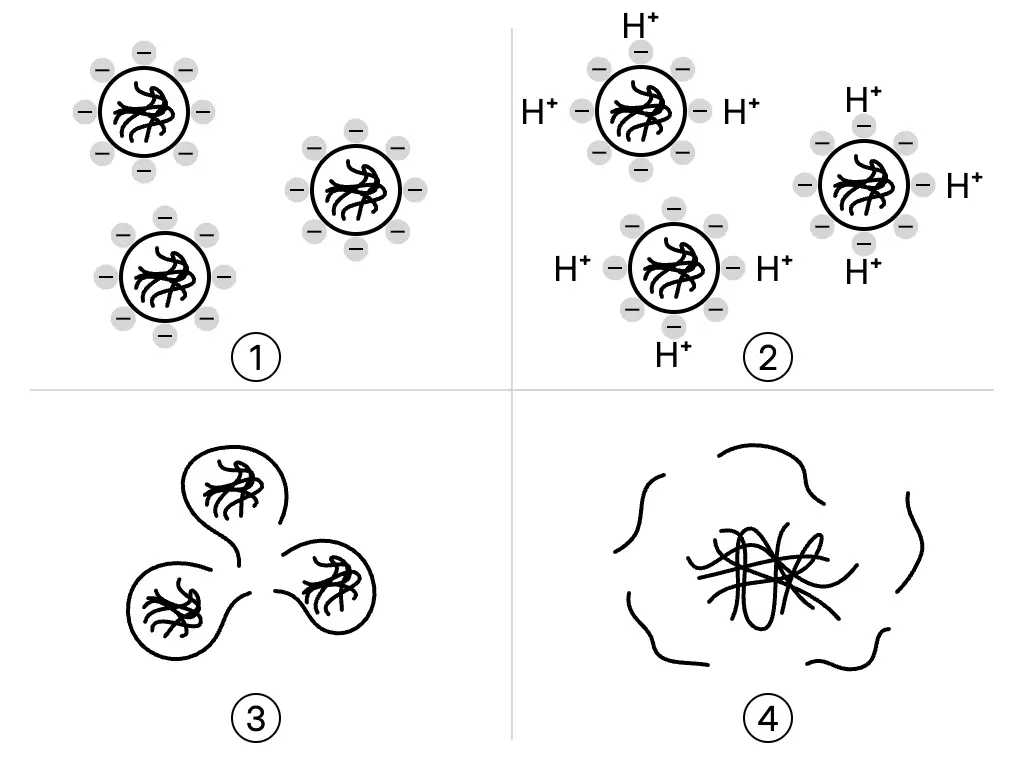
- A weak acid can be added to coagulate latex.
- Latex also coagulates naturally when exposed to air: airborne bacteria enter the latex and secrete lactic acid.
Prevention of Latex Coagulation
- Liquid latex is required for products such as gloves and rubber tubes.
- An alkaline solution such as ammonia is added to prevent coagulation.
- Hydroxide ions, , neutralise acid produced by bacteria. The protein membranes remain negatively charged, so the rubber particles continue to repel one another.
Producing a rubber tube from latex
- Aim: Produce a rubber tube from latex.
- Materials: Latex and ethanoic acid.
- Apparatus: Beaker, glass rod and measuring cylinder.
- Pour latex into a beaker.
- Add ethanoic acid and stir.
- Leave the glass rod in the latex briefly so that a latex layer forms on it.
- Remove the rod and allow the layer to dry.
- Dip and dry repeatedly until the desired thickness is obtained.
- Let the coated rod dry for several days, then strip off the dry layer to obtain a rubber tube.
Precaution: Wash and dry the product to remove excess ethanoic acid.
Vulcanisation of Rubber
Vulcanisation produces more elastic, higher-quality rubber by forming cross-links between polymer chains.
- Carbon–carbon double bonds in rubber react with sulphur or other substances.
- The resulting sulphur cross-links make the rubber stronger.
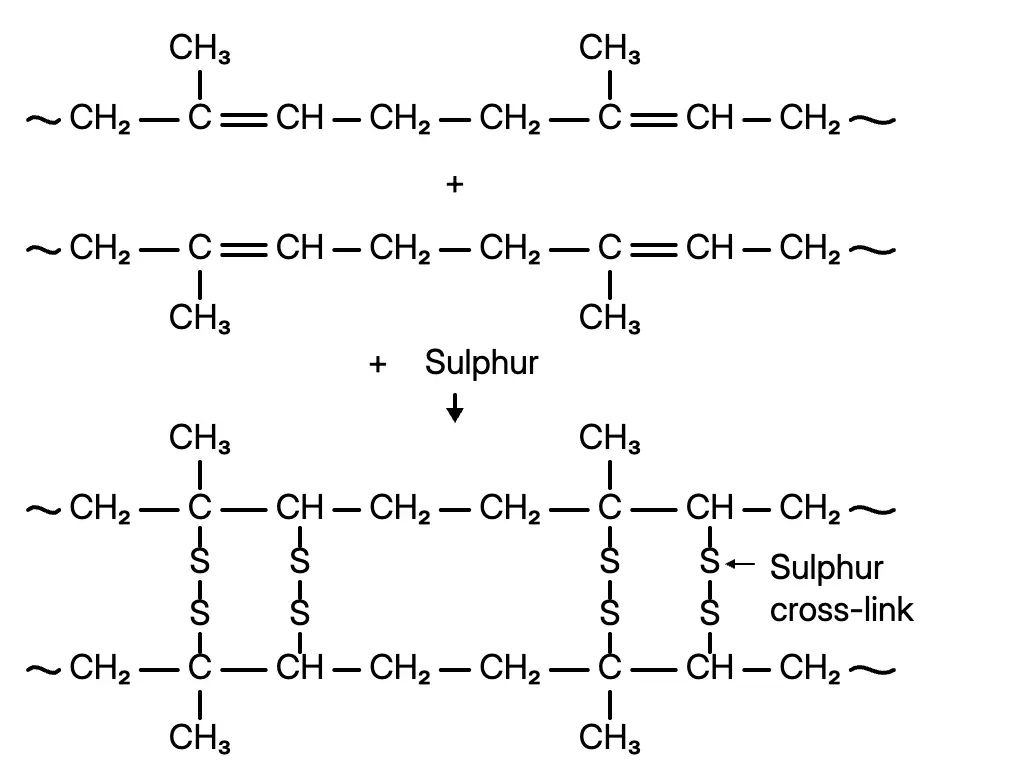
- Charles Goodyear discovered and patented vulcanisation in 1844.
Vulcanisation using disulphur dichloride
- Aim: Produce vulcanised rubber.
- Materials: Latex, ethanoic acid and disulphur dichloride, , in methylbenzene, .
- Apparatus: Beaker, dropper, retort stand, white tile, clip, knife, measuring cylinder and glass rod.
- Pour latex into a beaker.
- Add 3–5 drops of ethanoic acid and stir.
- Pour the latex onto a white tile, spread it evenly and leave it to dry for several days.
- Cut the dry rubber into small pieces.
- Dip the pieces into disulphur dichloride solution.
- Hang the pieces on a retort stand to dry.
Precaution: Carry out the activity in a fume chamber.
Sulphur is the main vulcanising agent for natural rubber. Rubber without carbon–carbon double bonds cannot be vulcanised by this method. Alternative agents or methods include peroxide, metal oxide and irradiation; these produce sulphur-free rubber and are more environmentally friendly.
Elasticity and Properties of Vulcanised Rubber
Experiment 4B — elasticity of vulcanised and unvulcanised rubber
- Aim: Investigate the elasticity of vulcanised and unvulcanised rubber.
- Problem statement: Is vulcanised rubber more elastic than unvulcanised rubber?
- Hypothesis: Vulcanised rubber is more elastic.
- Manipulated variable: Type of rubber strip.
- Responding variable: Elongation after the weight is removed.
- Fixed variables: Strip size and mass of the weight.
- Materials: Vulcanised and unvulcanised rubber strips.
- Apparatus: Retort stand, bulldog clips, weights and metre ruler.
- Suspend both rubber strips from the retort stand with bulldog clips.
- Measure their initial lengths, .
- Attach a weight to each strip and record the loaded lengths, .
- Remove the weights and record the recovered lengths, .
Sulphur cross-links:
- reduce the number of carbon–carbon double bonds, making vulcanised rubber harder to oxidise;
- prevent polymer chains from sliding past one another when stretched;
- pull the chains back towards their original arrangement when the force is removed; and
- require high heat energy to break.
| Property | Vulcanised rubber | Unvulcanised rubber |
|---|---|---|
| Elasticity | More elastic | Less elastic |
| Hardness | Hard | Soft |
| Strength | High | Low |
| Heat resistance | Resistant to high heat | Less resistant to high heat |
| Oxidation resistance | More resistant | More easily oxidised |
Answer practice questions to test your knowledge
Practice