4.1 - Polymer
Polymer, Monomer and Sources
- A polymer is a long-chain molecule formed by joining many repeating basic units.
- A monomer is the basic unit of a polymer.
- Polymerisation is the reaction in which monomers combine to form a polymer.
- Polymers may be classified by their source, method of production and characteristics.
| Source | Polymer → monomer |
|---|---|
| Natural | Starch → glucose; cellulose → glucose; protein → amino acid; natural rubber → isoprene |
| Synthetic | Polystyrene → styrene; polypropene → propene; polyvinyl chloride (PVC) → vinyl chloride |
- Natural polymers occur naturally and are obtained from the surroundings. Examples include starch, protein and cotton.
- Synthetic polymers are made through chemical reactions in laboratories or factories. Examples include nylon, polyethene, polystyrene and PVC.
- Plastic is a general term for synthetic polymers.
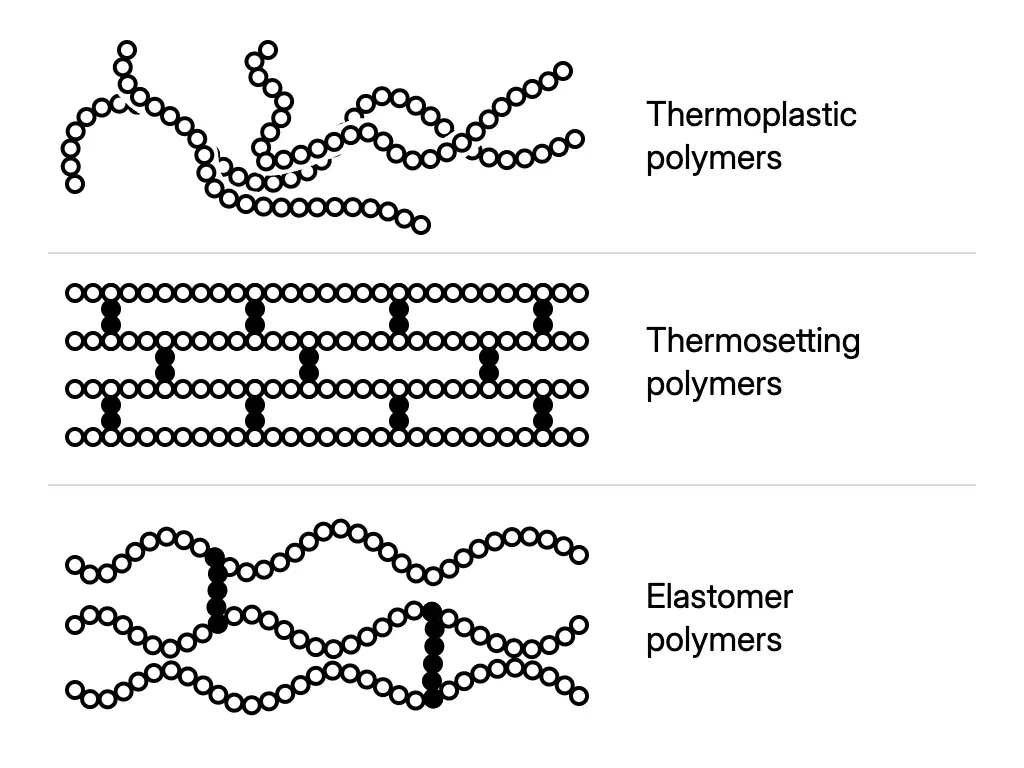
Types of Polymer
| Type | Characteristics and examples |
|---|---|
| Thermoplastic | Melts when heated, solidifies when cooled, can be remoulded repeatedly and recycled; polyethene, PVC, nylon |
| Thermosetting polymer | Cannot be remoulded after heating; normally disintegrates or burns and cannot be recycled; melamine, bakelite |
| Elastomer | Can be stretched and returns to its original shape when released; has high elasticity; polyurethane, styrene-butadiene rubber (SBR) |
Polymerisation Reactions
Polymerisation reactions are divided into addition polymerisation and condensation polymerisation.
Addition polymerisation occurs when monomers containing a carbon–carbon double covalent bond react with one another. The double bond opens and the monomers join a growing chain without forming another product.
| Monomer → polymer | Characteristics and uses |
|---|---|
| Ethene → polyethene | Durable and strong; plastic bags, bottles and packaging |
| Propene → polypropene | Durable; toys and textiles |
| Chloroethene (vinyl chloride) → polychloroethene (PVC) | Strong and hard; water pipes and electrical insulators |
| Styrene → polystyrene | Light and a heat insulator; heat insulation and food packaging |
- Repeating units: polypropene, ; PVC, ; polystyrene, . The phenyl group is .
Condensation polymerisation:
- involves at least two different monomers;
- uses monomers that each contain two functional groups involved in the reaction; and
- produces a polymer and a small molecule such as water, , or hydrogen chloride, .
| Polymer | Monomers and by-product |
|---|---|
| Terylene, a polyester | 1,2-ethanediol + terephthalic acid → terylene + water |
| Nylon, a polyamide | 1,6-hexanediamine + decanedioyl dichloride → nylon + hydrogen chloride |
- Terylene contains ester links, ; nylon contains amide links, .
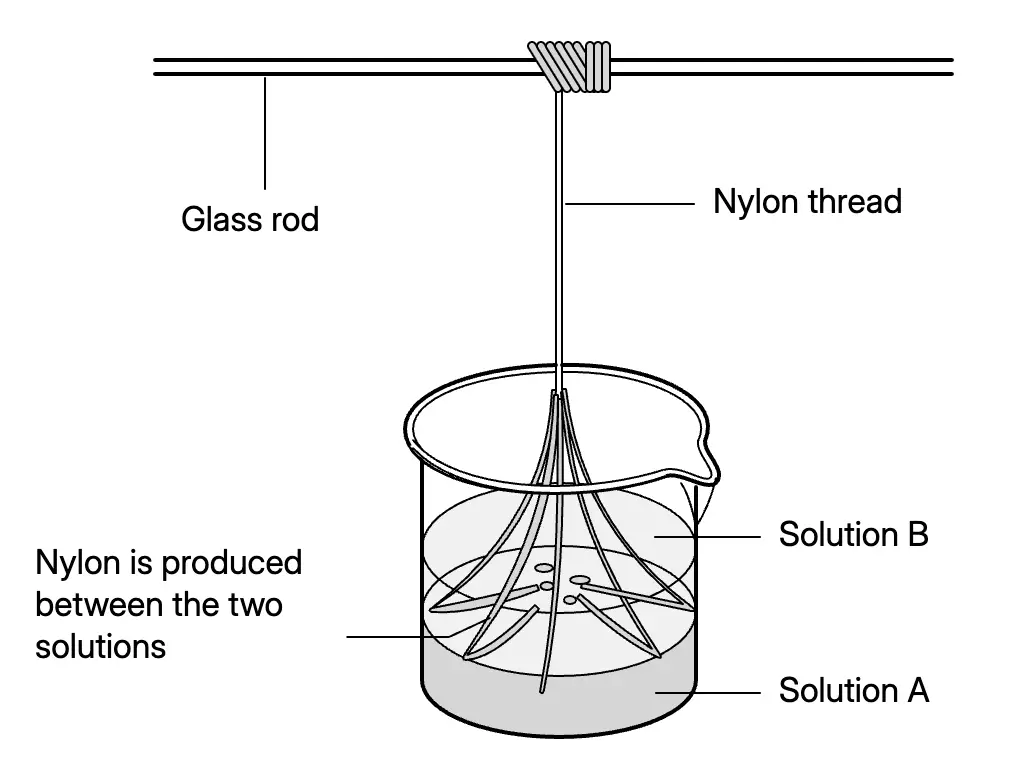
Synthesis of nylon
- Aim: Synthesise nylon and study the properties of the nylon produced.
- Materials: 1,6-diaminohexane, decanedioyl dichloride, sodium hydroxide powder, distilled water and hexane.
- Apparatus: Glass rod, beaker, tweezer and measuring cylinder.
- Dissolve decanedioyl dichloride in hexane; label this Solution A.
- Dissolve of 1,6-diaminohexane and sodium hydroxide in distilled water; label this Solution B.
- Pour Solution B slowly into Solution A along a glass rod so that the liquids do not mix.
- Use a tweezer to pull the layer formed at the interface and wind it around the glass rod.
- Rotate the rod slowly and continue drawing out nylon until no more is formed.
- Wash the nylon on the rod with distilled water and dry it.
Precautions: Wear rubber gloves, work in a fume chamber, and mix the remaining Solutions A and B completely before disposal.
Uses of Synthetic Polymers
Synthetic polymers are widely used because they can be lightweight, strong and hard, inert and unreactive, resistant to high heat, and good heat insulators.
- Polypropene: medical and laboratory apparatus.
- Polyethene: plastic bags.
- Nylon: threads for the textile industry.
- Acrylic polymer: waterproof roof coatings.
Polymers and the Environment
- Durable polymers may take a very long time to disintegrate and cause serious pollution.
- Plastic pollution can kill marine organisms and introduce microplastics into the food chain.
- Non-biodegradable plastic bags accumulate in landfills.
- Consumers can reduce landfill waste by recycling synthetic polymers.
- Additives can make plastics biodegradable, so bacteria decompose them, or photodegradable, so light decomposes them.
- Faster decomposition reduces plastic accumulation in landfills and lowers danger to wildlife.
Answer practice questions to test your knowledge
Practice